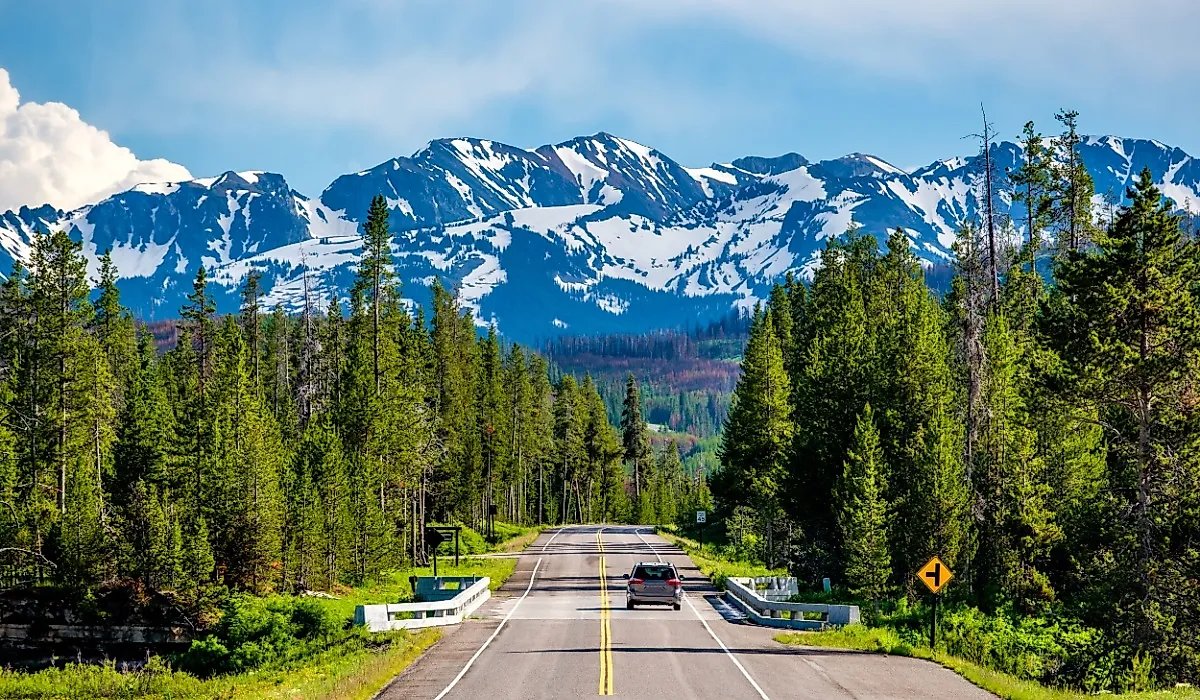
11 Amazing Wyoming Day Trips That Are Worth The Drive
For day trips that mix scenery, history, and wildlife in equal measure, Wyoming sets the bar high. You can stand at Old Faithful in Yellowstone, take in the Teton skyline from a Jackson trailhead, or trace the Oregon Trail through Casper. Three cities, eleven day trips, and a lot of road in between. Here are the trips worth the drive.
Casper Day Trips

Casper sits in central Wyoming on the North Platte River, surrounded by open plains and the looming silhouette of Casper Mountain to the south. It's the second-largest city in the state and a regional hub for ranching, energy, and outdoor recreation. Casper/Natrona County International Airport offers connections to Denver and Salt Lake City.
National Historic Trails Interpretive Center (within the city)

Start your visit to Casper at the National Historic Trails Interpretive Center, which opened in 2002 on a hillside above the North Platte. The 11,000-square-foot facility tracks the four 19th-century routes that funneled westbound migrants through this stretch of Wyoming: the Oregon Trail, the California Trail, the Mormon Trail, and the Pony Express. Galleries include covered wagons, original diary entries, a Native American gallery centered on the perspectives of the tribes whose homelands the trails crossed, and the Footsteps to the West theatrical introduction. Outside, four miles of trail run across 500 acres of grounds. Admission is free.
Tate Geological Museum at Casper College (within the city)

Casper College, founded in 1945 as the first community college in Wyoming, runs the Tate Geological Museum on its main campus. The headline exhibit is Dee the Mammoth, an 11,600-year-old Columbian mammoth excavated in nearby Glenrock and reassembled in the museum's main hall; Dee was about 70 years old at death. Other exhibits include Nicole the Torosaurus, a massive ceratopsian skull found by a Casper College professor in 2013, and a hands-on Dino Den play area for younger visitors. The museum sells a children's book that walks through Dee's excavation and reconstruction.
Ayres Natural Bridge Park (40-minute drive)

Wyoming's national parks get most of the attention, but smaller county parks scattered across the state offer their own draws. Ayres Natural Bridge Park, about 40 miles east of Casper, preserves one of only a handful of natural bridges in the United States with water still running beneath it. LaPrele Creek cut the 30-foot-high, 50-foot-wide arch over thousands of years through soft red sandstone. The bridge sat just a mile south of the Oregon Trail and became one of Wyoming's earliest tourist destinations in the 1860s. The park today supports picnics, short hikes, fishing in the creek, and primitive camping in a designated area.
Hot Springs State Park (2-hour drive)

Hot Springs State Park sits in Thermopolis, a town whose name combines the Greek words for hot and city. The Big Spring at the park's center is fed from deep aquifers and discharges water at a constant 128 degrees Fahrenheit. More than 1.8 million gallons spill over the park's mineral terraces every 24 hours. The state-run Bath House cools that water to a steady 104 degrees for therapeutic soaking, and admission is free under the terms of an 1896 treaty between the U.S. government and the Eastern Shoshone and Northern Arapaho tribes that originally held the land. The park also runs 6.2 miles of accessible trails, a suspension footbridge over the Bighorn River known locally as the Swinging Bridge, and a small bison herd that grazes within the park boundary.
Cody Day Trips

Cody, in northwestern Wyoming, sits about 50 miles from Yellowstone's east entrance and traces its identity directly to its founder, William F. Cody, the showman known as Buffalo Bill. The town is surrounded by the Absaroka Range and served by Yellowstone Regional Airport, which connects to Denver and Salt Lake City year-round.
Buffalo Bill Center of the West (within the city)

Much of what we associate with the Old West came through Buffalo Bill Cody's traveling show, which toured the United States and Europe between 1883 and 1913 with a cast that included sharpshooter Annie Oakley and, briefly, Lakota leader Sitting Bull. The show's portrait of frontier life was theatrical more than historical, but its legacy still shapes American Western imagery. The Buffalo Bill Center of the West in Cody, the town Buffalo Bill himself founded in 1896, holds five museums under one roof: the Buffalo Bill Museum (the showman's life and career), the Plains Indian Museum (19th-century artifacts and contemporary Native art from Plains tribes), the Cody Firearms Museum (more than 10,000 firearms tracing American small-arms history), the Draper Natural History Museum (Greater Yellowstone ecosystem), and the Whitney Western Art Museum (paintings and sculpture by Bierstadt, Remington, Russell, and others). A research library rounds out the complex.
Old Trail Town (within the city)

Old Trail Town, on the western edge of Cody, is a collection of 26 buildings and more than 100 horse-drawn vehicles assembled by historian Bob Edgar starting in the 1960s. Each structure was disassembled at its original Wyoming or Montana location, hauled to Cody, and rebuilt on what had been the original 1895 town site. The buildings date from 1879 to 1901 and include a saloon used by Butch Cassidy's Hole-in-the-Wall Gang and a cabin once occupied by Curley, the Crow scout who served with Lieutenant Colonel George Armstrong Custer's 7th Cavalry at the Battle of the Little Bighorn in 1876. The site also holds the grave of mountain man John "Liver-Eating" Johnson, reburied here in 1974.
Buffalo Bill State Park (15-minute drive)

A 15-minute drive west of Cody puts you at Buffalo Bill State Park, set in Shoshone Canyon at the foot of the Absaroka Range. The park's main feature is the reservoir formed by the Buffalo Bill Dam on the Shoshone River, which provides irrigation and hydroelectric power across the Bighorn Basin. The 8,000-acre reservoir holds rainbow, brown, lake, and cutthroat trout along with walleye, and several boat launches give anglers access. Windsurfing is a regular sight on summer afternoons, when the canyon funnels reliable wind through the park.
Yellowstone National Park (1-hour drive)

From Cody, the drive to Yellowstone National Park's East Entrance takes about an hour. Established in 1872, Yellowstone is the oldest national park in the United States and the most visited unit in Wyoming. The park spans 2.2 million acres across Wyoming, Montana, and Idaho, with more than 1,000 miles of hiking trails and a wildlife roster that includes grizzly bears, gray wolves, black bears, mountain lions, bison, and elk. Old Faithful, the park's signature geyser, erupts on average every 90 minutes (the actual interval ranges from 60 to 110 minutes), sending water more than 100 feet into the air. Note that the East Entrance closes from early November to early May; outside those months, the South Entrance from Jackson is the next closest option.
Jackson Day Trips

Jackson, in the Jackson Hole valley of northwestern Wyoming, sits at the foot of the Tetons and serves as the gateway to two of the country's most-visited national parks. Jackson Hole Airport, located inside Grand Teton National Park, is the only commercial airport in any U.S. national park.
National Museum of Wildlife Art (within the city)

The National Museum of Wildlife Art occupies a quartzite building set into a hillside above the National Elk Refuge, designed by architect Roger Easton to evoke Slains Castle on the coast of Scotland. The collection runs more than 5,000 works and traces wildlife art from antiquity to the present, with pieces by Georgia O'Keeffe, Andy Warhol, John James Audubon, Albert Bierstadt, and Carl Rungius. Rotating exhibits like Two of a Kind pair visually related works for closer comparison, and Prismatic Menagerie features sculptural pieces inspired by origami. Outside, the Sculpture Trail, designed by landscape architect Walter J. Hood, runs three-quarters of a mile through the hillside with more than thirty large-scale animal sculptures along the way.
Snow King Mountain Resort (within the city)

Snow King Mountain Resort, locally known as Jackson's Town Hill, rises directly behind the town square. It opened in 1939 with a single tractor-powered rope tow as Wyoming's first ski area. Today the resort runs lifts year-round. Winter brings skiing, snowboarding, and a tubing hill. Summer trades in a mountain coaster, a ropes course, scenic chairlift rides to the summit, and a network of hiking and mountain biking trails. The summit overlook gives you the full sweep of the Tetons across the valley.
Grand Teton National Park (entrance within the city)

One of the strongest reasons to base a Wyoming trip in Jackson is that Grand Teton National Park begins at the town's northern edge. The Teton Range has supported human presence for more than 11,000 years, and today serious climbers come for the Grand itself (13,775 feet) while casual hikers find plenty within reach. The Lakeshore Trail at Colter Bay runs a flat two miles along Jackson Lake. The Phelps Lake Overlook, off the Moose-Wilson Road, offers a moderate climb with a payoff at the top. Death Canyon, despite the name, is a popular full-day route for fitter hikers. Anglers should check current regulations before fishing: cutthroat trout in many streams require catch-and-release.
The Best of the West in Wyoming
Across these eleven day trips, you cover most of what makes Wyoming Wyoming: the geology of Yellowstone and the Tetons, the deep Native and frontier history of Cody and Casper, the homestead-era trails that funneled people across the plains, and the kind of open country that gives the state its space. Each trip is reachable by car in under a day. Pack accordingly.