Where People Are Moving To In Kansas In 2026
Kansas added 6,614 residents between July 2024 and July 2025. The surface number obscures what is actually happening on the ground. County estimates show losses across much of rural Kansas while a handful of suburbs in three metro orbits absorbed the gains. The dominant in-state pattern is no longer simply Kansans leaving the state. Growth concentrates along three corridors anchored by the Kansas City and Wichita metros plus the K-10 corridor near Lawrence. Six places carry most of that story.
Andover, Kansas

The Wichita metro's eastward expansion shows up most clearly in Andover. The city's population numbered about 17,000 in the Census Bureau's Vintage 2025 estimate, up from 14,892 in the 2020 Census. The single-year jump from July 2024 to July 2025 made Andover one of Kansas's faster-growing cities. At the county level, IRS Statistics of Income migration data for Butler County points to Sedgwick County as an important in-state source of movers, which fits Andover's role as a Wichita-area suburb rather than a standalone growth market.
Families leaving Wichita's core have a clear local draw in Andover Public Schools USD 385, which serves students across 11 schools. The district also draws students from both Butler and Sedgwick counties under the state's open-enrollment law that took effect in 2024. The city now has more than 4,000 housing units, and Kansas Medical Center, a 58-bed general hospital on West 21st Street, sits inside the city limits. New construction continues across the eastern half of the Wichita metro, with Andover positioned at the leading edge.
Gardner, Kansas

Gardner has become one of Johnson County's pressure-release valves as buyers look beyond the county's more expensive suburbs. The BNSF Logistics Park Kansas City intermodal terminal sits three miles west in Edgerton and has helped support warehouse and distribution development across southwestern Johnson County since 2013. That employment base, along with Interstate 35 access, has made Gardner a practical landing spot on the Kansas City metro's southwest edge.
With a population reaching 25,836 in the Kansas Division of the Budget's certified July 2025 estimate, Gardner is up 10.9 percent from 23,287 in the 2020 Census. The city added 458 residents in the most recent 12-month period, a 1.8 percent gain. City-level moves from Olathe, Overland Park, or Lenexa cannot be isolated in IRS county-to-county data because they are mostly moves within Johnson County. Gardner-Edgerton USD 231 gives the city a school district anchor as the I-35 corridor fills in.
Spring Hill, Kansas

Spring Hill's growth is split across two counties, which makes its migration story more complicated. The northern half sits inside Johnson County, the southern half inside Miami County, and that county line matters for the data. Recent county-to-county flows show money and households moving out of higher-cost Johnson County into Miami County.
The city has grown sharply since the 2020 Census when it counted 7,952 residents, and the most recent Census and state estimates keep it among the faster-growing cities on the metro edge. Spring Hill USD 230 runs five elementary schools, three middle schools, and one high school across the same bi-county footprint. Cardinal Glass, Clorox, and GemTech all operate plants inside the city limits, while future residential and commercial development concentrates along the 199th Street corridor.
Basehor, Kansas

Basehor has turned its position near Interstate 70 into a steady draw for households leaving denser parts of the metro. Wyandotte County is one of the key in-state sources to watch, especially for households leaving Kansas City, Kansas, and nearby suburbs for eastern Leavenworth County. Many arrivals are trading denser parts of the metro for newer housing and more rural lots. That movement shows up in the population numbers.
The city grew from 6,896 residents in the 2020 Census to 7,996 in the Kansas Division of the Budget's certified July 2025 estimate. The single-year gain from July 2024 to July 2025 was 277 residents, or 3.6 percent. New residential construction continues along 155th Street and Leavenworth Road, while Basehor-Linwood USD 458 gives the community a school anchor with five elementary schools, Basehor-Linwood Middle School, and Basehor-Linwood High School.
Tonganoxie, Kansas

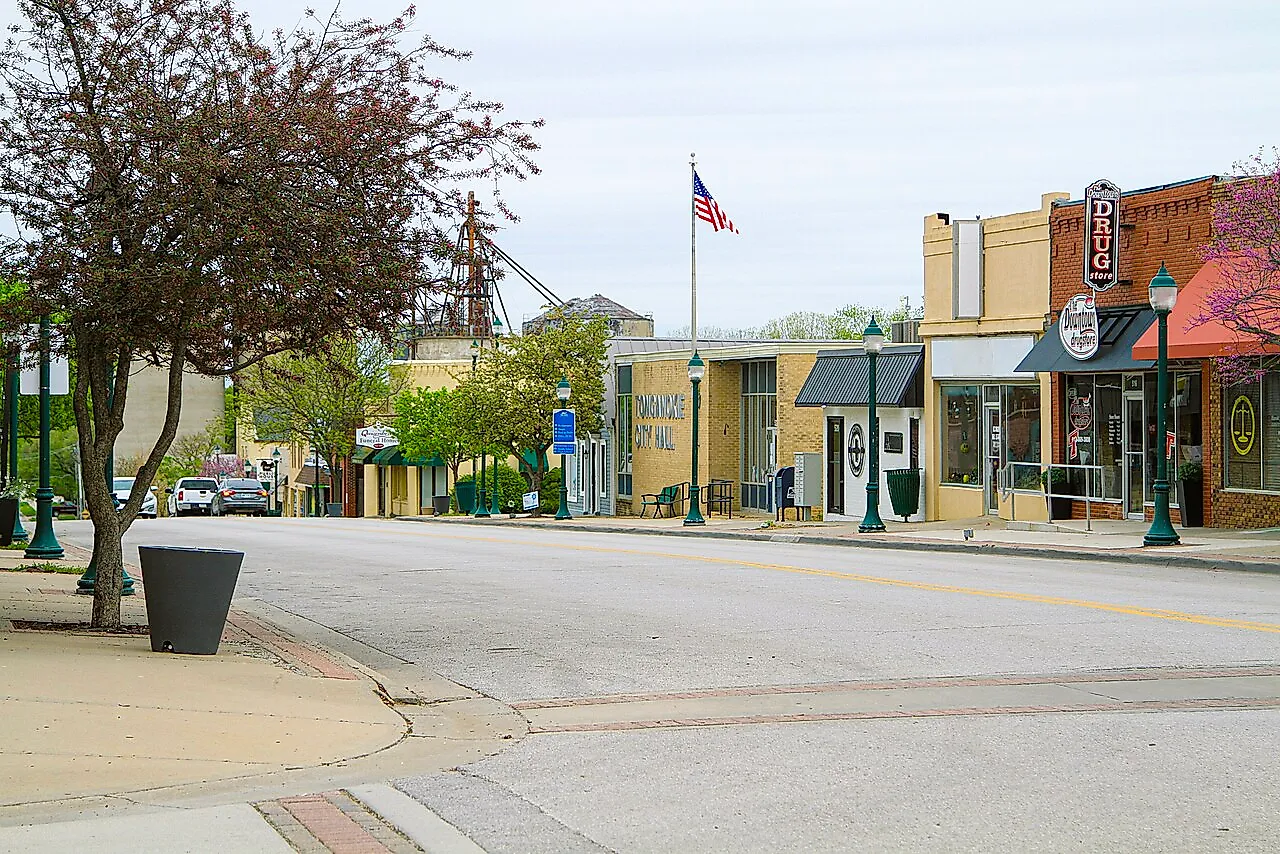
Tonganoxie's recent gains reflect the search for lower-density housing reshaping eastern Leavenworth County. The local version of that pattern runs through Wyandotte County, Bonner Springs, and western Johnson County, with households following the K-32 and K-7 corridors toward less crowded submarkets. At the county level, IRS migration data for Leavenworth County shows the broader in-state pattern behind Tonganoxie's growth, with movement from nearby Kansas counties into the Kansas City metro's outer western edge.
The city numbered 6,195 inhabitants in the Kansas Division of the Budget's certified July 2025 estimate, an increase of 11.2 percent from the 2020 Census. The single-year gain was 93 residents, with three-year cumulative growth of about 8 percent since 2022. Tonganoxie's median home values remain below many Johnson County suburbs, which has helped make the city a practical landing spot for in-state movers. Tonganoxie USD 464 has expanded enrollment across its elementary, middle, and high schools.
Eudora, Kansas

Halfway between two job markets pulling in opposite directions, Eudora stands five miles east of Lawrence along Kansas Highway 10. The most recent estimate placed its population at 6,564, up 2.4 percent from 6,408 in the 2020 Census. The headline growth understates the pressure building along the K-10 corridor. Lawrence has struggled to produce enough new single-family housing, while the Panasonic battery plant in De Soto has added a major employment center ten minutes east of Eudora.
Eudora has positioned itself as the bedroom community for both. IRS county-to-county data cannot say exactly how many movers landed inside Eudora, but Douglas County's location between Lawrence, Johnson County, and the De Soto job corridor makes the in-state movement story clear. Two multifamily projects broke ground in 2026 with the 96-unit 10 Union Lofts and the 36-unit Paschal's Landing both at the corner of 10th and Peach. A 134-acre annexation by a Johnson County developer cleared the city in October 2025 for hundreds of single-family homes north of K-10.
Where Kansas Growth Concentrates Now
The pattern that emerges is concentration. Kansas as a state added a little more than 6,600 residents in the latest annual Census estimate, and much of the visible local growth stacked into a short list of suburbs along three corridors. Rural counties and smaller outlying communities continue to lose population, while Andover, Basehor, Spring Hill, Gardner, Tonganoxie, and Eudora keep absorbing households looking for newer housing, school access, and shorter drives to expanding job centers. Panasonic, BNSF Logistics Park, and the Wichita and Kansas City suburban housing markets will keep shaping where the next round of in-state moves lands. School district capacity, road expansion on K-10 and US-56, and property tax pressure in the receiving counties will all be on the agenda over the next several years.