9 Offbeat Maryland Towns To Visit In 2026
A glass case at the Mermaid Museum in Berlin holds the museum's most prized artifact, a Cheeto shaped like a mermaid. That detail tells you most of what you need to know about Maryland's stranger side. The nine towns ahead lean into the eccentric, the macabre, and the gloriously specific. Renaissance jousts in Crownsville pair with carved decoys in Havre de Grace and ghost stories along the Ellicott City rail line. Some of the traditions started in the 1840s. Others showed up by 2016 and never left.
Berlin

Budget Travel named Berlin "America's Coolest Small Town" in 2014, capping a 20-year restoration that had already pulled two Hollywood productions into town: the 1999 Julia Roberts vehicle Runaway Bride and the 2002 fantasy film Tuck Everlasting both filmed extensively along Main Street, with the 1895 Atlantic Hotel anchoring both productions. The hotel still runs as a working inn and ground-floor restaurant. Burley Oak Brewing Company, a few blocks south on West Street, has anchored the town's craft beverage scene since 2011 with an oak-aged sour beer program that ships to specialty bottle shops along the Mid-Atlantic.
The Mermaid Museum on Main Street holds a Cheeto shaped like a mermaid under glass as the museum's most prized artifact. Founded by local artist Maloof, the museum fills a single room with cross-cultural mermaid folklore and unapologetically deadpan humor. The Ghost Museum a few blocks away documents the white lady seen on street corners, the little girl said to ride her bike through the Atlantic Hotel corridors on quiet nights, and the unclassifiable "elemental" reported near the old rail line. The Calvin B. Taylor House Museum, a restored 1832 Federal-style home, holds the country's largest collection of photographs from the nearby Glen Riddle Farm era, when both Man o' War and War Admiral trained at the farm just outside town.
Havre De Grace

On May 3, 1813, the British Royal Navy bombarded Havre de Grace during the War of 1812, destroying nearly every wooden structure in town. Lighthouse keeper John O'Neill fired a single cannon at the British fleet before being captured and later released, becoming the town's defining local hero. The Concord Point Lighthouse he later kept, built in 1827 at the mouth of the Susquehanna River, operated continuously until its decommissioning in 1975 and now opens seasonally for lantern-room climbs. The Maritime Museum two blocks inland tells the rest of the rebuilt waterfront's story.
The town's other identity centers on hand-carved decoys. Havre de Grace was the working duck-hunting hub of the upper Chesapeake from the 1880s through the 1960s, and the carving tradition that supplied the hunters evolved into an established American folk art. The Havre de Grace Decoy Museum holds working decoys downstairs and master-carver display pieces upstairs, with the Decoy Festival each May since 1981 packing the festival grounds for the country's largest event of its kind. The First Call Paranormal & Oddities Museum down the street pulls the town's stranger thread, including the Hattie Stone case (a local woman who allegedly poisoned five family members with strychnine in 1899) alongside Chessie sightings and a Feejee mermaid pulled from the long-running Dr. Gloom's Crypt of Curiosities collection.
Takoma Park

Takoma Park declared itself a Nuclear-Free Zone in 1983 and a sanctuary city soon after, two pieces of municipal theater that have mostly held up as durable signals of the town's edge-of-D.C. identity. The town was founded in 1883 as a planned railroad suburb on the Baltimore & Ohio's Metropolitan Branch, and its tree-lined Victorian-era streets still trace the original lots laid out by developer Benjamin Franklin Gilbert. The Old Town district along Carroll Avenue runs the original commercial blocks.
A canary-yellow payphone at the corner of Flower and Erie Avenues hasn't connected a call in years, and that's the entire point. The Bird Calls Phone is a public art installation created by local composer David Schulman in 2016, rewired so that every button plays the recorded call of a different bird native to Takoma Park. Button 5 plays a rooster, a deliberate nod to Roscoe the Rooster, a chicken who roamed downtown through most of the 1990s and was honored with a bronze memorial after his 1999 death. On Tulip Avenue, the 16-foot Chinese-style oak dragon named Herlong has watched the street from behind a backyard fence since 2007, carved from a lightning-struck tree by sculptor Janice Mauldin Bedford. The Takoma Park Folk Festival, held each September since 1978, spreads across seven stages with craft vendors and food stalls weaving through the neighborhood.
Hyattsville

Prince George's County established the Gateway Arts District by ordinance in 2001, designating a 2-mile stretch of Route 1 between Mount Rainier and Brentwood as a state-recognized arts corridor with tax incentives for artist housing, working studios, and exhibition space. Hyattsville sits at the heart of the corridor and now holds the highest concentration of working artists per capita in Maryland.
The Pyramid Atlantic Art Center, in a 13,000-square-foot historic building on Baltimore Avenue, runs the country's most active center for the book and paper arts, with dedicated studios for letterpress printing, bookbinding, papermaking, and printmaking. Artist Clarke Bedford has spent decades converting his Nicholson Street home into the Vanadu Art House, a private residence covered across every surface with recycled metal, mosaics, ceramic fragments, saw blades, light fixtures, and horned helmets, with several fully operational art cars parked out front and visible from the public street. The illuminated "After Dark" mural on Franklin's Restaurant and the 2,000-pound steel sculpture "A Pilgrim's Quandary" by Tom Ashcraft anchor the corridor's most-photographed corners.
St. Michaels

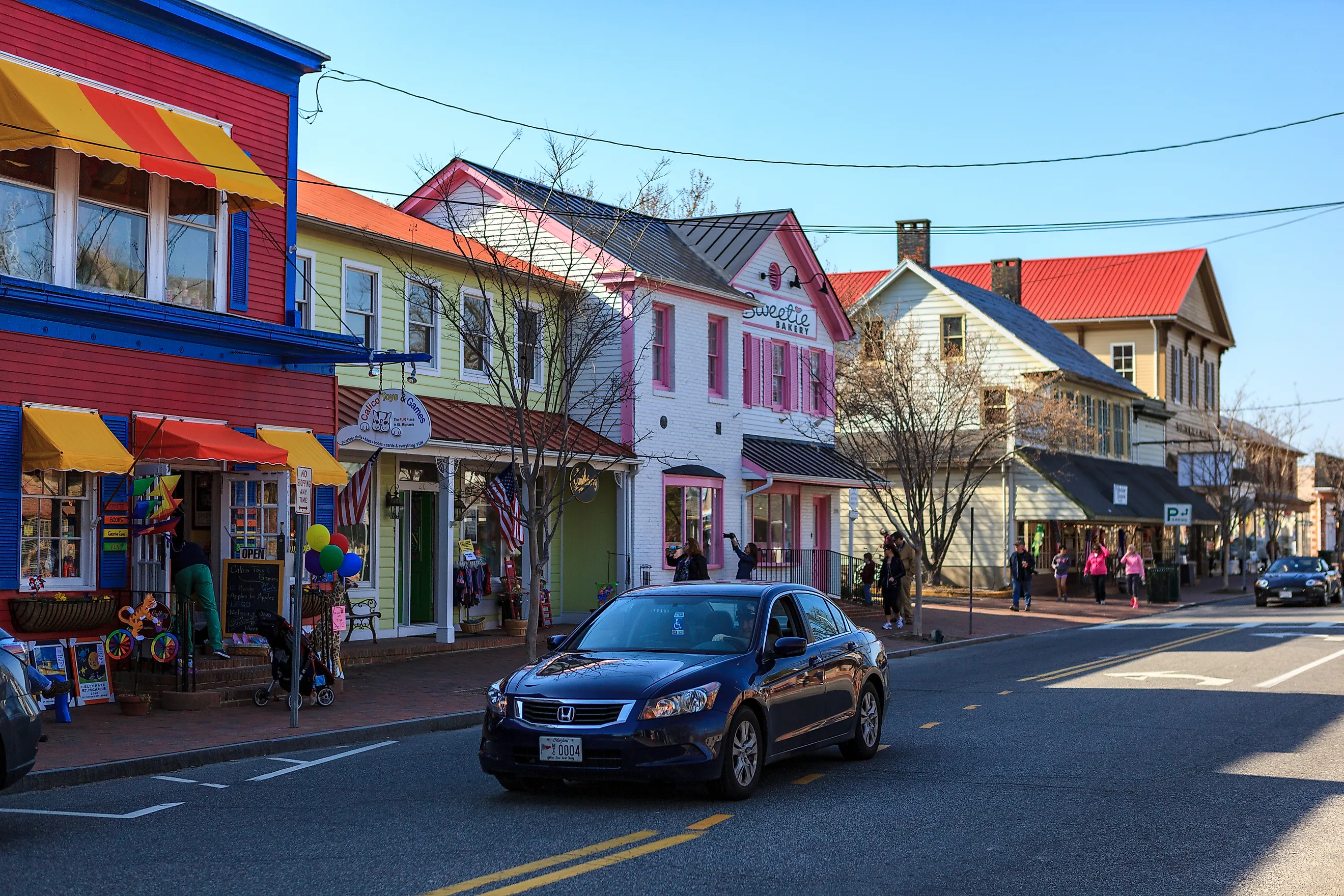
The British Royal Navy never burned St. Michaels during the War of 1812 because the town's residents hung lanterns in the treetops on the night of August 10, 1813, drawing British naval gunners to overshoot the town entirely. "The Town That Fooled the British" survived the war nearly intact, and the buildings that fooled the gunners still anchor the historic district along Talbot Street.
St. Michaels' more recent identity runs on Chesapeake Bay log canoes. The narrow multi-log boats trace back to 19th-century working watermen, and competitive racing dates to 1840 with the first Douglas Cup contests on the Miles River. The Miles River Yacht Club revived the tradition in 1920 and now bills itself as the "home of the log canoes," with crews leaning out on hiking boards each weekend afternoon June through September to keep the vessels from capsizing (which still happens regularly). The Chesapeake Bay Maritime Museum, an 18-acre campus on Navy Point founded in 1965, holds the world's largest collection of Chesapeake Bay watercraft and operates its own racing log canoe, the Edmee S., crewed by museum staff. The relocated 1879 Hooper Strait Lighthouse on the museum grounds opens for seasonal climbs over the Miles River.
Ellicott City

The Baltimore and Ohio Railroad reached Ellicott Mills in 1830, making the town founded in 1772 by Quaker brothers Andrew, John, and Joseph Ellicott the western terminus of the country's first commercial railroad. The original 1830 station, now the B&O Ellicott City Station Museum, predates the introduction of the steam locomotive on American rails. The complex still holds the original freight station, car house, and route-history exhibits documenting the period when railroad cars were pulled by horses.
Downtown Main Street, severely damaged by catastrophic flash floods in 2016 and 2018, has been rebuilt with engineered flood-control measures and a renewed mix of locally-owned shops, restaurants, and antique stores. Clark's Elioak Farm, on Clarksville Pike outside town, preserves restored attractions from the old Enchanted Forest theme park (which operated nearby from 1955 through 1995), including the Old Woman's Shoe, Cinderella's castle, the Three Bears' House, and dozens of original park structures based on nursery rhymes and classic children's stories. The property combines the rebuilt attractions with a Fairy Forest trail, pony rides, a small train, and a petting farm.
Boonsboro

The first completed monument to George Washington in the country sits 4 miles east of Boonsboro on South Mountain, a 30-foot stone tower built in a single day on July 4, 1827, by 511 Boonsboro residents using local field stones. The Washington Monument State Park preserves the tower along with overlooks across the Cumberland Valley and a section of the Appalachian Trail that passes the monument's base. The town itself was founded in 1792 by brothers George and William Boone, distant relatives of frontiersman Daniel Boone.
In 1920, a road crew quarrying limestone outside town pushed a drill bit into what they assumed was solid rock, and it kept going. The investigative explosion revealed the cave entrance still used today, and within two years Crystal Grottoes Caverns had opened to the public as Maryland's only commercial cave. Narrow passages lined with dense calcite formations wind roughly half a mile underground through chambers that stay 54 degrees year-round, with guided tours descending up to 110 feet below the surface. The Boonsboro Trolley Museum preserves the Hagerstown & Frederick Railway, the electric interurban system that connected the small western Maryland towns in the early 1900s. Greenbrier State Park covers the forested slopes of South Mountain alongside a 42-acre freshwater lake.
Chestertown

George Washington co-signed the founding charter of Washington College in 1782, making it the country's 10th-oldest college and the only one to bear Washington's name with his explicit endorsement. The campus still occupies a 30-acre site on the Chester River that's been in continuous use as a college since the original chartering. The Geddes-Piper House, built in 1784 for tea-merchant William Geddes, now houses the Historical Society of Kent County alongside its collection of Chestertown 18th-century material culture.
Chestertown's colonial street grid becomes part of the performance during two of Maryland's most elaborate annual festivals. Memorial Day weekend hosts the Chestertown Tea Party Festival (running since 1968), which reenacts the disputed 1774 protest in which local residents allegedly boarded the brigantine Geddes and dumped its tea cargo into the Chester River. Historians have found no contemporary record of the event, but the town has embraced the story through colonial parades, fife-and-drum performances, raft races, and a public reenactment along the waterfront that draws thousands to High Street. December brings the Dickens of a Christmas, a two-day Victorian festival that closes High Street to traffic and fills the blocks with vendor tents, bonfires, and draft horses pulling holiday carriages. The schooner Sultana, a full-scale 2001 recreation of the 1768 British vessel of the same name, docks on Water Street and runs public sails spring through fall.
Crownsville

The Maryland Renaissance Festival opened in Crownsville in 1977 and is now the second-largest renaissance festival in the country by attendance, drawing roughly 300,000 visitors across its 9-weekend annual run from late August through late October. The 27-acre wooded site holds more than 100 permanent timber-framed buildings constructed as the fictional 16th-century village of Revel Grove, with jousting tournaments staged in a dedicated arena and live theatrical performances rotating across 10 stages each day.
Each festival season builds around the court of King Henry VIII and a rotating historical storyline. The 2025 edition centered on the year 1539 and folded court painter Hans Holbein into the festival narrative. The Greybeards Viking Experience runs a separate weekend on the festival grounds with Viking combat demonstrations, mead tastings, historical encampments, and axe throwing. Outside the festival run, Crownsville preserves the Rising Sun Inn, a restored 18th-century tavern and museum that once served travelers moving between Annapolis and the western frontier. Tours walk through period-furnished rooms, tavern spaces, and exhibits on colonial-era travel.
Maryland's Other Itinerary
Maryland doesn't fight Washington and Baltimore for the road-trip headlines, but the offbeat Maryland towns above run a different kind of trip entirely. St. Michaels and Chestertown anchor the Eastern Shore on working maritime history. Berlin and Havre de Grace pair their oddities museums with carefully restored historic downtowns. Crownsville, Boonsboro, and Ellicott City fold festivals, theme parks, and underground tours into the central and western counties. Hyattsville and Takoma Park run urban-edge art districts and creative civic projects that don't repeat anywhere else. Each one earns its own visit, and most pair well with at least one neighbor on a longer Maryland circuit.