10 Small Towns Along The Chesapeake Bay With Unmatched Friendliness
Ten small towns along the Chesapeake Bay have built reputations for unmatched friendliness. The watermen culture sets the tone. Oyster boats fish the grounds their grandfathers did, and dock space gets shared. One family runs the seafood market for four generations. Local volunteers organize the festivals and fundraisers. That practical closeness is what people mean when they call these Maryland and Virginia towns friendly.
Cape Charles, Virginia

In Cape Charles, neighbors wave to each other from golf carts. Residents drive them to the post office, the harbor, and Town Beach. The slow pace leaves people time to stop and talk. The town grew up as a railroad and ferry terminus on the Eastern Shore. The storefront names along Mason Avenue still trace back to the old clamming and crab-processing families. About 1,000 people live here.
The Cape Charles Historic District holds about 600 turn-of-the-century buildings on the National Register of Historic Places. Most still serve as homes, shops, and inns. Offshore on Smith Island stands the Cape Charles Lighthouse. At 191 feet it is the tallest in Virginia and the second tallest in the country. The Coast Guard deactivated it in 2019, but it still marks the bay horizon. The town calendar fills with the Fourth of July festival, a summer concert series in Central Park, and the Saturday farmers market at the Oyster Farm. The Chesapeake Bay Bridge-Tunnel ties the southern tip of the Eastern Shore to the Hampton Roads mainland. Finished in 1964, it runs 17.6 miles across trestles, bridges, and two undersea tunnels.
St. Michaels, Maryland

St. Michaels has about 1,100 residents, few enough that the same shopkeepers and dockmasters turn up week after week. The town also carries the nickname "the town that fooled the British." During the War of 1812, residents reportedly hung lanterns in the treetops behind town. Royal Navy gunners aimed high and overshot the houses and shipyards. Historians doubt the tale, but the community marks it with a plaque.
The Chesapeake Bay Maritime Museum spreads across an 18-acre campus at Navy Point. It holds the 1879 Hooper Strait Lighthouse, moved here from its original bay site in 1966. A working shipyard on the grounds restores wooden Chesapeake workboats. The Classic Motor Museum displays vintage cars kept up by local volunteers. Patriot Cruises runs narrated harbor tours with crews from local watermen families. The annual WineFest each spring works as a community fundraiser. Its proceeds go to local nonprofits.
Oxford, Maryland

Fewer than 700 people live in Oxford, few enough that most still know each other by name. The town's oldest fixture keeps them tied to the water. The Oxford-Bellevue Ferry has crossed the Tred Avon River since 1683. That makes it the oldest privately operated ferry in the country, older than the United States. Service paused for about 60 years after the Revolution, then resumed for good. The boat carries up to nine vehicles plus bikes and walkers, every 20 minutes from late April through October. Bellevue, on the far shore, is a historically African American maritime community. Its families have worked the bay for generations.
Pope's Tavern serves European bistro fare inside the Robert Morris Inn. The inn claims parts dating to 1710 and a place among the oldest in the country. Doc's Sunset Grille is a working waterman bar with steamed crabs and a long harbor porch. The Oxford Fine Arts Show in early August runs entirely on volunteers. Flat, quiet paths trace the harbor through a downtown that has barely changed in a century.
Onancock, Virginia

Onancock's social life centers on Ker Place, a Federal-style mansion finished in 1799 for Scottish merchant John Shepherd Ker. The house hosts the town's free Music on the Lawn series each summer. It also hosts the annual Crab Crackin' fundraiser and the Christmas Homes Tour. The town dates to 1680 and counts about 1,170 residents. It works as the everyday hub for the farming and watermen communities on the bayside of Virginia's Eastern Shore.
The Onancock Wharf anchors a seasonal passenger ferry to Tangier Island. Tangier holds one of the last working waterman communities on the bay. Its population nears 400 and keeps falling as coastal erosion eats the island. Residents still speak a distinctive dialect that linguists trace to 17th-century English coastal speech. They have long claimed the title of soft-shell crab capital of the world.
Rock Hall, Maryland

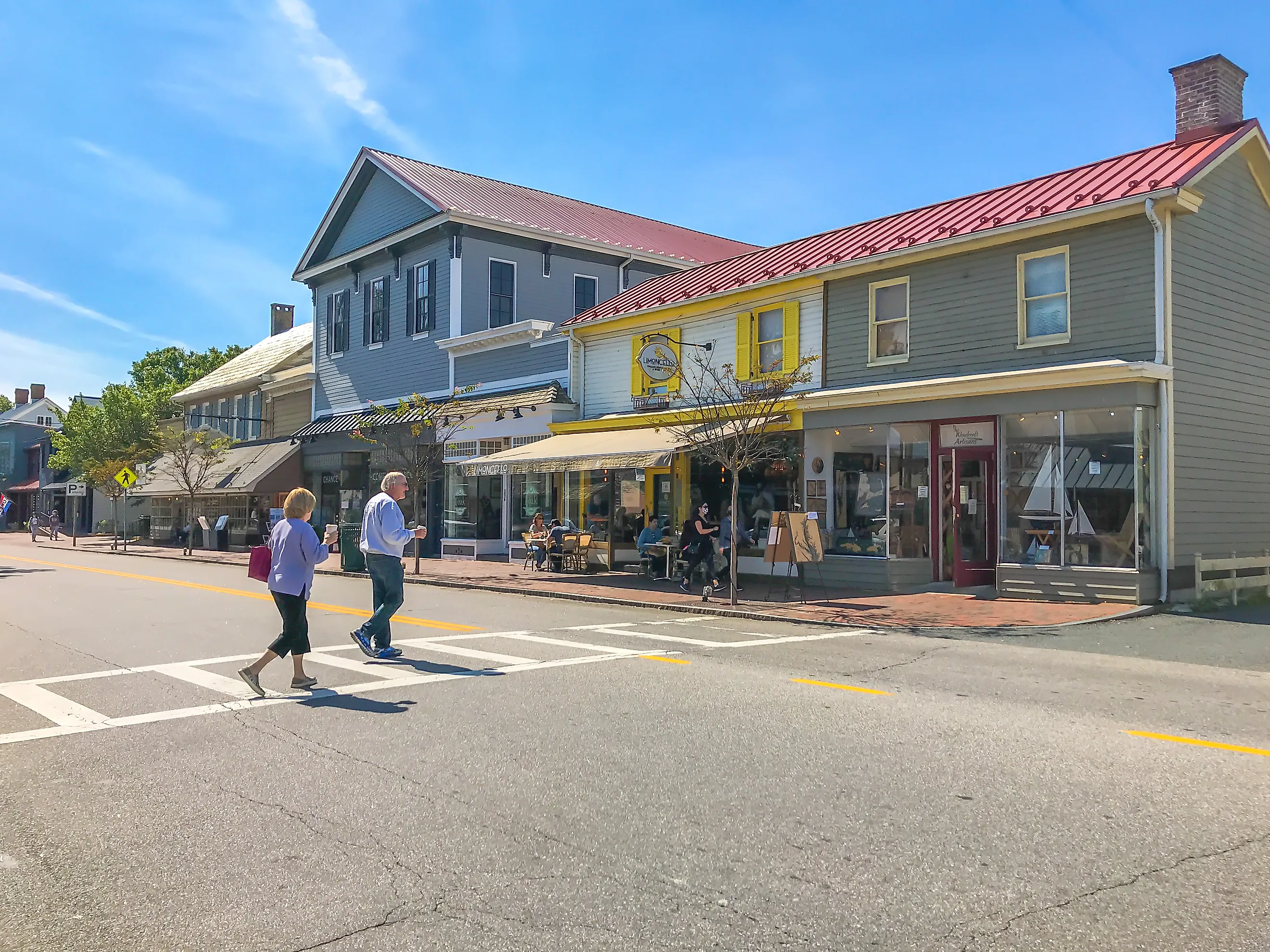
Street view in Rock Hall, Maryland.
Rock Hall calls itself the friendliest small town on the bay, and a year-round festival calendar backs the claim. The town also bills itself as the "Pearl of the Chesapeake." About 1,300 people live on this stretch of Maryland's Upper Eastern Shore. In the 18th and 19th centuries, the town served as a crossing point across the bay. Travelers passed through on the way between Annapolis and Philadelphia, well before any bridge spanned the water.
The Waterman's Museum runs out of a former workboat builder's shed at Haven Harbour. It documents the commercial fishing past through donated tools, photographs, and oral histories. Blue Crab Chesapeake charters take small groups out on traditional skipjacks. The Pirates and Wenches Fantasy Weekend in August is the year's biggest event. The whole town dresses in 17th-century pirate gear, and most businesses join in. The Rock Hall FallFest in October centers on oysters and music. Ferry Park serves as the public beach.
Havre de Grace, Maryland

Lighthouse at the end of the road in Havre De Grace, Maryland.
At about 14,800 people, Havre de Grace is the largest town on this list, yet its downtown still closes for a First Friday street party every month from May through October. The town has worked the river for nearly three centuries, where the Susquehanna meets the Chesapeake Bay. The Havre de Grace Promenade runs a half-mile along the Susquehanna and draws the morning-walk crowd. Live music and food vendors fill the First Friday closings.
The Havre de Grace Decoy Museum collects hand-carved waterfowl decoys from the upper Chesapeake. That carving trade once supported whole families along the river. The Concord Point Lighthouse, lit in 1827, ranks among the oldest continuously operated lighthouses on the East Coast. It guided river-mouth traffic until 1975. The Havre de Grace Art Show is one of Maryland's longest-running juried art festivals.
Crisfield, Maryland

The Harbor in Crisfield, Maryland.
Multi-generational watermen families have kept Crisfield's population steady near 2,500. The town was built on oysters and crabs, and it still calls itself the "Seafood Capital of the World." Much of downtown rests on a bed of oyster shells left by old shucking houses. Locals say the streets are literally built on them. Somers Cove Marina stays busy with commercial and recreational boats.
The signature event is the National Hard Crab Derby, held every Labor Day weekend since 1947. It runs crab races, cooking contests, a parade, fireworks, and a Miss Crustacean pageant. The whole town turns out. The Crisfield Heritage Museum tells the oyster-fleet story. Janes Island State Park opens protected paddling routes through marsh that watermen have used for centuries. Crisfield is also the mainland departure point for Tangier Island in Virginia and Smith Island in Maryland. They are the last two inhabited offshore island communities on the bay.
Irvington, Virginia

Irvington's first-Saturday farmers market runs on the same families staffing the same stands month after month. The market doubles as the town's social calendar from May through November. About 470 people live here, and close to half are 65 or older. The Steamboat Era Museum keeps the town's deeper story. Between 1813 and the 1930s, steamboats linked the Northern Neck to Baltimore, Norfolk, and Washington. When the lines closed, the area went quiet. That quiet is part of why the Northern Neck holds so much 18th- and 19th-century character. The town stands at the southern tip of the peninsula, between the Rappahannock River and the bay.
The Hope and Glory Inn fills a converted 1890 schoolhouse. It works with the nearby Dog and Oyster Vineyard to pair local wines with Rappahannock River oysters. The annual Irvington Crab Festival each May is smaller than the Crisfield derby. Its proceeds go to local organizations.
North Beach, Maryland
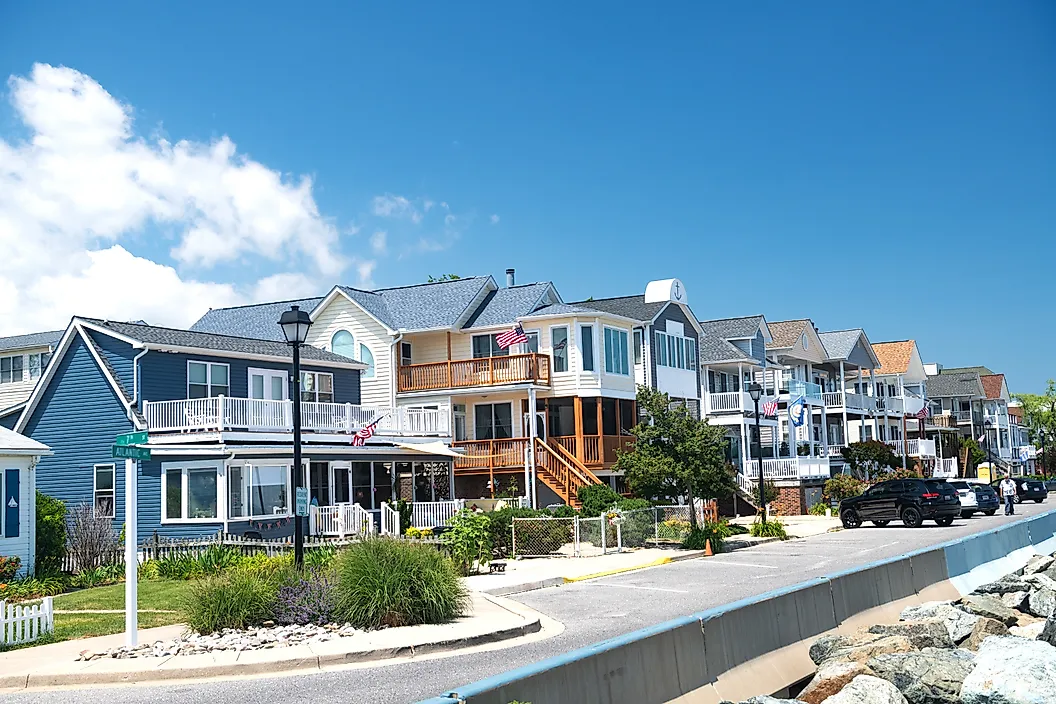
North Beach fits about 2,100 people into a compact grid behind a half-mile bay boardwalk. The morning walk along that boardwalk doubles as the daily meetup. The town was incorporated in 1910 as a bayshore resort for Washington-area visitors, who arrived by rail. The streetcar era left it walkable and tight-knit.
The Saturday morning farmers market, May through October, is the week's main social event. The Friday-night Movies on the Beach series projects films onto a sand-set screen in summer. The Bayside History Museum fills a former bayfront hotel and covers the resort years. The Wheel House Beer Garden on the boardwalk draws the summer-weekend crowd. Across the town line in Chesapeake Beach, Rod 'N Reel rents kayaks and paddleboards.
Smithfield, Virginia

Independent shops run by multi-generational Smithfield families line the downtown. About 8,800 people live here. The town is the only one on this list not directly on the bay. Its Pagan River runs into the James River and on to the Chesapeake, so Smithfield has long belonged to the larger bay community. Surveyors platted the town in 1750, and it was incorporated in 1752. By the late 1700s it had grown into a busy tobacco and shipping port.
The Isle of Wight County Museum keeps what it bills as the world's oldest ham, cured in 1902. Smithfield Foods, founded as Smithfield Packing in 1936, remains a major regional employer. Windsor Castle Park offers wooded trails, a fishing pier, and a boat launch. It hosts the Wine and Brew Fest each April. Fort Boykin Historic Park preserves an English colonial fortification first built in 1623, one of the earliest in English North America. Isle of Wight County is one of the original eight Virginia shires, established in 1634.
The Friendliness Pattern Along the Bay
The ten towns share a pattern. Each keeps a working maritime culture. The festivals and fundraisers run on local volunteers, not a tourism board. The same faces turn up at the farmers market, the fire-hall fundraiser, and the Labor Day parade. The hospitality is structural, not staged. It comes from places where neighbors have real reasons to know each other. New arrivals get noticed and absorbed instead of processed.