Where People Are Moving To In Arkansas In 2026
Northwest Arkansas climbed to the ninth-fastest-growing metro area in the country as of mid-2025, and Benton County alone added more than 10,000 residents between July 2024 and July 2025. Walmart's new 350-acre Home Office campus opened in phases through 2025. Tyson Foods and J.B. Hunt have kept the regional job pipeline running alongside Walmart's expansion. Housing costs across Northwest Arkansas remain affordable next to most coastal metros. Of Arkansas's 75 counties only 37 grew between 2020 and 2025. The seven places below show where most of that growth has concentrated.
Bentonville

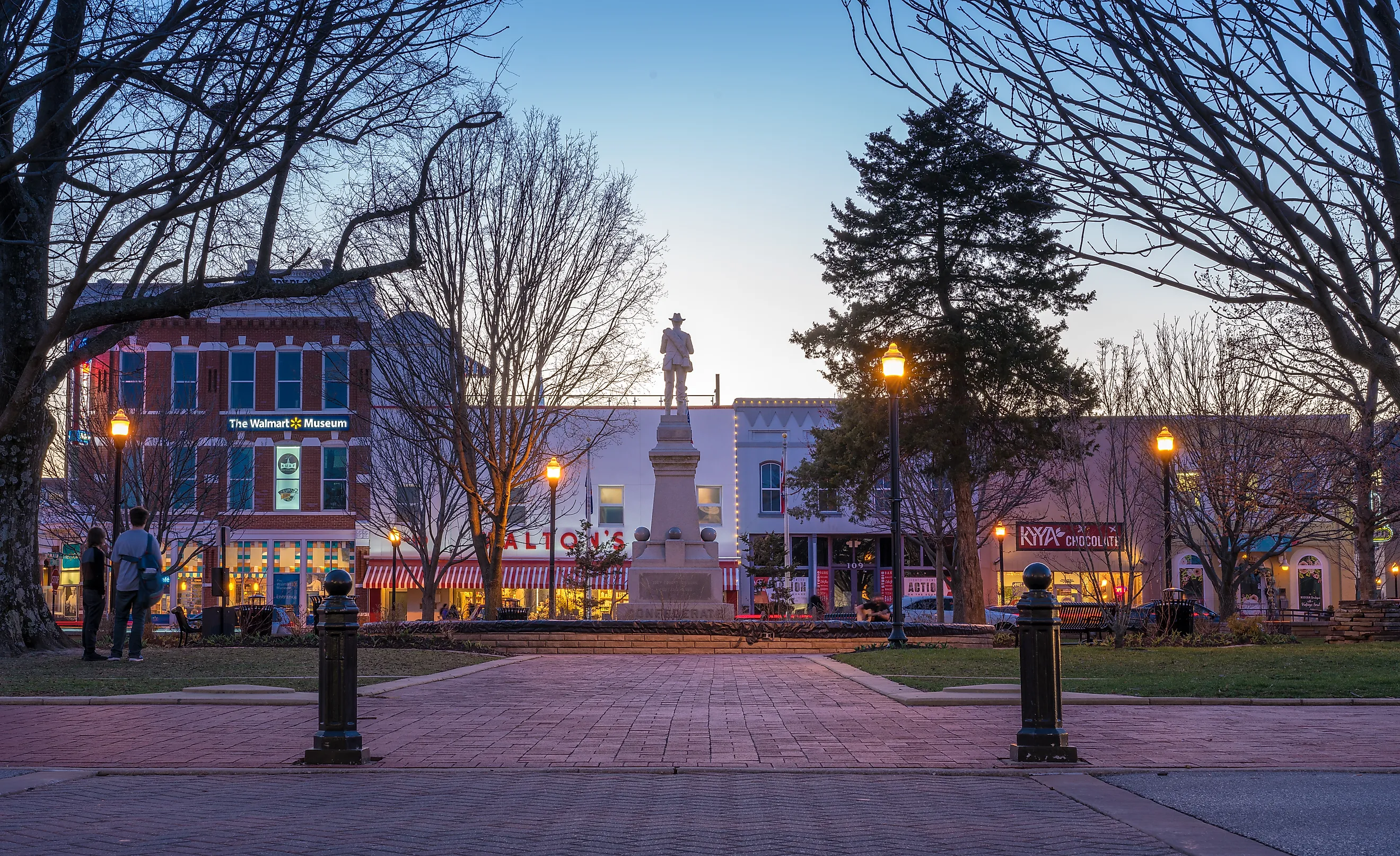
Bentonville stands at the center of nearly every Northwest Arkansas growth story, and recent Census estimates rank it among Arkansas's leaders in annual population growth. The 2020 Census recorded 54,164 residents; by 2024, Census estimates placed the city at 61,791 residents, a 14 percent increase in just four years. Walmart's new 350-acre Home Office campus on the east side of J Street has become a major growth engine, with portions of the redevelopment opening in phases beginning in 2025. The company's return-to-office policy has also pushed more employees to relocate to Bentonville from larger metro areas. Meanwhile, the Crystal Bridges Museum of American Art will unveil a 114,000-square-foot expansion designed by Safdie Architects on June 6, 2026, adding new galleries, the Quartz & Honey café, and expanded outdoor public space while increasing the museum's footprint by roughly 50 percent.
Centerton

Centerton sits five miles west of Bentonville on Highway 102, and it has ranked among the nation's fastest-growing cities in several consecutive Census estimate releases. Vintage 2025 estimates show the city adding roughly 1,400 residents between July 2024 and July 2025, pushing the population to about 27,200, up from 17,792 at the 2020 Census, which represents a gain of more than 50 percent in five years. The Census Bureau's estimates heavily reflect housing-unit growth, which in Centerton has been explosive, with subdivisions like Featherston Village, Huber Place, and Magnolia Landing spreading across former agricultural land west of Bentonville.
Much of the demand comes from buyers seeking lower housing costs while remaining close to Northwest Arkansas's major employers. Because Centerton sits in Benton County, moves from Bentonville don't register in IRS migration data, which tracks only county-to-county flows. Local realtors and building-permit activity point to continued demand from Walmart, Sam's Club, and supplier-network employees priced out of Bentonville, where the median listing price runs near $485,000 against roughly $350,000 in Centerton, according to Zillow. The city also benefits from its location inside the Bentonville school district.
Pea Ridge

Pea Ridge had 6,559 residents at the 2020 census, while the Vintage 2024 estimate was 10,190, and the city ranked among the top 10 numeric gainers statewide in Vintage 2025 estimates. The annual cumulative growth rate between 2020 and 2025 keeps Pea Ridge in the top three among Arkansas' cities, behind only Tontitown and Highfill. Just 10 miles northeast of Bentonville on Highway 72, Pea Ridge is still inside Benton County but far enough out that lot prices for new construction run materially below Centerton or Cave Springs.
The town has annexed adjacent land aggressively over the past several years to accommodate housing development. The historic anchor is the Pea Ridge National Military Park, site of an 1862 Civil War battle and one of the most fully preserved Civil War battlefields in the country. The park covers the north edge of town along US 62, drawing about 130,000 visitors a year within minutes of the city's rapidly growing western subdivisions.
Tontitown

Tontitown has posted the fastest sustained growth rate among Arkansas cities with over 1,000 residents since 2020. World Population Review, using Census population estimates, calculates the city's annual growth rate at roughly 9.3 percent. The town hugs the western edge of Springdale in Washington County along Highway 412. Much of the recent growth appears tied to workers from Springdale and Fayetteville seeking newer housing and lower land costs farther west. The Tontitown Grape Festival, held continuously every August since 1898, remains the region's premier cultural event, drawing tens of thousands over three days for spaghetti dinners and the popular grape stomp.
Cave Springs

Cave Springs holds the highest median household income in Northwest Arkansas at $146,473 in 2024, well above Bentonville's roughly $112,792, with a median home value of $570,000. The Vintage 2024 population was 6,582, up from 5,880 in 2020, and the Vintage 2025 release continued the trend with another year of strong percentage growth driven by single-family construction on the east side of town. The city lies just south of Bentonville and southwest of Rogers on Highway 112, within easy commuting distance of both the Walmart Home Office and the Northwest Arkansas National Airport (XNA), which has filled its newest subdivisions with Walmart executives and supplier-company directors.
In May 2024, the Cave Springs and Rogers city councils approved a land swap that consolidated municipal boundaries and opened additional acreage for residential development. Unlike the denser subdivisions spreading across Bentonville and Rogers, much of Cave Springs still develops in larger-lot neighborhoods that appeal to higher-income buyers seeking more space without leaving the Northwest Arkansas core.
Bella Vista

Bella Vista is the northern bookend of Northwest Arkansas, pressed against the Missouri state line, and it ranked fourth in the state for numeric population gain between July 2024 and July 2025, adding 1,232 residents to reach roughly 34,500, according to the US Census Bureau's Vintage 2025 estimates. It has also seen a five-year gain of about 14.5 percent since the 2020 Census. Cooper Communities developed the city as a planned recreational and retirement community in 1965, and the median age remains 51.3, the highest of any town on this list by a significant margin.
Cooper Communities spent decades marketing Bella Vista to retirees relocating from across the Midwest and Southern Plains, building the seven golf courses, multiple lakes, and recreational amenities that helped establish the city as one of the country's best-known recreational retirement communities. The Bella Vista Bypass extension of I-49, opened in October 2021, has made commuter access to Bentonville's job market viable, broadening the city's appeal beyond retirees and diversifying the population demographics for sustainable future growth.
Conway

Outside Northwest Arkansas, the strongest growth story is Conway, the seat of Faulkner County, 30 miles north of Little Rock on I-40. Conway ranked fifth in the state for numeric population gain between July 2024 and July 2025, adding 1,205 residents to reach roughly 71,900, a gain of more than 12 percent since the 2020 census of 64,134. That makes Conway one of the few major growth centers in Arkansas outside Benton and Washington counties, with the fast-growing Saline County suburbs of Benton and Bryant not far behind.
Three universities, the University of Central Arkansas, Hendrix College, and Central Baptist College, help keep Conway one of the youngest cities in Arkansas, with a reported median age of 27.3. Enrollment growth accelerated in fall 2024 after UCA posted record freshman enrollment gains and combined enrollment climbed above 10,000 students. Conway's economic story has diversified beyond higher education. Westrock Coffee opened a 570,000-square-foot, $315 million manufacturing facility in 2024, and Acxiom still maintains its headquarters downtown, while Conway Regional Medical Center remains one of the city's largest employers.
What the Numbers Suggest
The pattern in the 2025 Vintage data is undeniable: Arkansas's growth corridor runs along the I-49 spine in the northwest, pulses out from Conway in the center, and is now extending into the Saline County suburbs of Benton and Bryant. Meanwhile, much of the Delta and southeast Arkansas continue losing population, with Phillips County down 13.7 percent and Desha County down 12.4 percent since 2020. The Arkansas Economic Development Institute projects Northwest Arkansas could approach 1 million residents by 2050, a trajectory that depends heavily on continued rapid growth in smaller cities like the ones highlighted here. For communities in shrinking parts of the state, the long-term consequence is likely to be a continued shift in political influence, school enrollment, infrastructure spending, and economic attention toward Arkansas's fastest-growing regions.