The Safest Small Towns In Maryland
Maryland’s safest small towns stand out because their crime rates are not merely low—they are dramatically below the benchmarks used in SafeWise’s 2026 ranking. Based on complete 2024 FBI crime reports, the list compares violent- and property-crime rates per 1,000 residents across qualifying communities. Frostburg led the state with just 0.1 violent crimes and 1.0 property crimes per 1,000 residents. Ocean Pines followed with rates of 0.3 and 3.3, while Thurmont posted 0.7 violent crimes and 5.9 property crimes per 1,000. Together, these communities show where Maryland’s safety data is strongest and what daily life looks like in the towns behind the numbers.
Frostburg

Cyclists on the Great Allegheny Passage pass the Frostburg Depot below Main Street, with a switchback trail connecting the route to downtown and Frostburg State University farther uphill. Independent shops and cafes keep Main Street busy through the academic year. That mix of trail town and college town runs alongside the best safety record in the state.
SafeWise placed Frostburg first in Maryland for 2026, a jump from second the year before. The town logged 0.1 violent crimes and 1.0 property crimes per 1,000 residents, well below SafeWise’s analyst-calculated national benchmarks of 4.43 and 22.89. It was the only community on the state list to improve in both categories year over year. Its 2024 report to the FBI included no robberies and no motor vehicle thefts at all.
The Palace Theatre still books concerts, films, and community shows, a short walk from campus. When the weather turns warm, residents leave downtown and pick up the Great Allegheny Passage, which spans 150 miles between Cumberland and Pittsburgh, with Frostburg located along the route west of Cumberland.
State land wraps the area on most sides. Rocky Gap State Park sits to the east, while Savage River State Forest and New Germany State Park add trails, trout streams, and campsites to the west. UPMC Western Maryland handles the region's hospital care from nearby Cumberland, and Interstate 68 keeps the rest of Allegany County close.
Ocean Pines

Five swimming pools, two marinas, and a Robert Trent Jones golf course are a lot of recreation for a community of about 12,000. Ocean Pines carries all of it as ordinary neighborhood infrastructure.
The Worcester County community placed second on the 2026 list. Its 2024 numbers came in at 0.3 violent crimes and 3.3 property crimes per 1,000 residents, and the report showed no robberies. Both rates land well under the national benchmarks.
Ocean Pines runs on a different clock than Ocean City next door. It stays a full-time residential community after the summer crowds leave. The Ocean Pines Association keeps up the parks, playgrounds, walking and biking paths, ballfields, and a public yacht club, and the calendar fills with farmers markets, outdoor concerts, and holiday events.
The Atlantic beaches are a short drive away, but many residents spend more time on the quiet bays and canals that thread the community. Boat launches and neighborhood marinas put the water within reach of most streets.
Atlantic General Hospital sits just inland in Berlin, and Worcester County Public Schools cover local students. Groceries, pharmacies, and doctors' offices stay close enough that most errands never require the highway.
Thurmont

Plenty of visitors meet Thurmont only as the turn for Cunningham Falls State Park. Residents live with the park as a backyard. Maryland's tallest cascading waterfall drops 78 feet a few miles west of downtown, and Catoctin Mountain Park adds wooded trails, overlooks, and campgrounds right next door.
All that public land comes with one of the lowest crime counts in Maryland. SafeWise ranked Thurmont third for 2026, holding its place from the year before. The town reported 0.7 violent crimes and 5.9 property crimes per 1,000 residents, again with no robberies on the books.
Downtown leans on family bakeries, coffee shops, and independent storefronts rather than chain development. Catoctin Colorfest takes over town each autumn and pulls artists and crowds from across the region, and smaller seasonal events keep the sidewalks busy the rest of the year.
Frederick is under half an hour south on US Route 15, which makes the commute workable without giving up the smaller footprint at home. Frederick Health Hospital anchors regional medical care, and the town rounds out the basics with its own schools, parks, and recreation programs.
Brunswick

Brunswick still runs on train schedules. Weekday mornings start with commuters boarding the MARC Brunswick Line toward Washington, DC. Afternoons bring hikers and cyclists back off the Chesapeake and Ohio Canal towpath along the Potomac.
The town took fourth on the 2026 list. Its 2024 report showed 1.3 violent crimes and 4.9 property crimes per 1,000 residents, both down from the year before. With fewer than 8,500 people, Brunswick can see its rates swing more sharply year to year than a big city would. Across several years, though, it has stayed among Maryland's steadiest performers.
The railroad past is still easy to see. The Brunswick Heritage Museum keeps that story, and restored brick storefronts along Potomac Street hold restaurants, cafes, and independent shops. Just past downtown, the C&O Canal towpath runs for miles beside the river for walkers, cyclists, and anglers.
Frederick County Public Schools serve local families, and Frederick Health Hospital covers the area's care. Residents can ride the train, take US Route 340 or Interstate 70, or spend a Saturday on the river without going far.
Hampstead

Hampstead keeps its downtown at the center of things. Cafes, family restaurants, and seasonal festivals fill the business district while newer neighborhoods spread into the Carroll County countryside around it.
That community core sits behind one of the state's better safety records. SafeWise placed Hampstead fifth for 2026. The town of 6,445 reported 1.6 violent crimes and 8.5 property crimes per 1,000 residents, both under the national marks, and its violent crime rate fell by nearly half from the previous year. The 2024 report listed no rapes.
Hampstead Day gathers local groups, food vendors, and live music each May, and holiday markets carry the calendar through the colder months. Most of it happens within walking distance of the neighborhoods, which is part of how a town this size stays close-knit.
Carroll County Public Schools educate the town's students, and Carroll Hospital in nearby Westminster handles regional care. Maryland Route 30 runs straight to Westminster, northern Baltimore County, and the Pennsylvania line for commuters and shoppers.
Havre de Grace

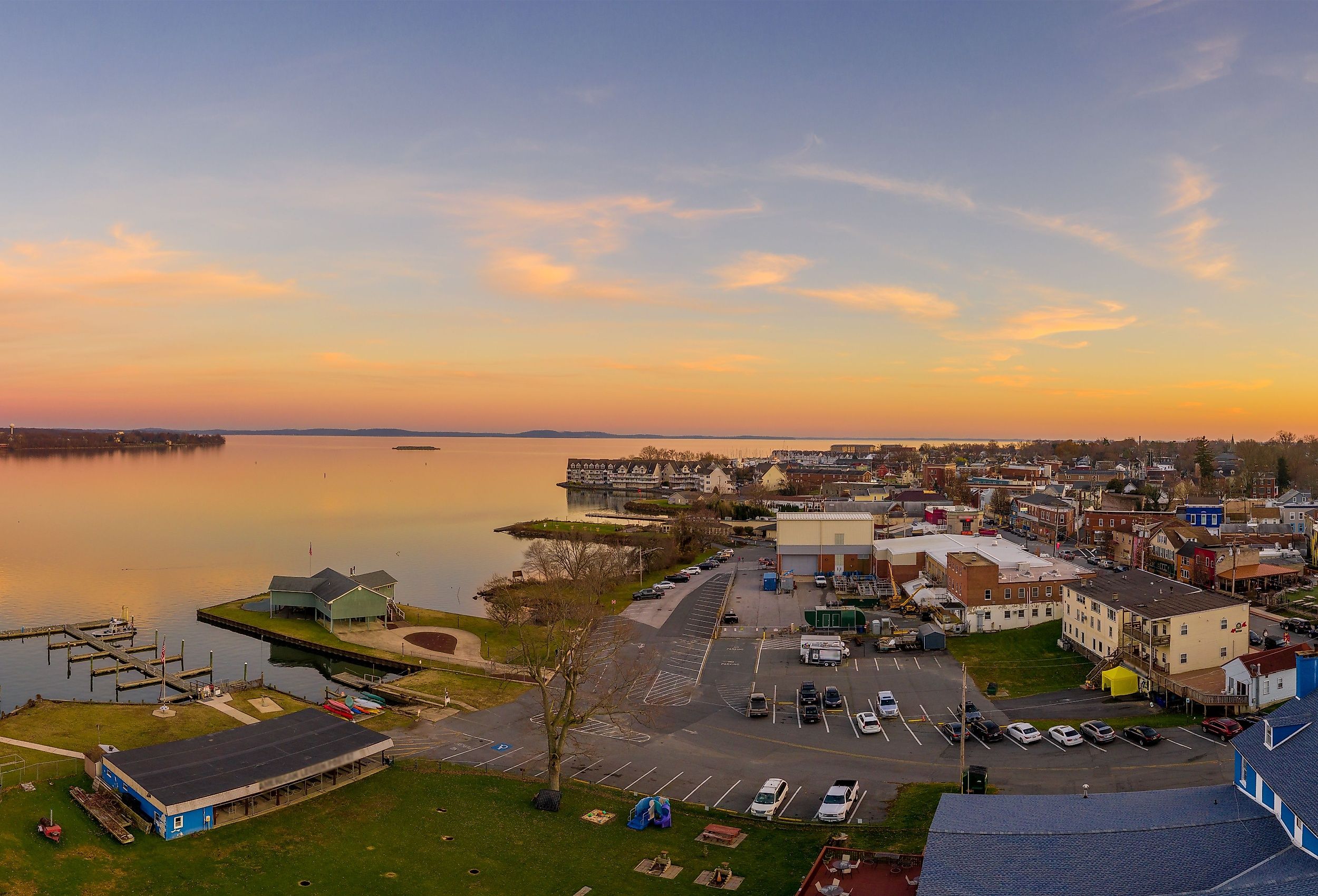
Havre de Grace sits where the Susquehanna River empties into the Chesapeake Bay. That meeting of river and bay gives the town miles of shoreline and shapes its days as much as the old downtown does.
The Havre de Grace Promenade runs along the water and links parks, marinas, and gathering spots with wide views of the bay. Concord Point Lighthouse, first lit in 1827, still marks the point, and nearby museums hold the region's maritime history.
SafeWise ranked Havre de Grace sixth for 2026, a first-time appearance on the list. The Harford County town reported 1.4 violent crimes and 13.1 property crimes per 1,000 residents, both below the national benchmarks. At more than 15,000 people, it is one of the larger communities in the top ten, so its year-to-year rates hold steadier than those of the smallest towns here.
The downtown packs restaurants, boutiques, galleries, and museums into a few blocks off the water. Tydings Memorial Park hosts concerts and festivals throughout the year, and the Maritime Museum and the Decoy Museum both trace the town's long tie to the Chesapeake.
University of Maryland Upper Chesapeake Medical Center in nearby Bel Air serves much of Harford County. Interstate 95, US Route 40, and the MARC Penn Line stop in Aberdeen connect residents to jobs across the region.
Mount Airy

Mount Airy sits astride the Carroll and Frederick county line, and about a mile south of downtown, four counties meet at once. Carroll, Frederick, Howard, and Montgomery all come together near the town, which puts several job markets within a short drive, while Mount Airy keeps its own identity.
SafeWise placed Mount Airy tenth on the 2026 list, another newcomer. The town reported 3.2 violent crimes and 10.6 property crimes per 1,000 residents. Those are the highest figures among the towns here, yet both still fall below the national benchmarks, and the 2024 report listed no rapes. Along with Frostburg, Mount Airy is one of the few names on the state list that is a true small town rather than a big-metro suburb.
Main Street still fills its historic storefronts with independent restaurants, coffee shops, and specialty retailers. Local traditions like the Main Street Chilli Cook-Off and the annual Christmas parade keep pulling residents downtown.
Watkins Park carries much of the town's recreation with ballfields, playgrounds, and walking paths, and it hosts community events throughout the season. Farms, orchards, and wineries in the surrounding countryside round out the weekends.
Because the town straddles the county line, students attend either Carroll County or Frederick County public schools, depending on their address. Interstate 70 and Maryland Route 27 put Frederick and Westminster within easy reach, and Frederick Health Hospital and Carroll Hospital cover the surrounding area.
What Maryland's Safest Small Towns Share
The common thread is the method, not the map. SafeWise built its 2026 ranking on complete 2024 crime reports filed with the FBI through the National Incident-Based Reporting System, which enabled towns across Maryland to be measured consistently. The places that rose to the top otherwise have little in common. A mountain college town, a coastal community built around an association, a pair of park-and-railway towns, and a Chesapeake waterfront city do not share a template.
Crime numbers only measure one thing, and SafeWise is careful to say they cannot capture everything about a place. They carry more weight next to the everyday things these towns already handle well: working schools, hospitals within reach, parks, local business districts, and events that keep neighbors in contact. That combination is what keeps these Maryland towns near the top of the list, making these towns ideal places to visit and live.