The Most Beautiful Cities in Germany
Germany's urban landscape runs from major industrial centers to towns with under 25,000 residents whose medieval cores have survived almost intact. The ten cities below are drawn from every region of the country and from every scale, but each one is regularly cited in travel writing and architectural surveys for the quality of its built environment. Some of these places, including Quedlinburg and Rothenburg ob der Tauber, function essentially as living museums of medieval German town planning. Others, including Hamburg, Munich, and Cologne, are full-scale modern cities whose historic cores survived (or were rebuilt after) the Second World War. The list is in alphabetical order, not in any kind of ranking.
Cologne

Cologne sits on the Rhine and is Germany's fourth-largest city, with a population of about 1.08 million. The city has more than 2,000 years of continuous history dating to its Roman founding as Colonia Claudia Ara Agrippinensium in 50 AD, and traces of Roman walls and gates are still visible in the modern center. The dominant building is the twin-spired Cologne Cathedral (Kölner Dom), construction of which began in 1248 and resumed after a long pause to reach completion in 1880; the cathedral is the largest Gothic church in northern Europe and a UNESCO World Heritage Site. The local kitchen has its own identity within German food, with Schweinshaxe, Sauerbraten, and the distinct top-fermented Kölsch beer served only in the cylindrical 200-milliliter glasses called Stangen.
Hamburg

Hamburg is Germany's second-largest city by population (about 1.9 million in the city proper, with around 5.1 million in the metropolitan area) and one of the largest in the European Union. The city sits on the Elbe River, about 110 kilometers from the river's mouth in the North Sea, and has been one of the major European ports since the Middle Ages. The red-brick Speicherstadt warehouse district (added to the UNESCO World Heritage list in 2015) is the largest such complex in the world. Reeperbahn in the St. Pauli district is the city's most-photographed entertainment street, sometimes called Germany's most sinful mile. Hamburg also functions as a major media, science, and education center, with three universities and the headquarters of national publications including Der Spiegel and Die Zeit.
Heidelberg

Heidelberg is a university town of about 163,000 residents on the Neckar River in Baden-Württemberg, where roughly a quarter of the population is enrolled at one of the city's higher-education institutions. Heidelberg University, founded in 1386, is the oldest in present-day Germany. The Renaissance and Baroque town center is dominated by the ruined Heidelberg Castle, the residence of the Prince-Electors of the Palatinate until it was largely destroyed in the late 17th century. The Old Bridge (Alte Brücke), built 1786-88, is the photographed landmark of the river view. The city draws particularly heavy visitor numbers during the December Christmas market and at the start and end of the academic year.
Marburg
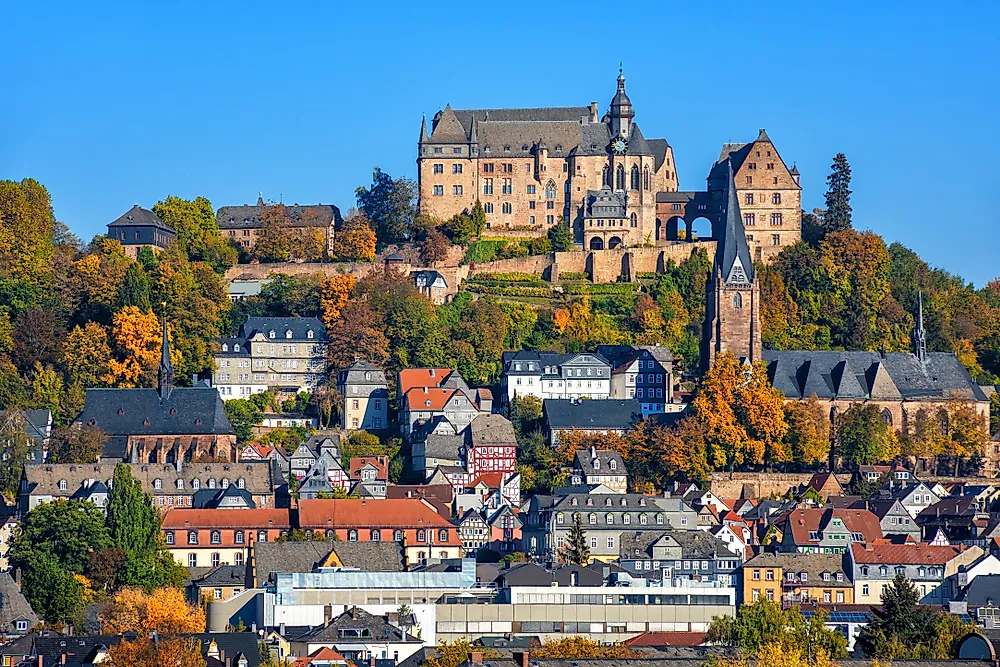
Marburg is a university town in Hessen of about 76,000 residents, dominated by the University of Marburg (founded in 1527 as the first Protestant university in the world). The town developed at the crossroads of two medieval trade routes connecting Prague with Cologne and the Alps with the North Sea. The Landgrave's Castle sits on a hill above the old town, which descends in stepped lanes of half-timbered houses to the Lahn River. The Elisabethkirche (Church of St. Elizabeth), completed in 1283, is one of the earliest purely Gothic churches in Germany and houses the shrine of Elizabeth of Hungary. Marburg is small enough to cover on foot in a weekend, and its hillside lanes are too narrow and steep for most through traffic.
Munich

Munich is Germany's third-largest city, with a population of about 1.51 million and a metropolitan area approaching 6 million. The capital of Bavaria is a major financial, technological, and academic center; companies headquartered in Munich include BMW, Siemens, Allianz, and Munich Re. Marienplatz, the central square, has been the city's commercial and civic core since 1158. The neo-Gothic New Town Hall (Neues Rathaus, completed 1909) dominates the square and houses the famous glockenspiel, which performs at 11 AM, noon, and (in summer) 5 PM. Other Munich landmarks include the twin onion-domed towers of the Frauenkirche, the surviving sections of the medieval city wall, and the English Garden, one of the largest urban parks in the world.
Nuremberg

Nuremberg is the second-largest Bavarian city after Munich, with about 525,000 residents. The city has been continuously inhabited for more than a thousand years and was one of the most important political centers of the Holy Roman Empire, where every emperor between 1356 and 1806 was required to hold his first diet. The old town within the largely surviving medieval walls includes the Imperial Castle (Kaiserburg), the houses of Albrecht Dürer (the most famous painter of the German Renaissance), and the churches of St. Sebaldus and St. Lawrence. Nuremberg also holds a heavier 20th-century historical legacy: the Nazi Party held its annual rallies here from 1927 to 1938, and the city gave its name to the postwar war-crimes trials of 1945-46. The Documentation Center at the former Nazi rally grounds and the courtroom where the trials were held are both open as historical museums.
Quedlinburg

Quedlinburg, on the northern edge of the Harz mountains in Saxony-Anhalt, is a town of about 24,000 residents and one of the most intact medieval town centers in Germany. The town was a residence of the Saxon emperors in the 10th century and a major stop on the Romanesque Road tourist route. The old town contains roughly 1,300 half-timbered houses dating from the 14th to the 19th centuries, and the entire old town and the castle hill above it have been listed by UNESCO as a World Heritage Site since 1994. The collegiate church of St. Servatius on the castle hill houses the Quedlinburg Treasury, one of the most important collections of medieval ecclesiastical art in Germany.
Regensburg

Regensburg sits at the confluence of the Danube, Regen, and Naab rivers in eastern Bavaria, with a population of about 157,000. The city has been continuously inhabited since the Roman fortress of Castra Regina was founded in 179 AD, and the Old Stone Bridge (Steinerne Brücke) across the Danube, completed in 1146, is among the oldest surviving stone bridges in Europe. Regensburg's medieval core escaped serious bombing in the Second World War and has retained its original street plan and a high concentration of Romanesque and Gothic buildings; the old town has been a UNESCO World Heritage Site since 2006. The city is the seat of the historic Thurn und Taxis princely family and hosts a major Dult fair each spring and autumn.
Rothenburg ob der Tauber

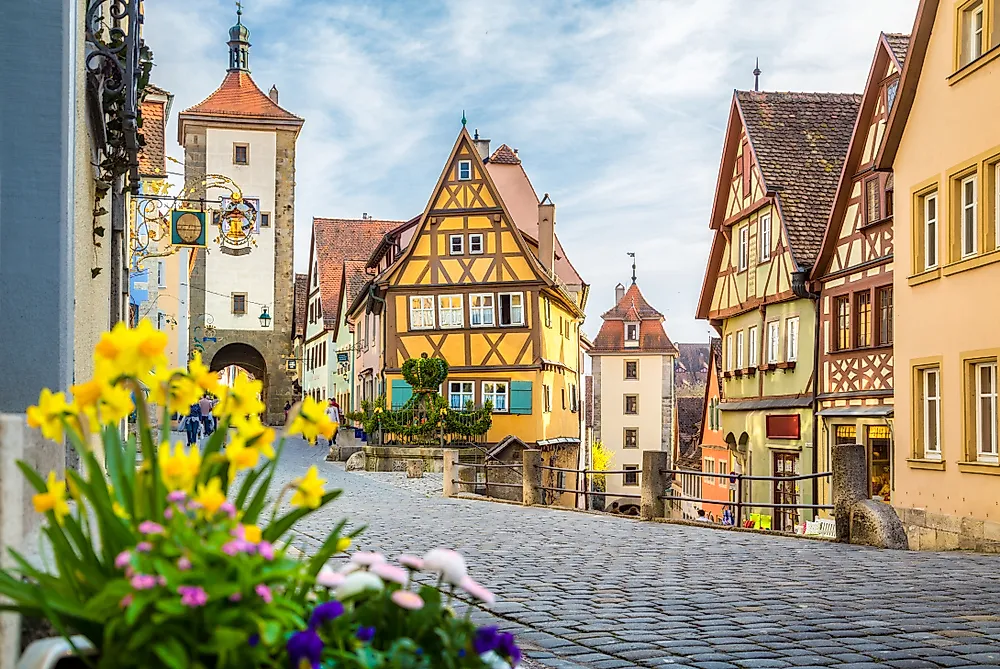
Rothenburg ob der Tauber is a town of about 11,000 residents on a ridge above the Tauber River in Franconia, roughly two hours by road from Munich. The town's full medieval wall is intact and walkable as a circuit, and the old town within it has been preserved in its 16th-century form (with restoration after a 1945 American bombing that destroyed about 40 percent of the buildings, subsequently rebuilt using historical photographs and archives). The Christmas Museum and the Medieval Crime and Justice Museum draw visitors year-round. The view from the Rathausturm (the town hall tower) gives a 360-degree panorama of the walled town and the surrounding Franconian countryside.
Tübingen

Tübingen sits on the Neckar River about 30 kilometers south of Stuttgart, with a population of about 91,000 of whom roughly a third are students at the University of Tübingen (founded 1477). The old town runs along a ridge above the river, with cobblestone alleys, market squares of half-timbered houses, and the medieval Hohentübingen Castle at the high end. The Hölderlin Tower, where the poet Friedrich Hölderlin spent the last 36 years of his life, is open as a small museum. The traditional Stocherkahn punt boats on the Neckar are the city's photographed signature, and the annual Stocherkahnrennen punt race in June is the local equivalent of a university Oxford-Cambridge rivalry. The Schwäbische Alb mountain range begins about 12 kilometers southeast of town.
What Connects These Ten
Seven of the ten cities above contain UNESCO World Heritage Sites or sit within UNESCO-listed cultural landscapes, and almost all of them have medieval or early-modern town centers that survived the Second World War either by chance (Quedlinburg, Regensburg, Bamberg-style luck of not being targeted) or by intent (Heidelberg was not heavily bombed because the US Army planned to use it as a postwar headquarters). The largest cities on the list (Hamburg, Munich, Cologne) lost large parts of their pre-war fabric in 1944-45 bombing raids and have rebuilt or reconstructed the most significant of their historic landmarks. The smallest (Quedlinburg, Rothenburg ob der Tauber, Marburg) function partly as living museums of pre-industrial German town planning, with strict preservation rules and a tourism economy that has replaced the manufacturing or agricultural base that the towns originally relied on.