The 9 Can't-Miss Towns In Illinois
Illinois keeps handing its biggest stories to its smallest towns. A tanner's son from Galena went off to win the Civil War and then the presidency. A congressman in Princeton hid freedom seekers in a compartment off his kitchen. Charles Dickens spent one night in Lebanon and wrote it into a book. Swedish farmers built a whole utopia on the prairie at Bishop Hill. These nine towns all punch far above their size, and the people who left the marks are the reason to go.
Galena

Ulysses S. Grant was working in his family's leather goods store on Galena's Main Street when the Civil War pulled him back into uniform. He came home a general and left again as a president, and the town has kept his house on the hill ever since. You can tour the Ulysses S. Grant Home State Historic Site, then spend the afternoon in the red-brick 19th-century storefronts that line the downtown. Galena sits in the Driftless Area, a pocket of northwest Illinois that the last glaciers went around instead of over, so the land here rises into steep limestone ridges and river valleys the rest of the state never got. The climb up to Horseshoe Mound Preserve opens onto a tri-state view across Illinois, Iowa, and Wisconsin. Down in town, Galena Kandy Kitchen has been pulling taffy and dipping chocolates for the road trip ahead.
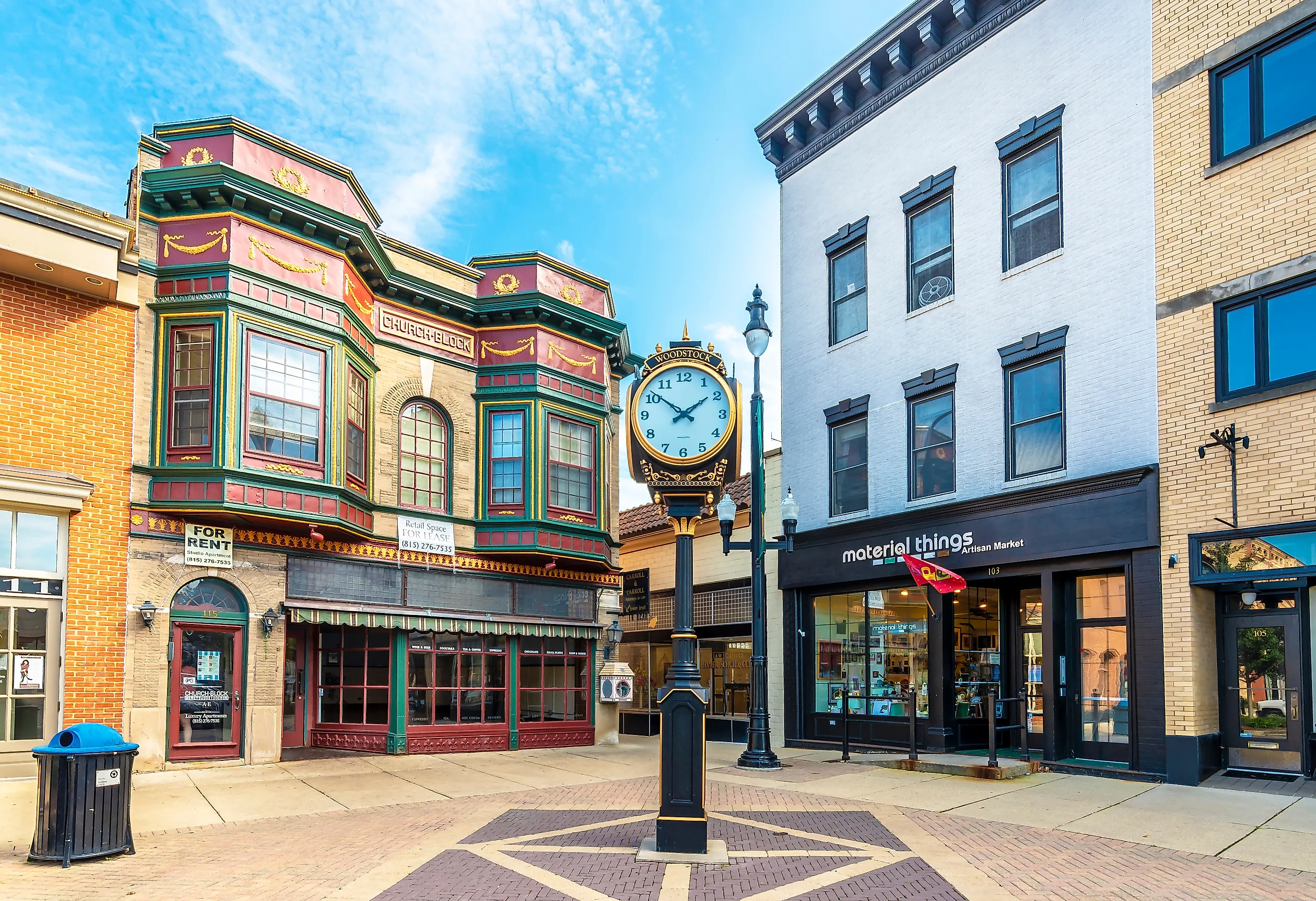
Woodstock

Harold Ramis needed a town square that could stand in for Punxsutawney, Pennsylvania, and in 1992 he found it in Woodstock. The 1993 Bill Murray comedy Groundhog Day shot here for weeks, and bronze plaques around the square still mark the spots where Murray stepped in the same puddle over and over. The square itself predates all of it, a tight late-19th-century grid built around a central park. At its head stands the 1889 Woodstock Opera House, where a teenage Orson Welles and Paul Newman both once performed and where touring companies still fill the calendar. The Dorr Woods and Dufield Ponds nearby give you restored prairie and wetland when you want the quiet.
Geneva

Colonel George Fabyan made a textile fortune and spent a good part of it on the strangest estate in the Fox River Valley. He hired Frank Lloyd Wright in 1907 to remodel the farmhouse now called Fabyan Villa, then filled the grounds with a Japanese garden, a Roman-style swimming pool, a private zoo, and a Dutch windmill. His lab here is where cryptographers William and Elizebeth Friedman got their start breaking codes. The villa and gardens are open to walk through, just south of the main strip. In town, Island Park spreads across footbridged islands in the middle of the river, and Graham's Fine Chocolates has been making its own candy and ice cream on Third Street since 1963.
Nauvoo

For a few years in the 1840s, Nauvoo rivaled Chicago as the largest city in Illinois. Latter-day Saints led by Joseph Smith built it up on a bend in the Mississippi, and after they were driven west, a group of French Icarian socialists moved into the empty houses to try a commune of their own. The rebuilt Nauvoo Illinois Temple crowns the bluff, and the flats below hold dozens of restored pioneer brick homes, blacksmith shops, and print offices worked by costumed guides. One of those Icarians, Emile Baxter, planted grapes here in 1857 and started what is now Baxter's Vineyards, the oldest winery in Illinois and still run by his descendants. Nauvoo State Park carries the walking and camping down to the water.
Princeton

Owen Lovejoy preached against slavery from a Princeton pulpit and backed it up at home, running what may have been the most important Underground Railroad station in Illinois out of a hidden compartment in his house. The 1838 Owen Lovejoy Homestead is a National Historic Landmark now, and a tour walks you through the abolitionist history and Lovejoy's friendship with Abraham Lincoln. Princeton spreads its shops along two historic districts that locals still call North Main and South Main. Three miles north stands the Red Covered Bridge, an 1863 wooden span over Big Bureau Creek that carried wagons and cars for 160 years until a truck strike closed it for restoration. For dessert, Myrtle's Cafe turns out scratch-made pie the way Bureau County expects it.
Lebanon

Charles Dickens spent the night of April 12, 1842 in Lebanon and left the town a story it has dined out on ever since. He was crossing the prairie by coach and stopped at the little Mermaid House Hotel, built in 1830 by a retired sea captain named Lyman Adams. Dickens praised the inn's cleanliness in American Notes and grumbled about the flat Looking Glass Prairie he had come to see. The building still stands on the brick-paved main street, open for tours by the historical society. Lebanon grew up around McKendree University, founded in 1828 and the oldest college in Illinois. Horner Park adds a fishing lake and a wooden bandshell a few blocks off the center.
Fulton

The Dutch settlers who arrived in Fulton in 1856 left the town a landmark it did not build until 2000. De Immigrant is a working windmill engineered in the Netherlands, shipped across the Atlantic in pieces, and reassembled by visiting Dutch millwrights right on the Mississippi flood dike. It is the only working Dutch windmill in Illinois, and its basalt stones still grind buckwheat, rye, and corn you can buy at the door. Fulton sits on the old Lincoln Highway where the road meets the river, so the Windmill Cultural Center next door fills in the immigrant history while barges push past on the water. Krumpets Restaurant and Bakery handles lunch and treats you like a regular by the second visit.
Arthur

Three families from Somerset County, Pennsylvania settled the farmland around Arthur in 1865, and their descendants made it the oldest and largest Old Order Amish community in Illinois. Horse-drawn buggies share the county roads with cars here, and more than half the state's Amish live within a few miles of downtown. The Wood Loft on Vine Street sells furniture built by local craftsmen, and Dick's Pharmacy still pours Green River sodas and phosphates at an antique marble fountain. Come at harvest, and the Great Pumpkin Patch spreads hundreds of pumpkin and squash varieties across a working family farm. Yoder's Kitchen sets out the Amish-style buffet, and the peanut butter pie is the reason to save room.
Bishop Hill

A Swedish preacher named Eric Janson led more than a thousand followers out of religious persecution and onto the Illinois prairie in 1846, and the village they raised at Bishop Hill became the seedbed of Swedish America. The colonists shared everything and built it all themselves, starting with the 1848 Colony Church, the first permanent building and still the heart of town. The Bishop Hill State Historic Site keeps the church, the Colony Hotel, and a museum of Olof Krans paintings that record daily life in the commune. The colony dissolved in 1861, but the buildings around the village park survived a century of quiet almost untouched. Swedish festivals like the September harvest days and the Lucia lights still fill the streets.
Nine Towns, Nine Long Shadows
What ties these nine together is not scenery but consequence. A leather clerk in Galena and a preacher in Princeton changed the country from towns you can walk across in ten minutes. Immigrants from Sweden, the Netherlands, France, and Pennsylvania each planted a way of life on the same flat prairie and made it stick. The reward of a trip like this is standing in the actual room where it happened, whether that is Grant's parlor, Lovejoy's hidden stair, or a windmill built an ocean away and carried here piece by piece. That is the American Midwest telling its story in its own small voice.