The 7 Can't-Miss Towns In Georgia
You can stand at the edge of a thousand-foot gorge, walk a beach full of toppled, sun-bleached trees, or pan for gold in the town that started America's first gold rush. All of it is in Georgia, and none of it is in Atlanta or Savannah. The good stuff is out in the smaller towns, some up in the mountains near Tennessee, others down on the barrier islands. Each of the seven below has one thing you will not find anywhere else in the state. Here is where to go.
Dahlonega

The first major gold rush in the United States started around Dahlonega in 1828, two decades before the strike in California, when a hunter turned up a gold-laced rock in the Lumpkin County hills. The Dahlonega Gold Museum sets out that history inside the 1836 courthouse on the town square, the oldest surviving county courthouse in the state, with a collection of coins struck at the local U.S. Branch Mint, which operated here from 1838 to 1861. A few blocks away, guides at the Consolidated Gold Mine lead tours 200 feet down into tunnels dug in the early 1900s, and creeks nearby still let visitors pan for flakes. The gold turns up again at the University of North Georgia, where the steeple of Price Memorial Hall is covered in local gold leaf. Every October, Gold Rush Days comes to the square, with a parade, panning contests, and craft vendors.
Cleveland

Grapes grow well in the hills around Cleveland, on the southern edge of the North Georgia Mountains, and six vineyards and wineries operate within reach of town. Guides at Yonah Mountain Vineyards lead tours through the barrel-aging caves, Tesnatee River Winery and Meadery is known for its honey wine, and staff at Limoges Cellars walk visitors through the winemaking process over five tasting pours. For time outdoors, the Yonah Preserve has well-maintained trails for hikers and mountain bikers, threaded past lakes, creeks, open fields, and spring wildflowers. History sits in town, too. The 19th-century Johnston Grist Mill still has its oversized wooden waterwheel, and the water turns it under the surrounding trees. Cleveland is also the home of the Cabbage Patch Kids, and at Babyland General Hospital, staff act out the dolls' births, admission is free, and the shop stocks the largest selection anywhere. On the grounds, The Gardens at Eula Springs are planted with irises, azaleas, Japanese maples, and apple trees along the walking paths.
Tallulah Falls

Tallulah Gorge cuts nearly 1,000 feet deep and runs about two miles through the northeast Georgia mountains, one of the deepest canyons in the eastern United States. On July 18, 1970, the daredevil Karl Wallenda walked a steel cable across it, a span of more than a thousand feet, and paused midway for two headstands. One of the towers that anchored his wire still stands on the north rim, and his suit hangs in the state park visitor center. Today, a suspension bridge sways 80 feet above the gorge floor, and a small number of permits each day allow the climb all the way down to the river among the waterfalls. Rim trails reach a string of overlooks for anyone who would rather stay up top, and the surrounding rivers and gorges are a favorite of hikers through the fall color season.
Calhoun

Calhoun, thirty-odd miles south of Ringgold in northwest Georgia, sits beside the ground where the Cherokee Nation ran its government. Just north of town, the New Echota State Historic Site marks the former national capital of the Cherokee, which stood here from 1825 until the forced removal of the late 1830s that became the Trail of Tears. One original structure remains among the reconstructed council house, courthouse, print shop, and homes, and a short film on the site's history plays in the visitor center. A few minutes away, The Rock Garden holds more than fifty miniature sculptures built from stone, pebbles, glass, tile, and wire. Volunteers have shaped them into castles, churches, and scaled-down versions of the Roman Colosseum and Notre-Dame, set among flower beds that show off the region's plantings.
Calhoun also has room to spread out. Two 18-hole courses, the Calhoun Elks Golf Club and the Fields Ferry Golf Club, sit near a lake where deer wander the edges. For lunch, the kitchen at Dub's High on the Hog turns out Brunswick stew, the thick Georgia standby of meat, tomatoes, and corn, with pecan cobbler on the side. The cooks at Thatcher's BBQ pair the same stew with collard greens, another dish that turns up on tables across the state.
Thomasville

The Big Oak stands at the corner of Crawford and Monroe streets in Thomasville, a live oak of about 340 years, roughly 68 feet tall with a limb span of 162 feet, the largest of its kind east of the Mississippi. Thomasville sits in the far south of the state near the Florida line and goes by the Rose City. The Rose Garden holds more than 1,500 blooms, and the Rose Show and Festival has taken place every spring since 1922. When the railroad reached the town in 1861, wealthy Northerners came south for the mild winters, and that "Winter Resort of the South" era is still visible in rows of Victorian mansions. The strangest of them is the Lapham-Patterson House, an 1885 Queen Anne home built with almost no square rooms and a staircase that wraps a double-flue chimney. Ten minutes out, the turn-of-the-century main house at Pebble Hill Plantation and its 3,000 acres are open for guided tours.
Tybee Island

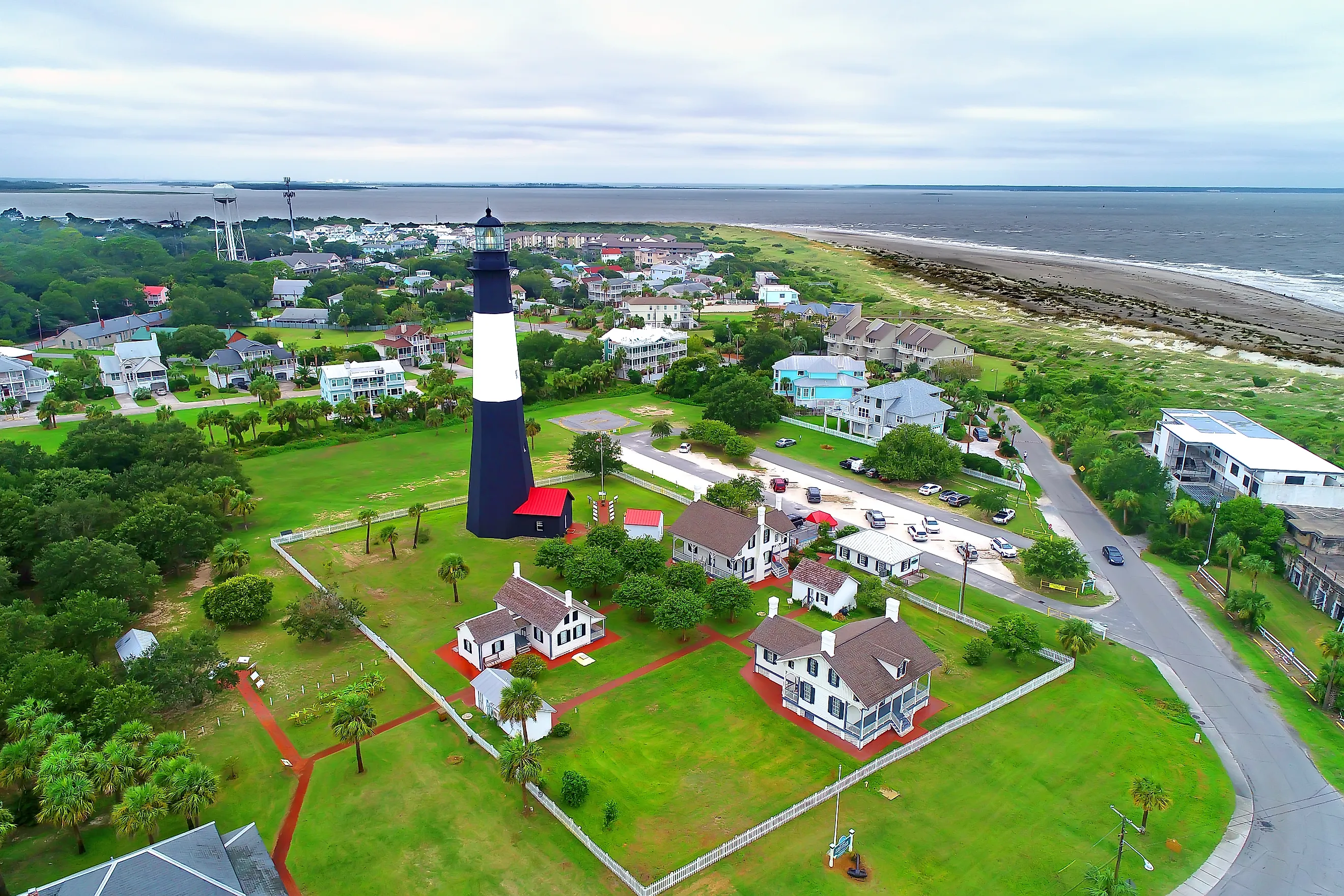
Tybee Island Light is the oldest and tallest active lighthouse in Georgia, a black-and-white tower of about 145 feet with 178 steps up to the lantern and a first-order Fresnel lens still in place. The current tower is the fourth on a station General James Oglethorpe set up in 1736 at the mouth of the Savannah River, and the climb pays off with a view straight out over the Atlantic. Tybee is a barrier island about eighteen miles east of Savannah, the easternmost point in the state, with wide public beaches along the ocean side. Near the north end, Fort Screven was part of the country's coastal defense from the Spanish-American War through World War II, and its old concrete batteries still sit along the dunes. For dinner, the cooks at The Crab Shack serve low-country boil at picnic tables over the marsh, with a lagoon of live alligators next door.
Jekyll Island

Driftwood Beach, on the north end of Jekyll Island, is a shoreline of sun-bleached oaks and pines that erosion has toppled onto the sand, some still rooted, others scattered along the tide line. Arrive at dawn and the light colors the trunks and the water behind them. Jekyll Island lies off Georgia's southeastern coast, and its landmarks cluster in a compact historic district. Faith Chapel, completed in 1904, is shingled in cypress inside and out, with gargoyles copied from Notre-Dame, an open-truss ceiling in the Gothic Revival manner, and a signed Louis Comfort Tiffany window installed in 1921. The one-hour Landmark Trolley Tour stops at the chapel along with the Jekyll Island Museum and a historic cottage. Visitors in October can catch the Shrimp and Grits Festival, a two-day event of food, live music, fireworks, and an artists' market that organizers have run for about two decades. In winter, District After Dusk comes to the downtown on a Saturday evening, with music, vendor tastings, and shopping specials.
Seven Towns, Seven Reasons
What links these towns is not a single theme but a set of specifics that cannot be swapped between them. Dahlonega and Thomasville trade on history, one a gold rush, one a Victorian resort. Cleveland and Calhoun turn on the unexpected, a doll hospital and a rock garden. Tallulah Falls holds its thousand-foot gorge, and the coast has two very different islands, Tybee with its colonial lighthouse and Jekyll with its driftwood shore. A traveler can find parks and Georgia cooking almost anywhere in the state, but the gold museum, the rock garden, and the coastal lighthouse each sit in exactly one place, and that is what makes each drive worth taking.