The 10 Biggest Cities In Alberta
Alberta is the fourth-most populous province in Canada, with an estimated 2025 population of approximately 5.04 million living across 660,000 square kilometers in the country's Prairies region. The province grew by roughly 770,000 residents between the 2021 Canadian Census and mid-2025, an increase of about 18 percent driven primarily by international and interprovincial migration. Alberta's two largest cities, Calgary and Edmonton, together account for more than half of the provincial population, and roughly 70 percent of all Albertans live in the Calgary-Edmonton Corridor, the 400-kilometer urbanized stretch of Highway 2 connecting the two metropolitan areas. The provincial economy remains built on oil and gas production, agriculture, and an increasingly diversified financial services and technology sector centered in Calgary.
The ten largest communities in Alberta by 2025 population estimate are profiled in detail below, followed by a table of the twenty-five largest places in the province. Figures cited are from the Alberta Regional Dashboard's January 2026 release of 2025 population estimates and Statistics Canada's subprovincial estimates for July 1, 2025.
1. Calgary: 1,608,000
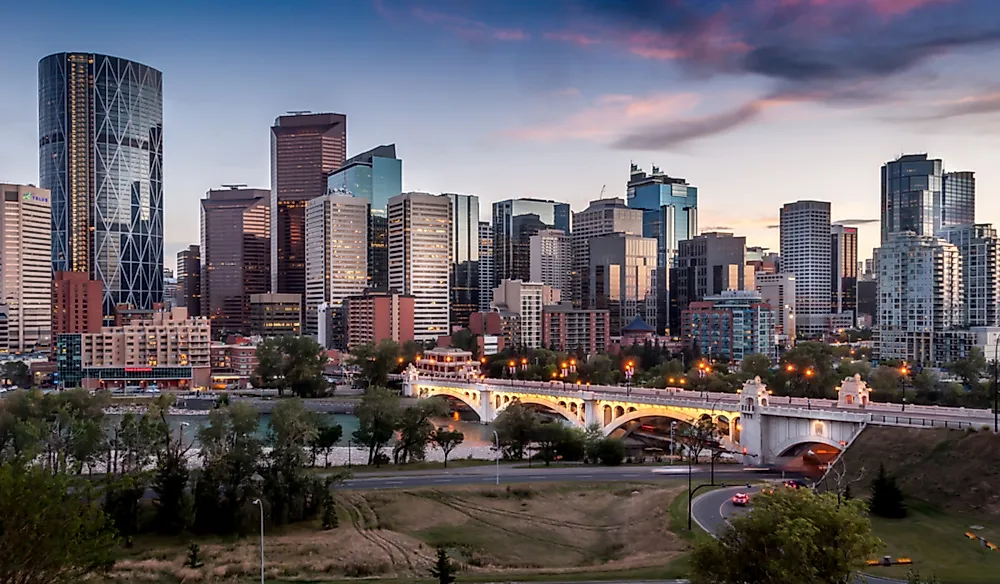
Calgary is the largest city in Alberta and the third-largest municipality in Canada, with an estimated 2025 population of approximately 1.6 million (up from 1,306,784 in the 2021 Census, a 19.4 percent increase over five years). The Calgary census metropolitan area extends to 1,836,012 residents as of July 2025, the fastest-growing major metropolitan area in Canada. The city sits at the eastern edge of the Canadian Rockies, near the confluence of the Bow and Elbow rivers, and serves as the corporate and financial center of western Canada. Calgary has the second-largest concentration of corporate head offices in Canada after Toronto, with the energy sector particularly concentrated in the downtown core.
The city hosted the 1988 Winter Olympic Games, and the Olympic Oval at the University of Calgary remains an active high-performance training center for speed skating. Calgary's largest annual event is the Calgary Stampede, a ten-day rodeo and exhibition held each July that draws over a million attendees. The city's diversification beyond oil and gas into financial services, technology, agribusiness, and renewable energy has made it one of Canada's fastest-growing major urban economies in the post-2020 period.
2. Edmonton: 1,238,295
Edmonton, the provincial capital and Alberta's second-largest city, had a Statistics Canada estimated population of 1,238,295 as of July 1, 2025 (up from 1,010,899 in the 2021 Census, an 18.3 percent increase). The Edmonton census metropolitan area extends to 1,692,385 residents, making it the sixth-largest CMA in Canada and one of the country's fastest-growing major urban areas. The city sits on the North Saskatchewan River in central Alberta and serves as the political and administrative center of the province, including the Alberta Legislature on a bluff overlooking the river valley.
Edmonton is a major hub for oil and gas refining, with the Refinery Row complex east of the city forming one of the largest concentrations of petrochemical upgrading and refining capacity in North America. The University of Alberta, a major research institution, anchors the city's educational and research sector. Edmonton is home to Fort Edmonton Park, the largest living history museum in Canada, and West Edmonton Mall, opened in 1981 and still one of the largest shopping and entertainment complexes in North America with over 800 stores plus an indoor water park, ice rink, and amusement park. The city's calendar of summer festivals, anchored by the Edmonton Folk Music Festival and the Edmonton International Fringe Theatre Festival, gives Edmonton its informal nickname as "Canada's Festival City."
3. Red Deer: 115,409
Red Deer had an estimated 2025 population of 115,409, up nearly 15,000 from the 2021 Census figure of 100,844. The city sits roughly midway between Calgary and Edmonton along Highway 2 and serves as the primary commercial center for central Alberta. Red Deer is located in the aspen parkland, a transitional ecological region between the boreal forest to the north and the open prairie to the south, and the surrounding agricultural land supports cattle, oil, and grain operations.
The city's economy combines agricultural distribution, petrochemical processing, and increasingly healthcare and education services as the regional hub for surrounding communities. Red Deer Polytechnic, formerly Red Deer College, was granted polytechnic status in 2021 and offers a mix of degree, diploma, and apprenticeship programs. The expansion of Red Deer Regional Hospital Centre and the construction of a new Justice Centre have positioned the city for continued growth through the late 2020s.
4. Lethbridge: 113,671
Lethbridge is the largest city in southern Alberta and the fourth-largest in the province, with an estimated 2025 population of 113,671 (up from 98,406 in 2021, a 15.5 percent increase). The city sits along the Oldman River roughly 90 kilometers north of the Montana border and serves as the economic, financial, and educational center for southern Alberta. The University of Lethbridge and Lethbridge Polytechnic together draw about 18,000 students to the city.
The local economy is anchored in irrigation-supported agriculture (sugar beet, potato, and grain production), food processing, transportation, and healthcare. The Lethbridge High Level Bridge, a steel trestle railway bridge spanning the Oldman River valley, was completed in 1909 and remains the longest and highest railway bridge of its type in the world at 1.6 kilometers in length and 96 meters above the river. Canadian Pacific Railway grain traffic still crosses it daily.
5. Airdrie: 92,544
Airdrie sits about 30 kilometers north of Calgary and is now Alberta's fifth-largest city with an estimated 2025 population of 92,544, having grown 24.2 percent between 2020 and 2025 to become one of the fastest-growing cities in Canada. The 2021 Census recorded Airdrie at 74,100, meaning the city has added over 18,000 residents in just four years. Airdrie is part of the Calgary census metropolitan area, and most of its workforce commutes to Calgary, though the city itself hosts a growing local commercial and light industrial base.
The community was originally established in 1889 as a Canadian Pacific Railway siding and remained a small rural town until the 1980s, when its proximity to Calgary's expanding suburbs began to drive sustained residential growth. Airdrie's population has more than quadrupled since 2001, when it was approximately 20,000, and the city is expected to surpass 100,000 residents in the late 2020s.
6. Fort McMurray: 78,632
Fort McMurray, the urban service area within the Regional Municipality of Wood Buffalo, had an estimated population of 78,632 as of April 2025, making it the largest population center in northern Alberta. The community sits at the confluence of the Athabasca and Clearwater rivers in the heart of the Athabasca oil sands, the largest deposit of bitumen in the world and the source of the great majority of Alberta's oil sands production.
Fort McMurray's economy is almost entirely structured around oil sands extraction, upgrading, and the construction and maintenance work supporting it. The community was incorporated as a city in 1980 but reverted to urban service area status in 1995 when it was amalgamated with the surrounding Improvement District 143 to form the regional municipality. Fort McMurray was the site of a devastating wildfire in May 2016 that destroyed over 2,400 structures and forced the evacuation of nearly the entire community for several weeks. The rebuilding effort continued through the late 2010s and population has gradually recovered.
7. Sherwood Park: 75,575
Sherwood Park is Alberta's largest hamlet, with a population of 75,575 according to Strathcona County's 2024 municipal census, the most recent comprehensive count for the community. The surrounding Strathcona County had a total 2025 population of 107,345, and Sherwood Park accounts for roughly three-quarters of that. The community sits immediately east of Edmonton along Highway 16 and is part of the Edmonton metropolitan area. Sherwood Park is the urban service area within Strathcona County, a specialized municipality that also includes substantial rural land outside the urban core.
Sherwood Park has remained a hamlet by deliberate choice: in a 1987 referendum, 89 percent of Strathcona County residents voted in favor of maintaining a single municipal government covering both the urban and rural portions of the county, rather than splitting Sherwood Park off as an incorporated city. The community's economy is closely tied to Edmonton's petrochemical refining sector, particularly the Alberta Industrial Heartland that hosts a major concentration of upgrading and refining facilities northeast of the city.
8. St. Albert: 74,730
St. Albert is Alberta's eighth-largest community by population and one of its oldest, with an estimated 2025 population of 74,730 (up from 68,232 in the 2021 Census, a 7.3 percent increase). The city is located on the Sturgeon River immediately northwest of Edmonton within the Edmonton metropolitan area. The community was founded on January 14, 1861 by Father Albert Lacombe, an Oblate of Mary Immaculate missionary, alongside the local Métis families who had been wintering in the area, and the settlement was named for Father Lacombe's patron saint by Bishop Alexandre Taché.
The original 1861 Father Lacombe Chapel is generally considered the oldest surviving building in Alberta and now stands as a provincial historic site on Mission Hill, where it was relocated in the early 1980s. The mission settlement served as a refuge for some 700 Métis and First Nations people during a devastating smallpox epidemic in 1870 and was, for a time, the largest Métis community in western Canada. The modern city has developed primarily as a residential suburb of Edmonton, with most of its workforce commuting into the larger city.
9. Grande Prairie: 71,160
Grande Prairie sits in Alberta's far northwest, approximately 460 kilometers northwest of Edmonton, with an estimated 2025 population of 71,160 (up from 64,141 in 2021). The city is the regional service center for the Peace River country, an agricultural and resource extraction region that extends into northeastern British Columbia.
Grande Prairie's economy combines oil and gas production (particularly the Montney and Duvernay shale plays), forestry (lumber and pulp processing), agriculture (grain, canola, and cattle), and transportation as the hub for the surrounding Peace region. The city's significant distance from larger urban centers makes it one of the most economically self-sufficient communities of its size in the province, with its own regional hospital, post-secondary institution (Northwestern Polytechnic), and air service to Edmonton, Calgary, and Vancouver.
10. Medicine Hat: 68,714
Medicine Hat in southeastern Alberta had an estimated 2025 population of 68,714 (up from 63,271 in 2021) and is one of Canada's sunniest cities, averaging over 2,500 hours of sunshine annually. The city sits along the South Saskatchewan River in the heart of southern Alberta's natural gas country, and the local utility, Medicine Hat Utilities, has historically owned its own natural gas wells, making the city unusual among North American municipalities in operating its own production-to-distribution gas system.
The city was established in 1883 as a Canadian Pacific Railway construction siding and grew rapidly after the discovery of the local natural gas field that has powered the regional economy for over a century. Author Rudyard Kipling visited Medicine Hat in 1907 and famously described the city as having "all hell for a basement" in reference to the vast natural gas reserves beneath it, a phrase that has become a regional motto. The city's economy combines energy production, manufacturing, agriculture, and increasingly healthcare and education.
The 25 Largest Places in Alberta by Population
| Rank | Place | Population (2025 estimate) | Status | Region |
|---|---|---|---|---|
| 1 | Calgary | 1,608,000 | City | Calgary Metro |
| 2 | Edmonton | 1,238,295 | City | Edmonton Metro |
| 3 | Red Deer | 115,409 | City | Central |
| 4 | Lethbridge | 113,671 | City | Southern |
| 5 | Airdrie | 92,544 | City | Calgary Metro |
| 6 | Fort McMurray | 78,632 | Urban Service Area (Wood Buffalo) | Northern |
| 7 | Sherwood Park | 75,575 | Urban Service Area (Strathcona County) | Edmonton Metro |
| 8 | St. Albert | 74,730 | City | Edmonton Metro |
| 9 | Grande Prairie | 71,160 | City | Northern |
| 10 | Medicine Hat | 68,714 | City | Southern |
| 11 | Spruce Grove | 44,575 | City | Edmonton Metro |
| 12 | Leduc | 39,966 | City | Edmonton Metro |
| 13 | Cochrane | 39,397 | Town | Calgary Metro |
| 14 | Okotoks | 33,482 | Town | Calgary Metro |
| 15 | Chestermere | 31,671 | City | Calgary Metro |
| 16 | Fort Saskatchewan | 30,575 | City | Edmonton Metro |
| 17 | Beaumont | 26,305 | City | Edmonton Metro |
| 18 | Lloydminster (Alberta portion) | 21,267 | City (border with Saskatchewan) | Central |
| 19 | Camrose | 20,801 | City | Central |
| 20 | Stony Plain | 19,662 | Town | Edmonton Metro |
| 21 | Sylvan Lake | 17,897 | Town | Central |
| 22 | Cold Lake | 17,815 | City | Northern |
| 23 | Brooks | 17,537 | City | Southern |
| 24 | Canmore | 17,341 | Town | Rocky Mountains |
| 25 | Strathmore | 16,416 | Town | Calgary Metro |
Source: Alberta Regional Dashboard (Alberta Treasury Board and Finance), 2025 population estimates updated January 16, 2026; Statistics Canada subprovincial population estimates for July 1, 2025, released January 14, 2026. Sherwood Park figure is from Strathcona County's 2024 municipal census, the most recent comprehensive count for that community. Fort McMurray figure is the April 2025 Statistics Canada estimate.
How Alberta's Urban Geography Compares
The concentration of Alberta's population in the Calgary-Edmonton Corridor has accelerated dramatically since 2021, driven by the largest interprovincial migration wave in the province's history. The Calgary census metropolitan area grew by 19.2 percent between 2021 and 2025 (adding nearly 296,000 residents), and the Edmonton CMA grew by 14.9 percent. The fastest-growing individual communities in the same period were nearly all suburbs of the two major cities: Chestermere grew 41.9 percent, Beaumont 27.9 percent, Airdrie 24.2 percent, and Cochrane 22.8 percent. Outside the Corridor and Fort McMurray, Alberta's population is broadly distributed across smaller communities, including 105 incorporated towns and over 280 unincorporated places. The next Canadian Census is being conducted in 2026, with detailed municipal-level data scheduled for release in 2027. Statistics Canada projects Alberta's population will surpass 5.1 million by mid-2026 if current growth trends continue.