9 Picture-Perfect Main Streets In California
Some of the best California main streets run at the ocean and end at the water's edge. Laguna Beach lets Forest Avenue drop its cars and spill onto the sand. Pismo Beach carries Pomeroy Avenue clear off the land and onto a 1,200-foot pier. On Catalina Island, the main drag greets you at the boat dock. These nine streets are worth the drive.
Laguna Beach

A classic sign that you have struck Main Street gold in a California coastal town occurs when you find a central street with car-restricted sectors that make room for foot traffic. That street in Laguna Beach is Forest Avenue. You can tell city planners keep pedestrians, vendor booths, and markets in mind because the final leg of Forest Avenue is closed off to automobiles in the last block before the beach, operating purely as a pedestrian walk. This area is known as the Forest Avenue Promenade, where you can shop, stroll, eat, drink or lounge before heading to or after coming back from a day at the beach.
The weekend farmer's market is another Main Street jackpot on the California coast. The Laguna Beach Farmer's Market runs every Saturday at 521 Forest Avenue, just a few blocks from the beach. Another highlight here is the Laguna Beach Cultural Arts Center (LBCAC), located at 235 Forest Ave, almost right in the middle of the Promenade. Laguna Beach has a solid reputation as a town friendly to the arts, and the LBCAC is proof as a permanent fixture here on the main street. And for a solid eating establishment with a proven track record, try 230 Forest Avenue, a popular restaurant for over 30 years in Laguna, named for its physical address, and located directly across the promenade from the arts center.
Carpinteria

Sometimes Main Street is a wider avenue than other streets in a town, often called a "strip." In Carpinteria, just over 10 miles south of Santa Barbara, that strip is the palm-lined Linden Avenue, which runs a full half-mile from the main downtown intersection to Carpinteria City Beach (billed locally as the "World's Safest Beach"). A pedestrian walk on this tee-up to the Pacific takes 8 to 10 minutes, but there is plenty to take in along the way if you want to make a day of it. Linden Square is a good place for shopping, lunch, and refreshment at 700 Linden Avenue, housing multiple venues.
The California Avocado Fest, a decades-long tradition, is one of the most exciting events of the year, and it takes full advantage of Linden Avenue's breadth and pedestrian-friendly layout. The festival hosts dozens of bands featuring live music, and every possible manifestation of the avocado during the fall harvest season: baskets of raw fruit, mountains of guacamole with chips, avocado ice cream, and more. There is also a Pacific Surfliner Amtrak Station right off Linden Avenue just before you reach the beach, making a handy connector to other spots along the coast via this popular passenger train, which runs 351 miles between San Diego and San Luis Obispo.
Carmel-by-the-Sea

California is full of poetic town names, and Carmel-by-the-Sea is among the best. There is a strong argument that Ocean Avenue is the Main Street of Carmel. This downtown also stands out for an additional series of blocks known jointly as the Golden Rectangle, roughly one square mile representing the best of Carmel's showcase homes, businesses, and hot spots. Carmel is a must-have on any tour of California's most photogenic main streets. Ocean Avenue makes up the northern band of the Golden Rectangle and leads right out onto Carmel Sunset Beach.
By following the beach walk to the south, you can make an easy loop, hiking the Golden Rectangle for morning or evening exercise, hunting for shells, shopping, people watching, and wine tasting. Then turn back east at Santa Lucia Avenue and north along Junipero Street, making a full circuit of the Golden Rectangle. Carmel-by-the-Sea has also been a go-to for film stars like Clint Eastwood, who was elected mayor of the town for a single term running from 1986 to 1988. While living in Carmel, Eastwood renovated the historic Mission Ranch into a popular hotel with a restaurant, piano bar, and tennis courts. There is a lot to do and see here. If you are in town on the second Saturday, don't miss the Carmel Art Walk, when participating downtown galleries hang a blue lantern out on the shopfront from 4 to 7 pm.
Pismo Beach

Another distinctive feature of California main streets is that the road often leads right out onto a pier into the ocean. In Pismo Beach this happens on Pomeroy Avenue, which makes an odd "dog leg" turn over to the Pismo Beach Pier and Promenade, the ultimate extension of downtown activity. This pier is exceptionally large at 1,200 feet, with four periodic diamond-shaped platforms that create a series of 30-foot-wide expansions for public activity, making it the longest pier in San Luis Obispo County.
Visit during the annual Clam Festival, a Pismo Beach tradition since 1946, which starts at 100 Pomeroy Avenue and then filters over toward the pier with activities like a clam chowder cook-off. There is an actual Main Street in downtown Pismo Beach, just one street over from Pomeroy. However, the real locus of activity evolved along Pomeroy as it segues into the pier and Promenade. It is also worth noting a convergence here of two highways that run parallel to the coast: the Pacific Coast Highway (PCH) and Highway 101. These two roads slow down in Pismo Beach through a series of intersections in the heart of downtown, gathering more business and tourist attractions. Try the Cool Cat Cafe for a burger at 198 Pomeroy, then walk across Cypress St. to Harry's Night Club and Beach Bar after the sun goes down.
Eureka

As time goes by, towns sometimes grow more complex even when they stay modest in size, and Eureka is one of them. It is not always obvious on arrival where the original center of activity sat, until you discover 2nd Street in the Old Town district. Where 2nd crosses F Street is the historic epicenter, home to many examples of classic Victorian architecture from the late 1800s. At the northern end of 2nd St, where it ends at M Street, you can view the Carson Mansion, often called the finest Queen Anne Victorian home in America, with its eccentric green coloring, now home to the Ingomar Club.
The Eagle House is another classic Victorian building on 2nd St worth exploring, and there are many others. Eureka is more of a port city than a beach town, but it runs parallel to Humboldt Bay as it empties into Arcata Bay along a connector called the Inner Reach. Parallel to 2nd St, the waterfront views of 1st Street give downtown overflow crowds room to enjoy recreational events and mingle in spread-out spaces and parks. The Boardwalk runs right along the water and leads up to the Eureka Aquatic Center, where you can rent canoes and kayaks. Eureka also has a thriving Eureka Main Street branch of the Main Street America civic organization, dedicated to improving downtowns all over the country.
Sausalito

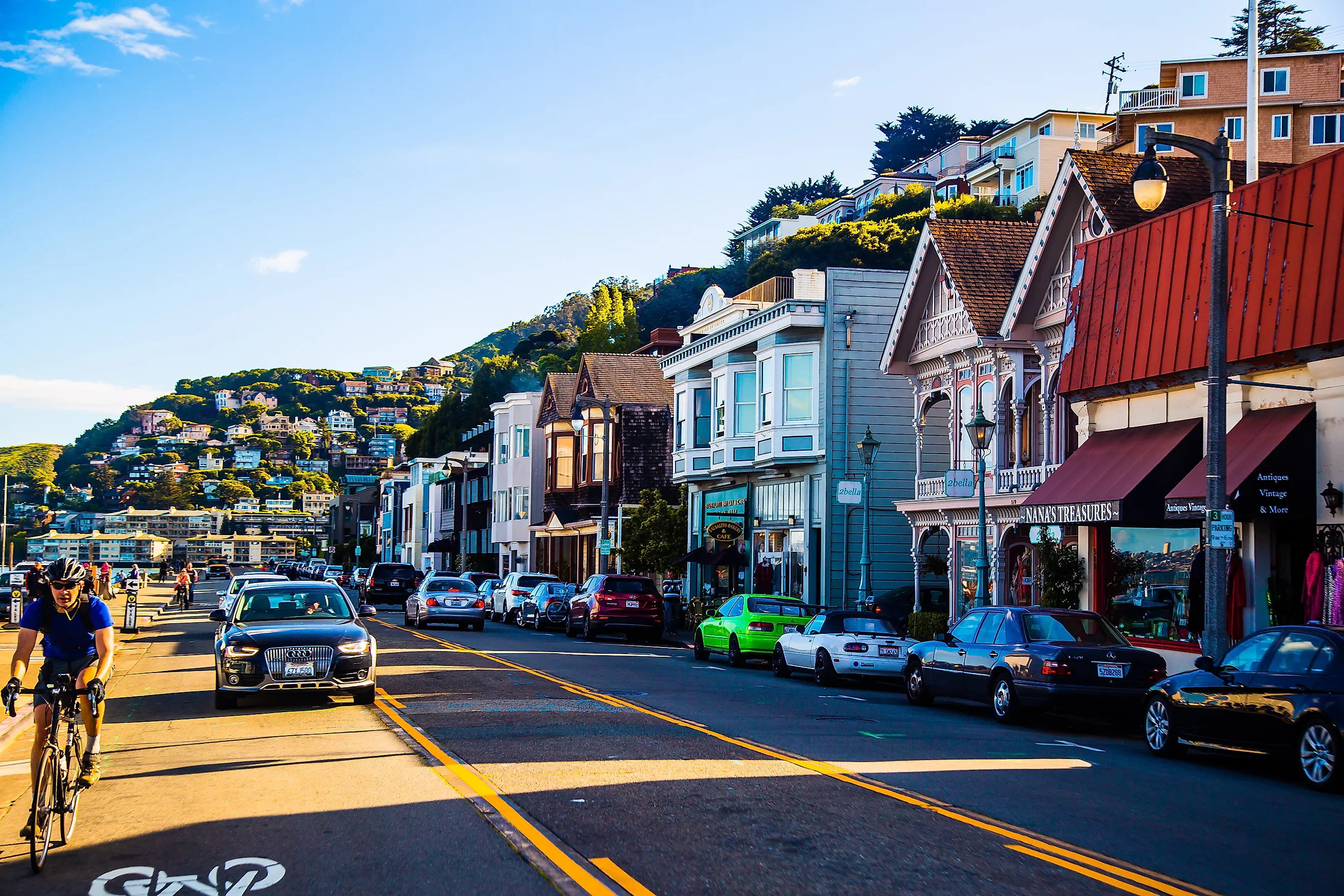
The Bridgeway Promenade is the main thoroughfare in Sausalito, and it delivers views of colorful buildings, houseboats docked nearby, art galleries, curiosity boutiques, shops, and restaurants. Sausalito is where you end up right after crossing the Golden Gate Bridge to the north, about 4 miles above San Francisco proper. The water view here is San Francisco Bay looking directly at the city, which makes for a memorable setting for dining at venues such as The Spinnaker.
As Bridgeway continues south, follow the Sausalito Boardwalk further along for more water and nature views. Sausalito was incorporated in 1893 and was originally an artist's retreat and boating getaway. The Sausalito Center for the Arts at 750 Bridgeway anchors a walkable stretch of public art in the parks, plus at least a dozen active galleries in this small town of just over 7,000 people. Consider hopping on the Sausalito Ferry for a trip over the bay and back.
Monterey

Monterey is another town with many layers, a fascinating history, and a modest but lively size of just under 30,000 inhabitants. It has preserved the classic California coastal town feel, and it too can claim an "Old District" in the center of downtown, named Old Monterey. The National Trust for Historic Preservation identified Monterey as an exemplary "Main Street Community." Monterey used to be a center of the sardine industry, when fish canneries exploded there in the early 20th century, especially during and after World War I, now refurbished as Cannery Row, a historic waterfront district.
Monterey rises from the large bay in sectors of different economic activity. Once you have found the central path to Old Fisherman's Wharf and Monterey State Historic Park, you have zeroed in on the vintage heart of downtown, where Alvarado Street offers the best glimpse of main street magic. This is where the string lights in the trees begin glowing at dusk, while visitors and residents celebrate the local culture through dining, shopping, and activities like the weekly Old Monterey Marketplace (Farmer's Market), held every Tuesday.
Avalon

Avalon is a special case, completely surrounded by water on Santa Catalina Island, 22 miles off the coast. Here the primary drag is a strip called Crescent Avenue, the only example on this list of a Main Street right on the waterfront, since the primary traffic into town arrives by boat. Again we see a convergence of the Promenade with Main Street, a feature noted in many coastal California towns. About 3 square miles in size, Avalon has a permanent population of just under 3,500.
First reached by Spanish explorers in the 16th century and popular during the late 19th century for fishing expeditions, Avalon was developed into a vacation destination by American entrepreneur William Wrigley, Jr. (founder of Wrigley chewing gum) beginning in 1919. The Catalina Casino was completed in 1929 by Wrigley's son, Philip Wrigley, and is the most striking building on the island, a fine example of Art Deco architecture. Wrigley never intended the Catalina Casino to be a place of gambling, but used the term in its original Italian sense of "a gathering place." Today it remains a top event venue with a ballroom, and it houses the vintage Avalon Theater for movie showings. Make sure to explore the Green Pleasure Pier for a better view of Avalon Harbor and a good vantage for photos of this coastal town.
Half Moon Bay

Half Moon Bay stands out for its cliffside views of the Pacific. Main Street here is actually called Main Street, which makes it a fitting final stop. It runs parallel to the coastline, following the flow of traffic along the Pacific Coast Highway (Hwy 1), which continues up to San Francisco, just 30 miles north. Half Moon Bay got its name in 1874 from the crescent shape of the bay, after first being called San Benito and then Spanishtown. It began as a Spanish agricultural settlement tied to the Catholic mission in San Francisco, and later developed a fishing industry around Pillar Point Harbor as American pioneers migrated west during the 1800s. Main Street here has three distinct sectors: Heritage Main Street, South Main Street, and North Main Street.
A lot of recent effort has gone into historic preservation and maintaining the vintage feel of this town. Some of the more remarkable early buildings worth checking out are the San Benito House at 356 Main St., now a popular inn with a public cafe and bar, and the Half Moon Bay Feed and Fuel Co. at 331 Main St, a classic general farm-supply store dating back to 1911. The most popular annual event here for over 50 years has been the Half Moon Bay Art and Pumpkin Festival, held in the downtown during the middle of October each year, at pumpkin harvest time.
Main Street Is Often In Old Town
Across these nine towns, one pattern holds: the most photogenic main street usually sits in an older, original historic district, even when that is not obvious the moment you arrive. That connection to an earlier period is what gives these streets their pull, a time when townspeople knew each other and local owners ran businesses within a small sphere of blocks. The drive to preserve Main Street keeps that sense alive, treating the street as the center of civic and cultural life, whatever its name happens to be. It is a reminder that the most memorable California downtowns were built at a walking pace, and they still reward anyone willing to slow down to it.