9 Off-The-Beaten-Path Towns In Utah
Utah's off-the-beaten-path towns lie far from the state's major population centers and busiest national parks, often on the edge of less-developed public lands. Their identities are shaped by mining, pioneer architecture, and local arts, evident in Helper's restored downtown and Spring City's blocks of 1880s pioneer buildings. Small museums also preserve that heritage, including the dinosaur skeletons in Castle Dale's Museum of the San Rafael and the river-running exhibits at Green River's John Wesley Powell River History Museum.
Just outside each one lie some of the least-crowded landscapes in Utah, like the hoodoos of Goblin Valley near Hanksville and the 1.9-million-acre Grand Staircase-Escalante beyond Escalante. These nine towns show why the most memorable places are often found well beyond the usual route.
Helper

Helper is a small town with a complex mining history that intersects with its arts community. Despite its relatively small population of around 2,100, its reputation as an arts community is growing each year thanks to numerous local activities and events. The Helper Arts Festival, held each August, brings live music, artist booths, and live painting demonstrations to Main Street.
The mountains and cliffs surrounding Helper contribute to its identity as well. Gordon Creek Falls Trail follows a 2.3-mile route through the canyon landscape before reaching the falls. Most hikers complete it in 30 minutes to an hour.
The Helper Museum occupies a restored downtown building and documents the railroad and mining industries that once sustained the town. Its exhibitions and oral histories cover local life during the 20th century.
Spring City

Home to about 1,100 residents, Spring City preserves one of Utah's most intact collections of pioneer-era architecture against the backdrop of the Sanpete Valley. The buildings date to the 1880s, and nearly all of them follow traditional patterns. Some are reminiscent of Scandinavian architecture, while others follow Pattern book styles of the late 1800s. The town offers tours of some of the historic home.
Spring City also has a thriving arts community. There are numerous galleries on Main Street, including Spring City Arts & Art Gallery and The Highland Gift Shop and Gallery. Horseshoe Mountain Pottery is also nearby and sells stoneware mugs and bowls.
Spring City Heritage Day is held toward the end of May every year. There is a craft market, live music, and food trucks.
Garden City

Garden City lies along the turquoise waters of Bear Lake, though a year-round population of about 940 makes it far quieter than its summer reputation suggests. The lake's striking blue-green color comes from suspended limestone particles rather than any tropical origin. The surrounding valley's identity is rooted in raspberry farming, a crop that took to the high-altitude climate generations ago.
Some of the town's most distinctive traditions surface in the off-season. Bear Lake is home to the Bonneville cisco, a small fish found nowhere else on Earth, which locals dip-net through the ice each January during a cold-weather gathering known as the "Cisco Disco." The same stretch of winter brings the Bear Lake Monster Winterfest, built around a lake-monster legend that traces back to an 1868 newspaper account.
In the former settlement of Pickleville, since annexed by Garden City, the pine-log Pickleville Playhouse has staged homespun melodramas and musical comedies each summer since 1977. When the raspberry harvest peaks, the town hosts Bear Lake Raspberry Days each August, a few days of vendors, a parade, and the region's celebrated raspberry shakes.
Castle Dale

Castle Dale is a sometimes overlooked, quiet town best known for its proximity to climbing areas, backcountry landing strips for recreational aviation, watersports, and geocaching. For a town of only 1,550 people, there is a lot to do. Recreation options also include mountain biking on the Good Water Rim Trail, considered one of the best riding trails in the state.
Castle Dale also served as an early educational center for this region of Utah. Emery Stake Academy, for example, opened in 1889 as the region's first high-school level educational institution.
The Museum of the San Rafael is also in town. It focuses on the region's prehistoric past through dinosaur exhibits, including the skeletons of Albertosaurus and a T. Rex skull.
Green River

Green River is a desert town along the Green River that offers access to river sports, desert recreation, and museums. The main historic landmark in town is the John Wesley Powell River History Museum. It's on the shores of the Green River and focuses on the Colorado River system, river running, and local geology and paleontology.
Crystal Geyser is one of the area's most distinctive landmarks. It's a cold water geyser near town that's regarded as partially human-made. It goes off sporadically, sometimes every hour, sometimes it's more than a day between eruptions.
Green River also hosts Melon Days, a celebration of the town's famous melons and many farming families. It's been ongoing for 120 years and takes place in September.
Hanksville

Hanksville is truly an off-the-beaten-path small town in Utah, located at the junction of State Routes 24 and 95 and surrounded by sparsely developed desert. The town developed around agriculture and mining, industries that continue to contribute to the local economy. Access to boating, rock climbing, and sightseeing is available in the surrounding parks.
Goblin Valley State Park is about 30 minutes from Hanksville and is a remote park in the San Rafael Desert known for its thousands of hoodoos. One of these hikes is called The Goblin's Lair. It's a 2.3-mile trail that is on the eastern boundary of the park. It traverses the beautiful desert landscape and leads to a large slot canyon.
Hollow Mountain reflects Hanksville's role as a remote highway town. It was built into an excavated sandstone hill beside the junction and has been a convenience store supplying food, fuel, and other necessities since the 1980s.
Escalante

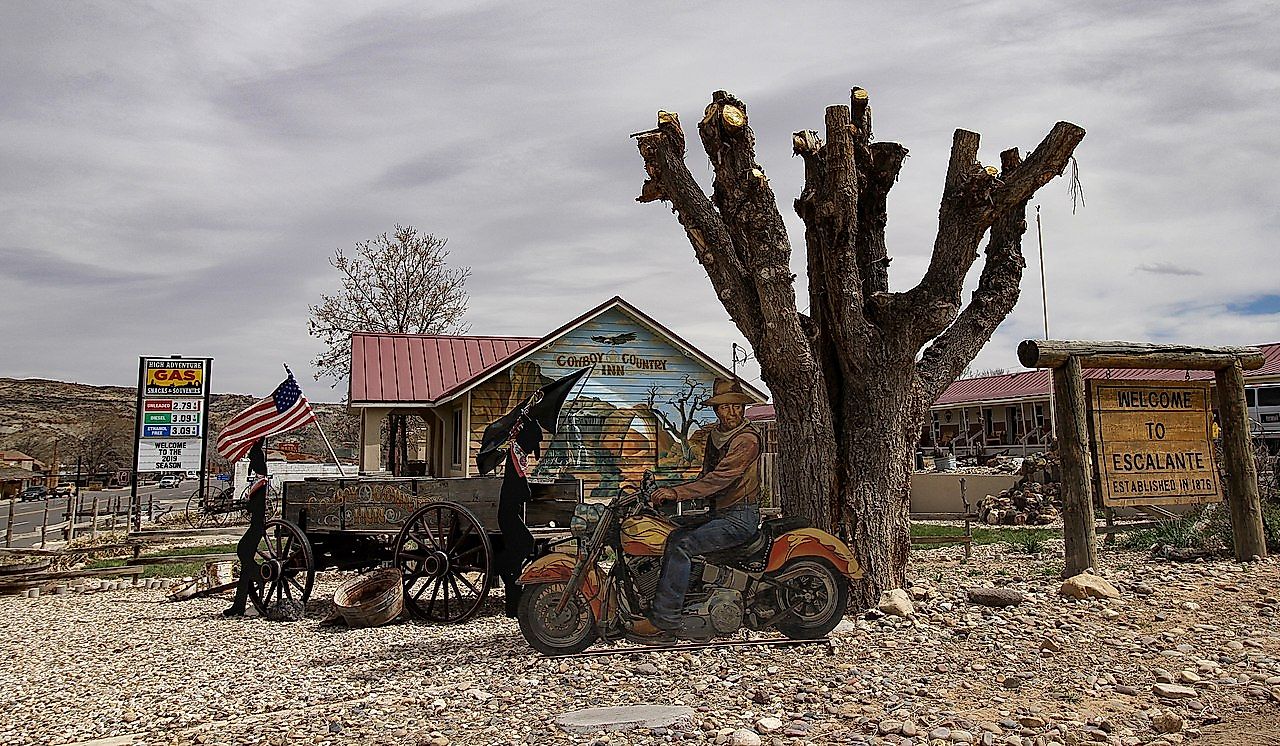
Escalante is a Southern Utah town near Grand Staircase-Escalante National Monument that was settled in the 1870s. Its historic district features preserved buildings and streets that are connected to the town's pioneer history. The Escalante Heritage Center focuses on the town's settlement. There are self-guided walking tours of the historic district where you learn more about the town's early development.
Grand Staircase-Escalante National Monument is only a six-minute drive from town and is home to a sweeping 1.9-million-acre expanse of slot canyons, prehistoric sites, and desert hiking trails.
Just five mintues away is a local geological wonder, the Escalante Petrified Forest State Park. The Petrified Forest Trail follows a one-mile loop through juniper forests and lava flows.
Torrey

Broken Spur Inn and Steakhouse in Torrey, Utah.
With fewer than 500 residents, Torrey is a compact arts and dining community in a remote part of southern Utah. Independent restaurants, stores, and galleries fill the town center, with the Torrey Gallery specifically displaying work by regional artists.
Compared with Utah's larger national park towns, Torrey retains its small-scale character, something that's shaped by its isolated desert setting. It has access to quiet trails and overlooks that contrast with the more popular trails in this part of the state. Local trailheads lead into the surrounding red-rock landscape, while limited development preserves expansive nighttime views of the stars.
Bluff

Views of the stone formation called Twin Rocks and the Twin Rocks Cafe in Bluff
The very small town of Bluff, Utah, is located along the San Juan River and is often associated with the surrounding high-desert rock formations. Bluff Fort is perhaps the most-often-visited local landmark. Established in 1880, the historic site is now a museum that showcases the town's pioneer history and the arduous travel of the 1800s.
To see the landscape, head down to the San Juan River and join in on a rafting expedition, hosted by Wild Expeditions. Canyoneering and hiking trips are also available.
Where Utah’s Lesser-Known Stories Live
These towns sit beyond Utah's largest population centers and resort hubs. But distance is only part of what makes them off the beaten path. Mining, farming, and regional arts are interpreted through small museums, historic districts, and festivals rooted in local life. The communities are modest in size, and their traditions and surrounding landscapes reveal parts of Utah that aren't available in the larger cities.