9 Ireland Towns Where Time Stands Still
Ireland’s green hills and coastlines are home to historic towns like Kinsale, where visitors can still explore Charles Fort, a star-shaped fortress that overlooks the harbour. Cobh offers an authentic Titanic experience with its original White Star Line ticket office. In Cong, visitors can still visit the ruins of the 12th-century Cong Abbey. In the following towns, including the aforementioned, you will find yourself transported back in time, even as you enjoy many modern creature comforts.
Kinsale, County Cork

Pretty Kinsale was once a medieval fishing port and became a mainstay in Irish history after the Battle of Kinsale was fought here in 1601. After the war, the town was a British naval base before it transformed into the tranquil coastal town it is today. Visitors can take the Scilly Walk, starting in Kinsale itself, to Charles Fort, which is one of the largest military installations in Ireland. The structure is built in the shape of a star, and some of its outer walls are up to 16 meters high. It is possible to walk the ramparts to enjoy the views of Kinsale Harbour. In town, there are colourful houses to admire that line the streets that lead to the mouth of the River Bandon. Visitors can watch the fishing boats and sailboats in the harbour before heading out on a heritage walk with Kinsale resident Dermot Ryan. Ryan is exceptionally well-versed in Kinsale’s history and helps visitors visualize nearly 1,000 years of settler adventures, the Battle of Kinsale, and the Lusitania disaster.
Cobh, County Cork

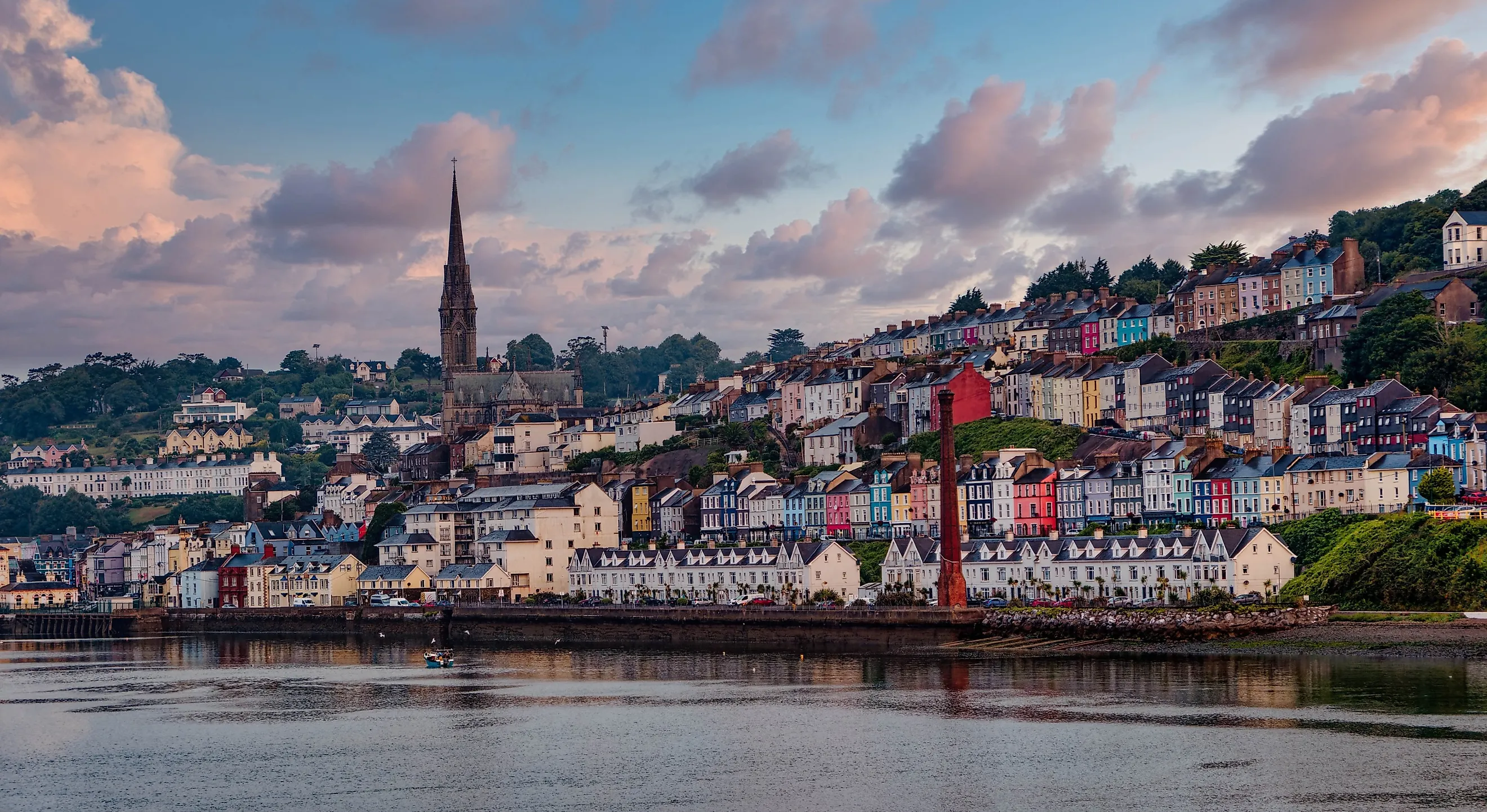
For a long time, Cobh was known as Queenstown. It was the main port where millions of Irish citizens set sail for America. The town is also famous as the last port where the Titanic picked up its final 123 passengers in 1912 before heading out to sea and towards its inevitable demise. Visitors can relive some of Cobh’s Titanic history at the Titanic Experience, where they can see the White Star Line Ticket Office and watch the sinking in ‘real time’ thanks to audio-visual magic. There is also the Titanic Trail to explore, which passes St. Colman’s Cathedral, one of the most gorgeous cathedrals in Ireland. The church features neo-Gothic architecture, stained glass windows, and the largest carillon in the country. In front of the Cathedral stands the ‘deck of cards’, which is a row of very bright painted houses that sit along an incline. And those who want to see just how time stands still in Cobh can head to the Cobh Heritage Center to learn all about the history of the area, dating back to the 1600s.
Adare, County Limerick

The Earl of Dunraven planned Adare’s layout in the 1800s, but the town’s roots date back to medieval times, when monks built abbeys along the local river. Visitors in 2026 can discover more about these times at the Adare Heritage Center, before walking the village to see the Trinitarian Abbey and charming cottages. The cottages sit on Main Street and were built by the Caroline Countess of Dunraven in the 1830s. The Abbey was built in 1230 and is the only church of the Trinitarian order in the country. The Augustinian Priory stands on the banks of the Maigue River, where there is also a trailhead that leads along the river. The trail begins at the Heritage Center, and walkers can choose to walk to the railway bridge or the Abbey to get to the river. Those who plan to stay for a bit can book a fancy room at the historic Adare Manor and enjoy a fantastic golf course and a Michelin-starred restaurant.
Clifden, County Galway

A local landlord built Clifden from scratch in the early 1800s. His goal was to bring business and life to the remote Connemara countryside. The result was a thriving town that played a major role in the advent of radio communication. People who want to visit Clifden today can take the Wild Atlantic Way and make their first stop Clifden Castle. This stunning building dates to 1818 and looks like something from a fairytale with its overgrown walls. Visitors can also detour to the Marconi Radio Station, just off the Wild Atlantic Way. The station was built in 1907 and was the first transatlantic wireless transmission service in the world. From here, visitors can make their way to Clifden Bay to take a walk out to Omey Island (this takes around 3 hours). Or, they can opt for a hiking adventure at Diamond Hill in Connemara National Park. This hike ends with magnificent views of the famous Twelve Bens Mountains.
Dingle, County Kerry

Dingle was a bustling trading hub in the Middle Ages and served as a hub for trade with continental Europe. The town sits in a region where Irish is still spoken today, and it has managed to keep its traditional music and maritime culture alive for many centuries. Most travellers choose Dingle as a destination for one of two reasons. They either want to explore the town’s history or see the locations used to film Star Wars scenes. Those who prefer history head to Minard Castle. The castle features prominently in the town’s history and was also the backdrop for some of the scenes of Ryan’s Daughter. Visitors who prefer to see the Star Wars filming locations take Slea Head Drive to see Sybil Head, where the scenery is instantly recognizable. Other things to do in Dingle are to explore the Dingle Peninsula or hit a hardware pub that offers wellies and beer.
Inistioge, County Kilkenny

After an Augustinian priory was built near a natural crossing point on the River Nore, Inistioge was established in the 1200s. It took on its current shape in the 18th century, when it became a village linked to a nearby estate. Visitors are drawn to the 10-Arch Stone Bridge that dates back to the 18th century. This limestone bridge, with its ten arches, connects the two sides of the valley the town lies in and spans the River Nore. Above the town, the Woodstock House & Gardens sit on the hills, allowing visitors to explore restored Victorian gardens, an arboretum filled with exotic trees, and a red-brick conservatory. In the town itself, the Inistioge Village Green features Georgian and Victorian townhouses painted in bright colors. Visitors can also see the ruins of the aforementioned Augustinian priory at the nearby St. Mary’s Church.
Cong, County Mayo

Cong sits between two big lakes and grew around a 7th-century monastery. This tiny town became world famous in 1952 as the main filming location for John Wayne’s The Quiet Man. Visitors can see the Cong Abbey that sits on the grounds of the aforementioned monastery. The site also includes the monks' fishing house on the River Cong, where the monks once sat beside the fireplace waiting for fish to swim into a net they span below a trap door. Those who want to hike can head to the Cong Nature Trail or the Cong Loop Trail in Cong Forest. The greenery is simply stunning, and the forest is a great place to soak in the atmosphere and just relax. The trees also frame the Guinness Tower, another structure that looks like something out of a fairy tale book. In the town itself, visitors can check out The Quiet Man museum, which houses displays centred around the film, which was also one of the first colour films not shot in America.
Westport, County Mayo

Some Irish towns grew naturally over time. Westport was meticulously planned out in the 1780s. All of its stone bridges, streets, and riverwalks were designed to look both stunning and balanced. Westport’s history is still evident at Westport House, where the original dungeons used by the so-called Pirate Queen can be seen. Those who do not necessarily want to tour the house can hike the woodland trails or take a walk in the gardens of the estate. In town, it becomes very clear that all the streets and walks are either connected or lead to a square named The Octagon. Westport sits next to the Carrowbeg River, and several stone bridges connect the river’s banks. After walking the streets and the bridges, visitors can head to one of the popular pubs like Matt Molloy’s or Porterhouse for a pint and some live music.
Carlingford, County Louth

Carlingford was settled in the 12th century by a Norman knight who built a castle right on the waterfront. The town still boasts medieval streets and some of the best stone fortifications on Ireland’s east coast. Visitors can walk these streets today and also visit the Carlingford Castle ruins at the harbour. The views from the castle are spectacular, and the history within the ruined walls is easy to picture. Other historic sites to see include the old town gate, the Tholsel, which was once a toll gate and then a town gaol. And the Mint, a fortified townhouse dating to the 15th century, is equally as fascinating to explore. Hiking is an adventure up the slopes of the Slieve Foye Mountain, where hikers can see into Northern Ireland, before heading to Carlingford Oyster Company for a meal of fresh local oysters harvested from the Carlingford Lough.
Visit the Irish Towns Where Yesterday Meets Today
The best part about visiting Irish towns where time stands still is that the attractions are not just cookie-cutter tourist traps. When you walk past the brightly coloured houses in Cobh or cross a stone bridge in Inistioge, there is nothing fake about it. You are walking and standing in places where historic communities have worked and lived for hundreds of years. Visiting these places will allow you to truly lose yourself in Ireland’s history while seeing how it still influences modern life.