9 Best New Jersey Towns For A Weekend Trip
A single morning's drive across New Jersey runs from the gingerbread rooftops of the southern shore to a stone obelisk on the highest ridge in the state, with boardwalk neon, college quadrangles, and river towns full of other people's old furniture in between. That is the case for a New Jersey weekend in one sentence: the ocean and the mountains sit a short drive apart, so there is no need to choose between them. Each of the nine towns below is built around one clear anchor, and together they cover nearly every kind of trip in reach.
Cape May

Cape May sits at the very bottom of the state, and it has been taking in summer visitors since the mid-1700s, which makes it the oldest seaside resort in the country. The whole town is the attraction. In 1976 the federal government named the entire city a National Historic Landmark, a distinction no other city in the United States holds, and the reason is the buildings: hundreds of Victorian frame houses painted in colors a modern developer would never dare. A five-day fire leveled the town center in 1878, and the owners rebuilt in the elaborate style of the moment, which is why the streets look the way they do.
The set piece is the Emlen Physick Estate, an 18-room mansion built in 1879 by the Philadelphia architect Frank Furness, who gave it chimneys so oversized they look like a mistake until a guide explains they were the point. Washington Street Mall runs a few blocks of shops and ice cream in the old downtown, and the beach itself covers about two and a half miles. A short drive away at Cape May Point State Park, the 1859 lighthouse still works, and anyone willing to climb its 199 steps gets a look at the spot where the Atlantic Ocean meets Delaware Bay.
Wildwood

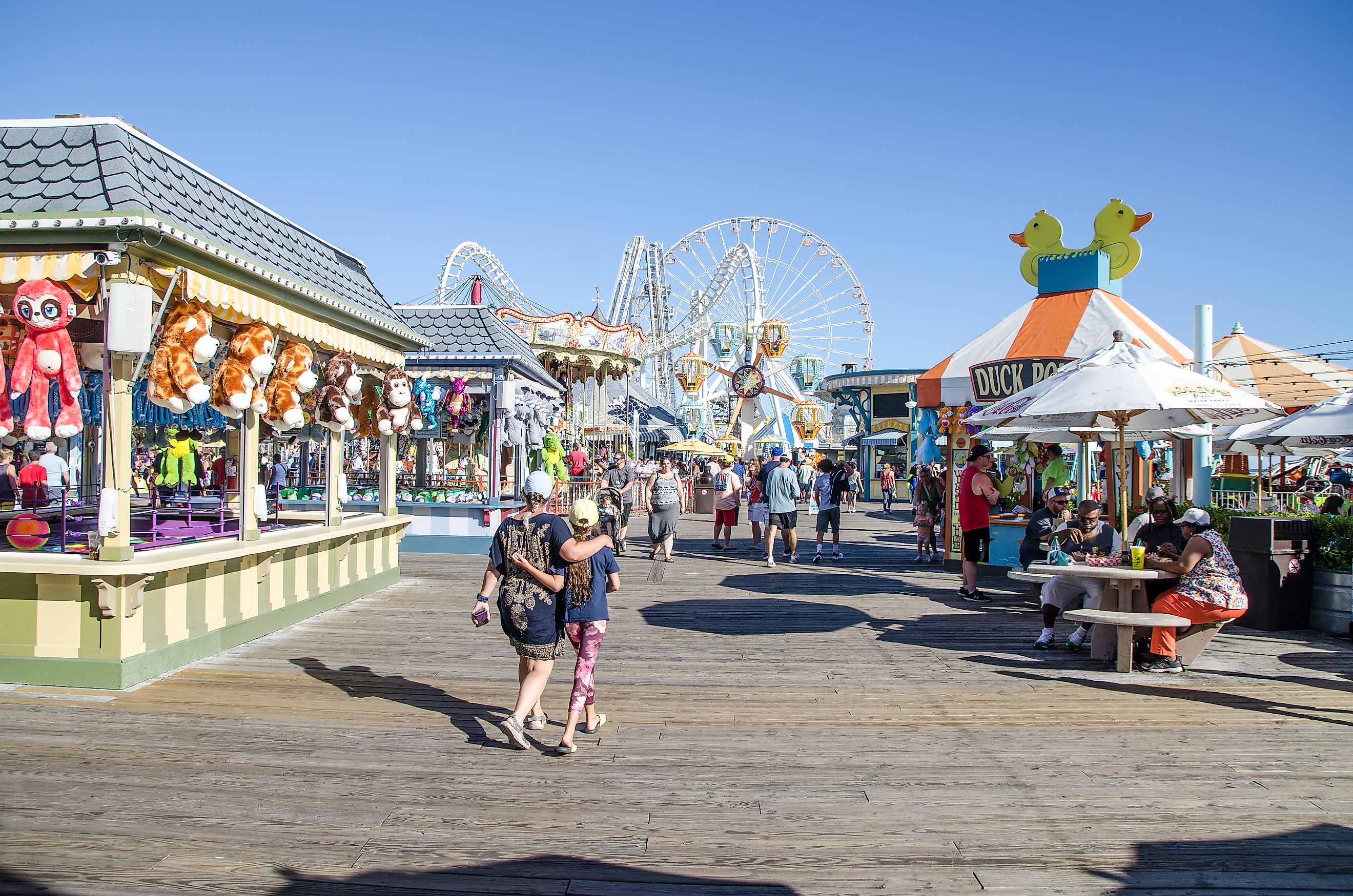
If Cape May is the quiet older sibling, Wildwood is the loud one a few miles up the island. Its beaches are wide, free, and famously long, so wide in places that the town runs a tram just to carry people from the boardwalk to the waterline. The boardwalk is the draw, two and a half miles of it, and the centerpiece is Morey's Piers, an amusement park spread across three piers and two waterparks with more than a hundred rides between them. A roller coaster running out over the ocean is a particular kind of experience, and Wildwood has several.
The town's other signature is architectural, in a way the Cape May preservationists might not recognize as architecture. Wildwood kept its 1950s and '60s motels, all boomerang signs and plastic palm trees and names like the Caribbean and the Starlux, and the doo-wop style is now protected and celebrated rather than torn down. For families deciding between the two ends of the island, the split is simple: Cape May is for looking at old houses, and Wildwood is for handing a kid a fistful of ride tickets.
Ocean City

Ocean City has been dry since its founding by Methodist ministers in 1879, meaning no bars and no liquor stores, and the town has leaned into the family reputation ever since. Eight miles of beach back up to a boardwalk that runs about two and a half miles, lined with the usual boardwalk economy of fudge, pizza, and Playland's Castaway Cove, the amusement park at the north end. Nobody comes here for nightlife, and that is precisely the point for the crowd that fills it every July.
The surprise sits just past the developed blocks. Corson's Inlet State Park takes in a stretch of oceanfront that was never built on, a rare thing on this coast, all sand dunes and salt marsh and the birds that feed in them. A visitor can spend the morning losing money at skee-ball and the afternoon watching ospreys work the marsh, without moving the car far. That contrast, carnival on one end and undeveloped shoreline on the other, is the whole case for the town.
Atlantic City

The Atlantic City boardwalk was built in 1870 for an unglamorous reason: hotel owners were tired of guests tracking beach sand into their lobbies, so a rail conductor named Alexander Boardman helped push a wooden walkway along the shore. That first version was a mile long and stored away each winter. It grew into the oldest and longest boardwalk in the world, now running about five and a half miles along the beachfront, and everything the city is known for is arranged along it.
Steel Pier juts a thousand feet out over the water with rides stacked on it, including a 227-foot observation wheel that turns slowly enough to make the whole coastline hold still. The casinos line the inland side of the boards, the beach runs free and open on the ocean side, and the two halves have coexisted under a city ordinance for over a century. A weekend here can be as expensive or as cheap as a visitor wants, which is a fair summary of Atlantic City in general.
Highlands

Highlands sits on Raritan Bay near the top of the shore, and it is the gateway to Sandy Hook, the narrow sand spit that guards the entrance to New York Harbor. The Sandy Hook unit of Gateway National Recreation Area covers seven miles of ocean beach, with trails threading through dunes, ponds, and salt marsh where hundreds of bird species turn up over the year. At its northern tip stands the Sandy Hook Lighthouse, first lit in 1764 and still working, which makes it the oldest operating lighthouse in the country. It was built 500 feet from the water; shifting sand has since left it a mile and a half inland, a fair illustration of how restless this coast is.
Up on the bluff above town, the Twin Lights overlook the bay from one of the highest points on the shore. A light has stood on the site since 1828, and the fortress-like brownstone towers visitors climb today went up in 1862; the view takes in Sandy Hook, the ocean, and the Manhattan skyline on a clear day. Down at the water, the Bahrs family has run a seafood restaurant on the waterfront for generations, and old military bunkers sit hidden among the dozen miles of wooded trails in Hartshorne Woods Park just outside town.
Princeton

Turn inland and the trip changes character entirely at Princeton. The town grew up around Princeton University, founded in 1746 and one of the oldest colleges in the country, and the campus is the reason to come. Its Gothic stone buildings were designed to look centuries older than they are, and the University Chapel, still used for weekly services, is all pointed arches and vaulting from a much earlier age, a convincing echo of the Middle Ages a short walk from a coffee shop.
The Princeton University Art Museum holds around 100,000 works spanning 5,000 years, from Greek and Roman antiquities to contemporary painting, and admission has long been free. A few blocks off campus, the Morven Museum & Garden occupies the state's first governor's mansion, its formal gardens open for wandering. The town is also, quietly, where Albert Einstein spent his last two decades, and the house where he lived still stands on a residential street, unmarked and privately owned, which is a very Princeton way to treat a landmark.
Lambertville

Lambertville faces the Delaware River in the state's southwestern corner, connected by a bridge to New Hope, Pennsylvania, on the far bank. Its factories turned out rubber, hairpins, and, at one point, toilets during the industrial century, and the goods went out on the Delaware and Raritan Canal. When those factories closed, artists and antique dealers moved into the empty brick warehouses because the rent was cheap, and the reinvention that followed made Lambertville the antiques capital of New Jersey. One of the largest collections of landmarked buildings in the state, behind only Cape May and Flemington, fits inside a single square mile.
Bridge Street is the spine, lined with galleries, antique shops, and restaurants inside the old Victorian storefronts, and much of it is browsable on foot in an afternoon. The canal towpath runs along the river for walkers and cyclists, and every spring the town throws the Shad Festival to mark the fish returning to a Delaware that was too polluted to support them until a cleanup in the 1970s. Washington crossed the ice-choked river just below town on Christmas night in 1776, back when Lambertville was still called Coryell's Ferry, a detail the town has never quite stopped mentioning.
Clinton

Almost every photograph of Clinton is the same photograph: a four-story red mill reflected in the South Branch of the Raritan River, with a waterfall beside it. That building is the Red Mill, put up around 1810, and its fame is well earned given the workload it has carried over two centuries: wool processing, textiles, grist, and, at various points, graphite and peach baskets. It is the centerpiece of the Red Mill Museum Village, an open-air collection of a dozen historic buildings preserved to document the area's working past.
Directly across the river, the Hunterdon Art Museum fills a second old stone mill with contemporary art and craft where machinery once ran, so a matched pair of mills faces off across the water. Just outside the center, Spruce Run Recreation Area surrounds one of the largest reservoirs in the state, open for boating, fishing, and swimming in summer, with campsites and trails for anyone who wants to stretch the visit past the postcard.
Sussex

The trip ends where the state runs out of up. Sussex sits in the far northwestern corner, surrounded by forest and ridge, and it is the way into High Point State Park, roughly 15,000 acres wrapped around the summit of the Kittatinny Mountains. At 1,803 feet, that summit is the highest ground in New Jersey, and the 220-foot High Point Monument stands on top of it, a stone obelisk built in 1930 to honor the state's veterans. The climb up its stairs buys a view of three states at once, New Jersey, New York, and Pennsylvania, spread out below.
More than 50 miles of trails thread the park, alongside campsites and lakes for summer swimming, including the Cedar Swamp Trail, a level two-and-a-half-mile loop around a high bog full of plants that belong much farther north. For anyone who wants the ground to fall away faster, Skydive Sussex operates just outside town with jumps from as high as 14,500 feet, which is one way to see the ridge and the shore in the same glance. It is a fitting place to finish, the exact opposite corner of the state from where this drive began.
One State, Every Kind Of Weekend
What ties these nine towns together is how little they have in common. A Victorian resort at the southern tip and a war memorial on the northern ridge belong to the same small state, reachable in an afternoon's drive of each other, and the towns in between fill in every register from casino neon to canal towpath. The shore towns offer the sheer volume of things to do, Princeton and Lambertville suit a slower and more deliberate kind of visit, and Clinton and Sussex swap the ocean for a river mill and a mountain view. The point is not to choose one. A single weekend, pointed in almost any direction, lands somewhere worth the drive.