8 Wallet-Friendly Small Towns To Retire In Northern Ireland
Retiring in Northern Ireland does not have to mean stretching a budget. Whitehead, a seaside town on Belfast Lough, already counts more than a quarter of its residents as 65 or older. Strabane sits in the second-cheapest council area in the country, with the Sperrin Mountains a short drive east. Armagh pairs two cathedrals and a 300-acre public demesne with house prices below the national average. Larne runs rail and ferry links out of a compact town center at the southern end of the Antrim Coast Road. These eight small towns match modest housing costs with the walkable centers and everyday services that matter most in retirement.
Armagh

Armagh holds city status but keeps a small-town footprint, and almost everything sits within a walk of the center. It is the ecclesiastical capital of Ireland, seat of both the Church of Ireland and Roman Catholic primates, and its two St Patrick's cathedrals face each other from opposite hills. Prices are moderate. Armagh City, Banbridge and Craigavon posted a standardised house price of £179,907 at the end of 2025, comfortably below the Northern Ireland average.
The Palace Demesne is the everyday green space, spanning 300 acres and a short walk from the center. It housed the Church of Ireland archbishops between 1770 and 1975 and is now a public park with walking paths and gardens. County Armagh is orchard country, and the Bramley apple grown here remains a cooking staple. Each September, the county runs the Armagh Food and Cider Weekend, with orchard tours and cider tastings alongside artisan street markets. The Armagh Observatory and Planetarium offers a different sort of afternoon. The observatory dates to 1790, and the planetarium alongside it runs exhibits and dome shows that hold up well when grandchildren are visiting.
Strabane

Strabane is a down-to-earth town in County Tyrone, sitting where the River Mourne meets the Finn to form the Foyle. Derry is about half an hour up the road, and Letterkenny is a similar run in the other direction across the border, so proximity to urban centers is appealing. Housing is the draw here, however. The Derry City and Strabane council area recorded a standardised house price of £177,589 at the end of 2025, the second lowest in Northern Ireland.
Gray's Printing Press, a National Trust property on Main Street, still displays its historic presses and tells the town's printing history. The Sperrin Mountains rise to the east, with quiet country roads and gentle walking. Moor Lough, a few miles out, has small beaches and trout fishing. Strabane also maintains a quirky, creative streak. The Tinnies stand near the Lifford Bridge, five stainless steel and bronze figures of musicians and dancers, each about 18 feet tall. Officially titled Let the Dance Begin, they were made by Derry sculptor Maurice Harron and installed in 2000 to mark the millennium. The community dresses them for Christmas and for Tyrone GAA runs.
Larne

Larne is a coastal town in County Antrim, compact enough that most daily errands sit within a short walk of the town center. Mid and East Antrim carries the lowest standardised house price of any council area in Northern Ireland, £173,261 at the end of 2025, which makes seaside living unusually affordable here. Transport is the other argument for Larne. The rail and bus station sits about a third of a mile from the town center, the ferry port runs to Scotland, and Belfast is just 25 kilometers down the coast, close enough for a day out without the city price tag.
Larne also marks the southern end of the Antrim Coast Road, which runs north past Ballygalley and Glenarm with pull-in points along the way. A few miles inland, Gleno Waterfall is reached by a short path with benches near the water, though the route includes steps and a few steeper sections. Closer in, Larne Town Park sits above the promenade, with views across Larne Harbour and the North Channel and level paths for an easy afternoon.
Omagh

Omagh is the county town of Tyrone and the largest one on this list. It sits where the Drumragh and Camowen rivers meet to form the Strule. Housing runs close to the Northern Ireland average rather than well below it. Fermanagh and Omagh recorded a standardised price of £194,970 at the end of 2025, against £195,936 for the country as a whole. The Ulster American Folk Park, a few kilometers north of town on the A5, is the main attraction. The open-air museum traces Irish emigration through furnished cottages and a full-scale replica emigrant ship, with craft workers demonstrating at the looms and forge.
Gortin Glen Forest Park lies a short drive out, with gentle trails and a forest drive winding up into the Sperrin Mountains. The foliage there is at its best in October. In town, the Strule Arts Centre programs live music and theater throughout the year. The Sperrins themselves, a designated Area of Outstanding Natural Beauty, start almost at Omagh's edge, with quiet country roads and marked hill trails.
Enniskillen

Enniskillen occupies an island in the River Erne, with Upper and Lower Lough Erne spreading out on either side. It is the largest town in County Fermanagh, and the water is one of its biggest assets, with boat trips and level walking along the quays. Housing sits near the Northern Ireland average, but what Enniskillen adds is medical access. South West Acute Hospital runs a 24-hour emergency department alongside local general practices and private clinics right in town.
Enniskillen Castle stands on the bank of the River Erne, built by the Gaelic Maguire chieftains in the 15th century and later used as a garrison fort and military barracks. It now houses the Fermanagh County Museum and the Inniskillings Museum. Outside town, the Cuilcagh Lakelands UNESCO Global Geopark, formerly the Marble Arch Caves Global Geopark, takes visitors underground past river passages and rock formations. Castle Coole, a neoclassical mansion completed in the 1790s, sits in parkland with guided house tours and quiet estate walks.
Banbridge

Banbridge is a market town of 17,400 in County Down, built along the River Bann and named for the bridge put across it in 1712. Its main street climbs a steep hill, steep enough that in 1834 an underpass was cut through the middle of it so loaded horses would not have to reach the top. Locals call it The Cut. Housing sits well below Belfast levels, despite the city being only 34 kilometers up the A1 when a bigger trip is needed. Everyday costs stay manageable, with local markets and discount chains covering the weekly shop.
The Boulevard, on the edge of town, is an outlet shopping village home to familiar brands and regular discounts, and Solitude Park runs along the river, with open green space and benches. The F.E. McWilliam Gallery and Studio celebrates the Banbridge-born sculptor Frederick Edward McWilliam. Admission is free, and the site shows his work alongside temporary exhibitions of Irish and international art, with a craft shop and cafe on site.
Cookstown

Cookstown sits near the geographic middle of Northern Ireland, a County Tyrone town with an unusually generous plan. Main Street runs straight for 2 kilometers at 41 meters wide. It was laid out in the late 18th century and is among the longest and widest in Ireland, doing the work of the town square Cookstown never built. The street carries independent shops and supermarkets, plus the Burnavon Arts and Cultural Centre for music and theater. Villa Vinci on Loy Street handles the Italian end of things, with pizza and pasta. The outdoor Saturday Market runs weekly for food and crafts.
Mid Ulster recorded a standardised house price of £189,185 at the end of 2025, which puts Cookstown in an affordable market. The trade-off is that local general practices cover routine care, but hospital treatment means traveling out of town. Drum Manor Forest Park lies just west on the A505. Woodland trails loop a wildfowl lake, and the walled garden is managed as a butterfly habitat. The ground-floor walls of a 19th-century manor house survive at the center of it. Tullyhogue Fort, a nearby hilltop earthwork, was the inauguration site of the O'Neill kings of Ulster.
Whitehead

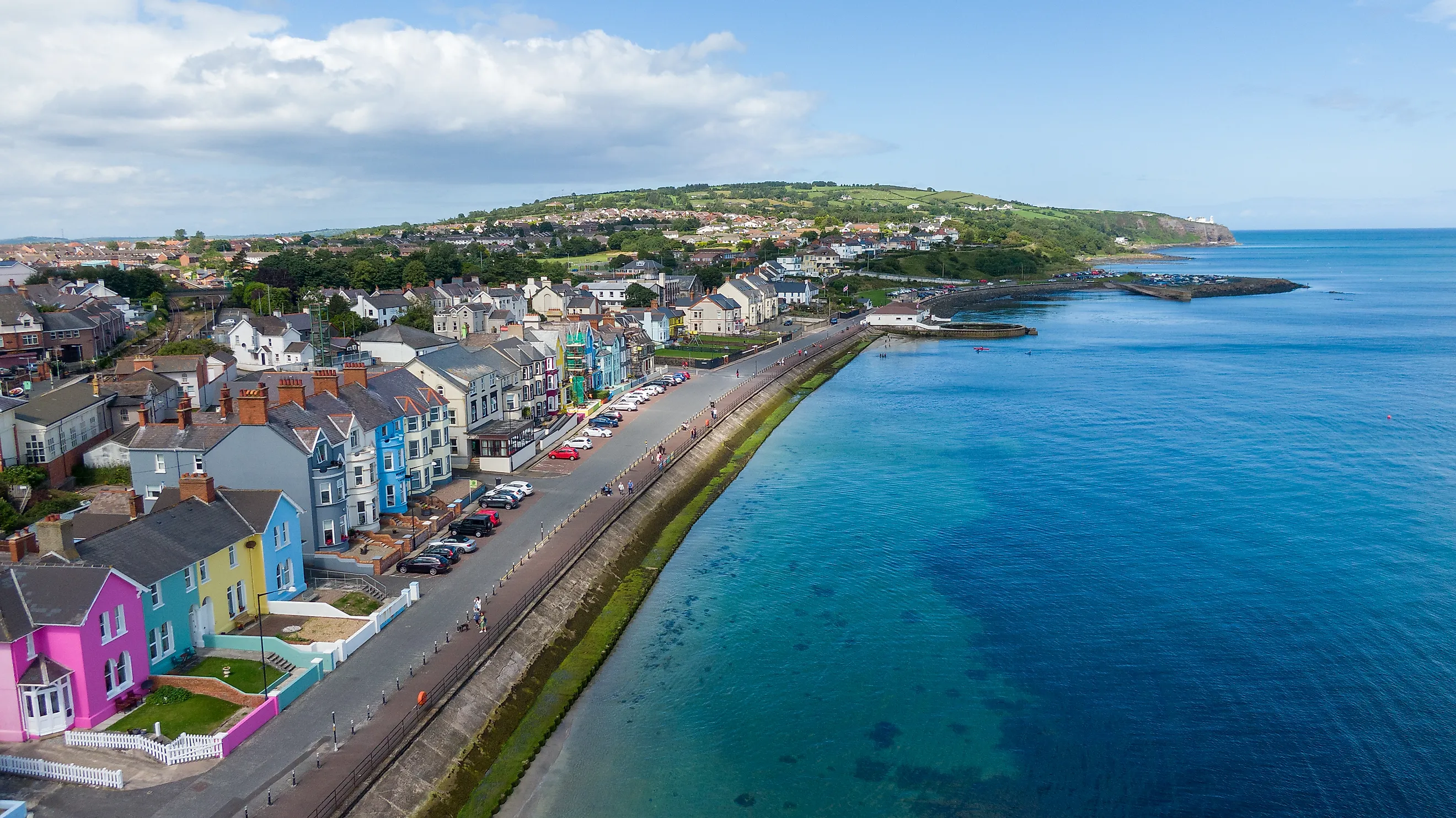
Whitehead is the smallest entry here, a seaside town of 3,537 on the north shore of Belfast Lough that grew up around the railway after it arrived in 1862. The Victorian and Edwardian terraces are painted in blocks of color, and the station in the middle of town still runs regular trains on the Larne to Belfast line. Its age profile already skews older, which is a reflection of the town's appeal to seniors and retirees. At the 2021 census, 26.3 percent of residents were 65 or over, against 17 percent across Northern Ireland. Mid and East Antrim housing is also the cheapest of any council area, at £173,261.
The Blackhead Path is the landmark, a cliff walk running out to Blackhead Lighthouse past rocky shore and small caves, with the keepers' cottages let as holiday accommodations. Sections close periodically for rockfall repair, so it is worth checking with the council before setting out. The route also includes steep steps that suit a moderately active walker. Golfers are also in luck, with the 18-hole Whitehead Golf Club and the 9-hole Bentra course in town. Meanwhile, the Whitehead Railway Museum holds restored rolling stock, including a 1950s carriage.
Weighing Price Against Access In Northern Ireland
The price spread across these eight towns is narrower than it first appears. Mid and East Antrim, covering Larne and Whitehead, is the cheapest council area in Northern Ireland at £173,261, while Fermanagh and Omagh sits within about a thousand pounds of the national average. The real variable is access. Whitehead and Strabane trade distance from acute hospital care for the lowest housing costs in the country, while Enniskillen and Armagh cost more and keep a hospital and a full town center close at hand. Anyone weighing these eight is choosing between those two things, but the result is invariably a rewarding and fulfilling retirement in Northern Ireland.