8 Top-Rated Small Towns In The Rockies
The highest-rated small towns in the Rockies all back up against something enormous, a national park, a glacier, or a peak past 14,000 feet. Rocky Mountain National Park, one of the country's busiest, starts at the edge of Estes Park. Over in Jackson, the town square has four arches made entirely of elk antlers. People have lived at Taos Pueblo for a thousand years, centuries before there was a United States. Most are ski towns in winter and trailheads in summer.
Estes Park, Colorado

Estes Park puts its downtown right at the foot of the mountains. Elkhorn Avenue lines up local shops and eateries against a backdrop of granite peaks. The Riverwalk threads behind the storefronts, connecting the visitor center to the meeting of the Big Thompson and Fall rivers. The Stanley Hotel presides over the north edge of town, a white-clapboard landmark from 1909 with a red roof and a reputation. Stephen King checked in one off-season night and left with the idea that became "The Shining."
Estes Park serves as the eastern gateway to Rocky Mountain National Park, 415 square miles of alpine lakes, high meadows, and granite peaks topping 14,000 feet. The park ranks among the busiest in the United States. Most of its visitors pass through Estes to reach it. Trail Ridge Road climbs out of town above 12,000 feet, the highest paved through-road in any American national park.
Banff, Alberta

Banff is one of the few towns built inside a national park, and not just any park. Banff National Park was Canada's first, established in 1885. The townsite still operates under federal rules that cap its growth. Banff Avenue stretches the length of downtown with Cascade Mountain framing the far end. The Banff Gondola climbs Sulphur Mountain right from the edge of town. The Banff Upper Hot Springs steam away nearby at the highest elevation of any hot spring in the country.
Winter turns Banff into a base for three ski areas, including Sunshine Village and the Lake Louise Ski Resort up the road. The turquoise water of Lake Louise lies about 40 minutes northwest, a standard day trip out of town. Closer in, the Fairmont Banff Springs rises over the trees in limestone turrets that earned it the nickname "Castle in the Rockies."
Jasper, Alberta

In Jasper, the wildlife outnumbers the traffic. Elk graze along the streets at dawn. Waiting out a herd crossing on the way to morning coffee is routine. The town is the hub of the largest national park in the Canadian Rockies, a UNESCO World Heritage Site. Its compact downtown formed around the railway that still passes through it. In July 2024, a wildfire swept the townsite and destroyed about a third of its buildings. Jasper reopened to visitors that September and has been rebuilding since, with most businesses, lodging, and park attractions back in operation.
The Columbia Icefield, Maligne Lake, and Pyramid Lake all lie within a short drive of downtown. Most of that country came through the fire intact. So did the Fairmont Jasper Park Lodge, a run of log buildings on Lac Beauvert since 1922 that reopened within months of the flames. The surrounding Jasper National Park also forms one of the largest dark-sky preserves in the world, where the nights rival the days.
Aspen, Colorado

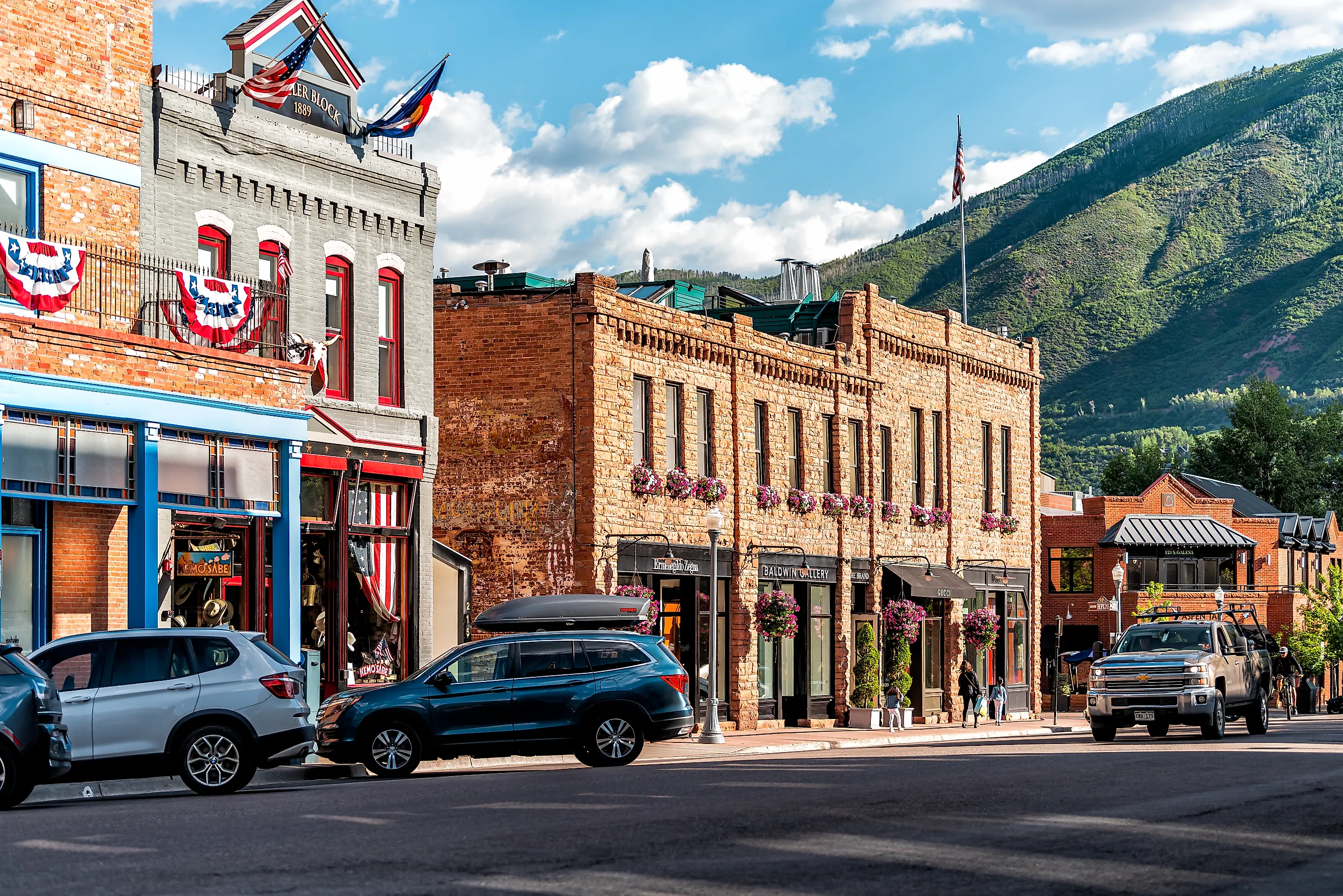
The charming downtown area of Aspen, Colorado.
Aspen sets Prada and Gucci storefronts among block after block of Victorian buildings from its 1880s silver-mining boom. The grid is flat and walkable. The old brick storefronts now house galleries, bookshops, and restaurants. The cultural calendar goes surprisingly deep, with the Aspen Music Festival and School taking over summers, plus the Aspen Ideas Festival and Aspen Filmfest.
The skiing is what put Aspen on the map. It spreads across four separate mountains. Aspen Mountain rises straight from the edge of downtown, joined by Aspen Highlands, Buttermilk, and the much larger Snowmass a few miles away. Buttermilk hosts the Winter X Games most years. Highlands guards the hike-to bowl that expert skiers chase. The Little Nell waits at the base of Aspen Mountain for anyone ready to ski straight to the lift.
Jackson, Wyoming

Jackson frames its town square with four archways built entirely from shed elk antlers. The square stands at the center of a walkable downtown with an Old West look, complete with wooden boardwalks, a saloon or two, and art galleries between them. The Wort Hotel, open since 1941, remains the town's social hub, its Silver Dollar Bar inlaid with more than two thousand actual silver dollars.
The National Elk Refuge borders the town to the north. Each winter, thousands of elk move down to shelter there within sight of the streets. Bison, moose, and the occasional bear travel through the valley known as Jackson Hole. Two national parks frame the horizon, with Grand Teton minutes away and Yellowstone National Park a short drive north. The classic photograph of a weathered barn beneath the Teton range comes from Mormon Row, just inside the park boundary.
Taos, New Mexico

Taos shows how far south the Rockies reach, set in the Sangre de Cristo subrange beneath Wheeler Peak, the highest summit in New Mexico at over 13,000 feet. The town blends Native American, Hispanic, and Anglo cultures. That mix is visible on every adobe-lined street. Taos Pueblo, a multi-story adobe complex at the edge of town, has been continuously inhabited for more than a thousand years, making it one of the oldest such communities in the United States. It carries both UNESCO World Heritage and National Historic Landmark status.
The Kit Carson Home and Museum preserves the adobe residence of the frontier scout, now given over to the region's history. Northwest of town, the Rio Grande Gorge Bridge spans a chasm that drops about 565 feet to the river, the second-highest bridge on the US highway system when it opened in 1965. The light and landscape have attracted artists for more than a century, since the Taos Society of Artists formed in 1915. The Historic Taos Inn, open since 1936 in a cluster of adobe houses from the 1800s, still gathers that crowd around its Adobe Bar.
Whitefish, Montana

The old Great Northern depot still stands at the foot of Central Avenue, the spine of the downtown Whitefish built around the railroad. The timber-framed station now houses the Stumptown Historical Society Museum, named for the stumps that the town's early loggers left behind. Central Avenue itself buzzes year-round with breweries, restaurants, and ski shops, a walkable core that backs onto Whitefish Lake. The town has preserved its early-1900s buildings even as it became one of Montana's better-known mountain towns. The Garden Wall Inn, a restored 1923 clapboard house a block off the avenue, still takes in guests.
Whitefish Mountain Resort overlooks the town from the slope just above, one of the larger ski areas in the northern Rockies, with runs that look down on the lake and the valley. Glacier National Park lies less than an hour east, with over 700 miles of trails, the alpine crossing of Going-to-the-Sun Road, and the still water of Lake McDonald.
Waterton, Alberta

Waterton stands at the exact line where Alberta's prairie meets the mountains. The drive in crosses flat grassland until the peaks rise without warning, which is why the town goes by the tagline "Where the Mountains Meet the Prairie." The small townsite spreads along the shore of Upper Waterton Lake, the deepest lake in the Canadian Rockies. The Prince of Wales Hotel, a steep-roofed landmark from 1927, looks down on the water from a bluff above town.
The town stands inside Waterton Lakes National Park, Canada's fourth national park, set aside in 1895. Together with Montana's Glacier National Park across the border, it forms the Waterton-Glacier International Peace Park, the first international peace park in the world when the two nations joined them in 1932, and a UNESCO World Heritage Site since 1995. Wildlife moves freely through the valley. Black bears and the occasional grizzly turn up along the roadsides in spring. The combined park also carries a Dark Sky designation, which leaves its night skies dark enough for serious stargazing.
Small Towns That Earn the Mountains
The best of the Rockies shows itself in specifics. Jackson frames its town square with four arches of shed elk antlers. Whitefish protects the old Great Northern depot that the railroad left downtown. Waterton marks the exact spot where Alberta's prairie gives way to peaks. Jasper sends elk wandering down its streets at dawn, even now as the town rebuilds. Each place carries its own version of the high country, built on mining, railroads, ranching, or peoples who arrived centuries earlier. That range is what the rating rewards.