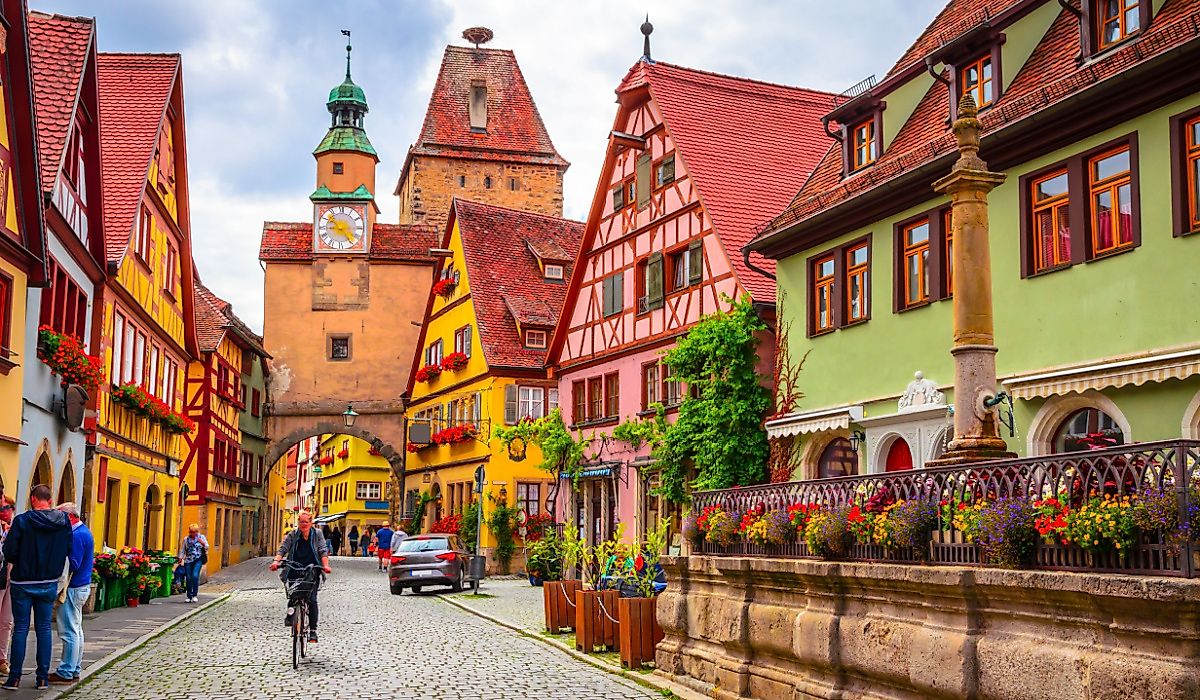
8 Prettiest Small Towns In Germany
Some of Germany's prettiest places are small enough to cross on foot in an afternoon. Rothenburg ob der Tauber keeps a full ring of medieval walls above the Tauber valley. Bacharach guards a cluster of towers among Rhine vineyards, and Mittenwald paints saints and scrollwork across its alpine houses. The eight towns below earned their top spots on aesthetic appeal, featuring half-timbered squares, hilltop castles, vineyard slopes, and lakeshore promenades. They inspire curious exploration, slow meandering, and picture-perfect memories.
Rothenburg ob der Tauber, Bavaria

Rothenburg ob der Tauber crowns a sandstone plateau where the Tauber River bends through Middle Franconia. A complete ring of medieval walls still encircles the old town, one of only three in Germany to keep its fortifications whole, alongside Nördlingen and Dinkelsbühl. Visitors can climb the covered rampart walk and follow it past watchtowers and gabled roofs for most of the circuit. Below the walls, the Burggarten occupies the site of a vanished castle and looks out over the river valley and its vineyards.
The town's most photographed spot is the Plönlein, a fork in the lane where a half-timbered house leans between two towers. At the center, Marktplatz holds a Renaissance town hall and hosts the Christmas market that fills the square through Advent. Just off it, St. Jakob's Church shelters the Altar of the Holy Blood, a limewood altarpiece carved by Tilman Riemenschneider in the early 1500s. Rothenburg is a key stop along the northern stretch of the Romantic Road, and its evenings empty out once the tour coaches leave.
Bacharach, Rhineland-Palatinate

Bacharach fills a narrow shelf between the Rhine and the vineyard slopes that rise behind it, roughly 30 miles upstream of Koblenz. The town belongs to the Upper Middle Rhine Valley, a stretch of gorge that UNESCO added to its World Heritage list in 2002 for its castles and terraced vines. Above the rooftops stands Burg Stahleck, a hilltop castle rebuilt in the 20th century and run today as a youth hostel with wide views down the Rhine River. The climb to it passes the Wernerkapelle, a roofless Gothic chapel of red sandstone left as a ruin.
Down in the old town, timber-framed houses crowd Marktplatz and Oberstraße, among them the much-photographed Altes Haus. A walkable circuit of the medieval wall still links surviving towers, including the Postenturm and the Hutturm. For the best vantage, the Malerwinkel, or Painter's Corner, frames the towers and vineyards as the Rhine Romantics once sketched them.
Cochem, Rhineland-Palatinate

Cochem wraps around a bend of the Moselle about an hour upriver from where it meets the Rhine at Koblenz. Steep Riesling vineyards climb straight from the water's edge, and the reconstructed Reichsburg Cochem looks down on the town from a wooded cone above. French troops destroyed the original castle in 1689, and a Berlin businessman rebuilt it in neo-Gothic style later in the 19th century; guided tours now cover its halls and turrets. Along the river, the Moselpromenade runs past cafés and flower beds where cruise boats tie up for the day.
The old town gathers around Marktplatz, where St. Martin's Church and a Baroque town hall frame the square. For a longer view, the Cochemer Sesselbahn chairlift lifts riders to the Pinnerkreuz, a hilltop cross above a broad loop of the Moselle. Each year in late summer, the Cochem Wine Festival takes over the riverfront with tastings, parades, and a fireworks night over the water.
Monschau, North Rhine-Westphalia

Monschau threads along the Rur in a steep, wooded fold of the Eifel, close to the Belgian border in Germany's far west. Because no railway ever reached the center, its slate-roofed timber houses have stood largely unchanged for some 300 years. Stone and wooden bridges cross the little river between them, and the view upstream toward the hillside castle is the image most tied to the town. That castle, Burg Monschau, dates to the 13th century and now holds a hostel. The footpath up to it opens the best angle over the rooftops.
In the center, the Rotes Haus recalls the wealth that cloth once brought here, its rooms hung with Rococo woodwork around a carved oak staircase. A short walk away, the Senfmühle has ground mustard by waterpower since 1882 and still sells it by the jar. Forest trails climb straight out of town into the Eifel uplands, which spread west toward the moors of the High Fens.
Wernigerode, Saxony-Anhalt

Wernigerode spreads along the Holtemme at the northern foot of the Harz, its old town so brightly painted that locals call it the colorful town of the mountains. Timber-framed houses painted in ochre, rust, and green line the lanes toward Marktplatz. There, the Rathaus stands on carved oak posts with a steep double staircase out front. The building dates to the end of the 15th century and ranks among the finest half-timbered town halls in the country. Above it all, Schloss Wernigerode rides a wooded ridge. Rebuilt to its present romantic form by 1893, the palace recalls Neuschwanstein and opens its terraces to long views across the range. From the town station, the steam engines of the Harz Narrow-Gauge Railway pull uphill toward the Brocken, at 3,743 feet the highest summit in northern Germany. The half-timbered neighbor of Quedlinburg, a UNESCO town, sits only about 40 minutes away for anyone with a second day to spend.
Meersburg, Baden-Württemberg

At Germany's southern edge, Meersburg rises in two tiers above the northern shore of Lake Constance, its upper and lower towns joined by stairways and the steep Steigstrasse. Two castles share the skyline. The Altes Schloss, a squat stone keep often called the oldest inhabited castle in Germany, stands on a bluff over the water. Beside it, the Baroque Neues Schloss overlooks the vineyards, its grand staircase designed by Balthasar Neumann. Built as a residence for the prince-bishops of Constance, the newer castle now serves as a museum.
The poet Annette von Droste-Hülshoff spent her last years in the town and is closely tied to both houses. Terraced vineyards fall toward the lake below, producing the pale rosé the region calls Weissherbst. From the Lerchenberg viewpoint above the vines, the shoreline and the distant Alps line up across the water. Car ferries slip out from the lower town to Constance on the far shore throughout the day.
Schiltach, Baden-Württemberg

Northwest of the lake, in the forested hills of Baden-Württemberg, Schiltach occupies the notch where the Kinzig meets the smaller Schiltach river. The old town climbs the hillside above the water, since floods long kept building off the banks, and locals still call the compact center the Städtle. Its heart is a sloping, triangular Marktplatz ringed by half-timbered houses whose gables lean at every angle. The Rathaus at the high end shows a painted front gable. Württemberg court architect Heinrich Schickhardt redesigned the square after the fire of 1590. Whole streets of timber houses, some dating to the 16th century and others to the 19th, have been under protection since 1971, which is why the ensemble feels so intact. Down by the river, the Schüttesäge Museum keeps alive the trades that built Schiltach, like log rafting on the Kinzig, and leather tanning along its banks. The view from the town bridge, back across the water toward the stacked gables, is the one photographers come for.
Mittenwald, Bavaria

Mittenwald shelters beneath the limestone walls of the Karwendel, where the young Isar runs down toward Munich near the Austrian border. Unlike the timber-framed towns farther north, its houses wear Lüftlmalerei, a Bavarian fresco style painted straight onto the plaster. The scenes show saints, painted columns, and glimpses of village life. The pedestrian Obermarkt runs through the middle of it, lined with these facades and with workshops that still build violins by hand. The craft dates to the 17th century, when Matthias Klotz brought lutherie home from Italy.
A bronze figure of him stands outside the parish church of St. Peter and Paul, whose tower and ceiling carry frescoes of their own. The Geigenbaumuseum traces the trade through tools and finished instruments in a former workshop. For height and air, the Kranzberg chairlift carries walkers above the roofs to trails that climb toward the Karwendel peaks. Goethe passed through in 1786 and called the town a living picture book.
Postcards at Village Scale
These eight towns trade the scale of Germany's big cities for something a visitor can take in at their own pace. Rothenburg brings its walls, Bacharach and Cochem their vineyard towers, and Meersburg its two tiers above the lake. Monschau, Wernigerode, and Schiltach carry the timber lanes, while Mittenwald answers with painted plaster under the Alps. For travelers who care less about covering ground than about the view from a single bridge or rampart, these German towns are a must.