8 Picture-Perfect Main Streets In The Prairies
The prairies and their corresponding communities possess an underappreciated beauty. Across the interior states and central Canadian provinces, fields of golden wheat and wild grasses stretch to an infinite horizon, with old mining, homesteading, and agricultural towns popping up seemingly out of nowhere to punctuate the landscape. From the historic grain elevators of Nanton, Alberta, and Val Marie, Saskatchewan, to the stately historic districts of Guthrie, Oklahoma, and Emporia, Kansas, these eight main streets highlight picture-perfect aspects of North America's prairie population hubs.
Nanton, Alberta

Southern Alberta is home to a string of historic highway towns that blend the pragmatism of the prairies with the tantalizing foothills of the Canadian Rockies. One might be tempted to shoot straight for the Hollywoodized strip at Fort Macleod, but for a picture-perfect main street, go no further than Nanton.

Nanton sits less than an hour's drive south of Calgary, sandwiched between Highway 2 and its modest layout. 20th Street, between 20th and 21st Avenue, acts as Main Street in these parts, projecting a salt-of-the-earth prairie appeal with just a touch of modernity. On the one end, you will find a colorful cluster of sweets and antiques, and at the other, you will be introduced to Georgie's Cafe, the local (non-alcoholic) watering hole. Tap Town Books and a smattering of boutiques happily fill the spaces in between. To cap things off, upon emerging on 20th Ave, look to the right, and you will spot Nanton's branded and delightfully weathered historic grain elevators.
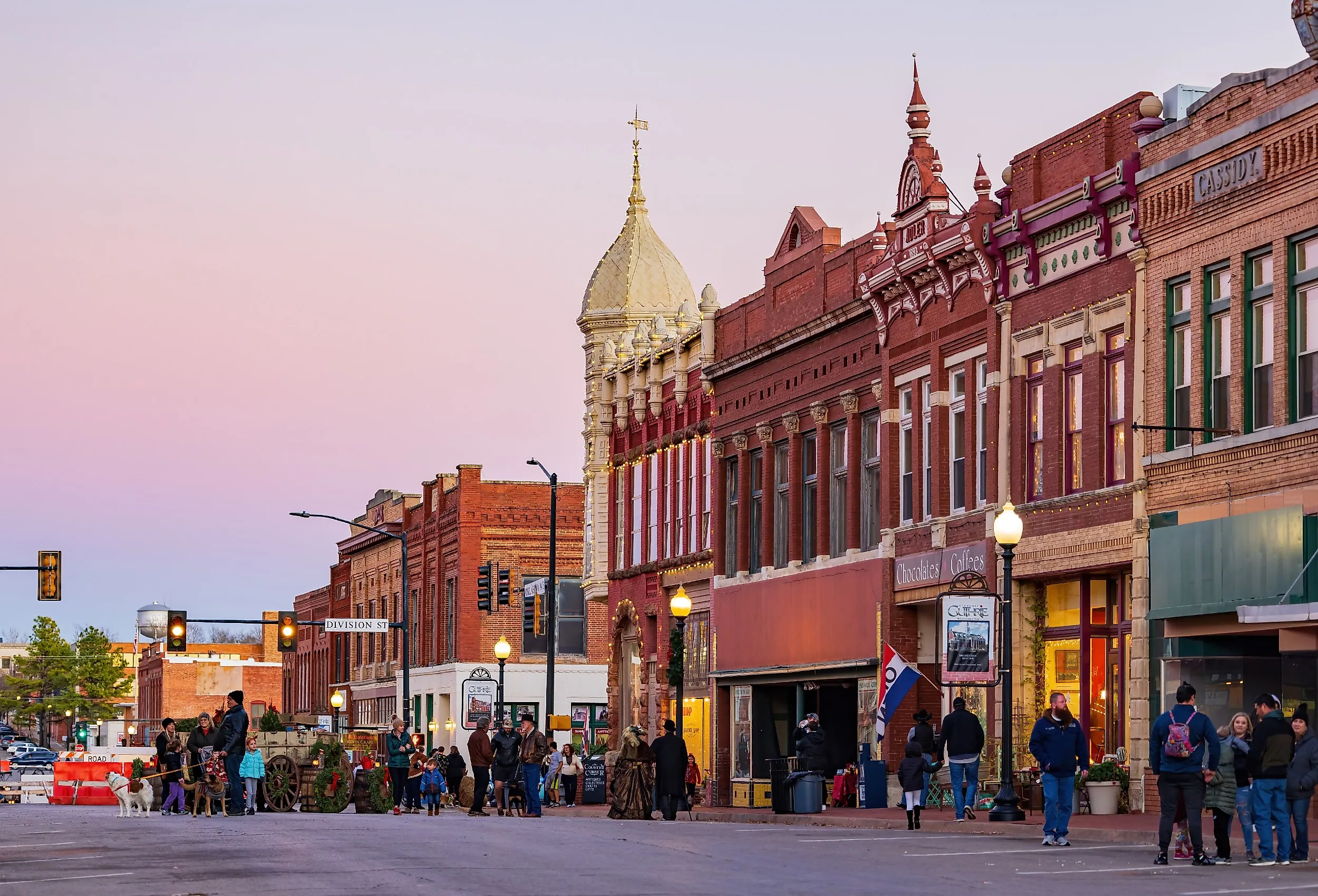
Guthrie, Oklahoma

Prairie towns often hid in the niches of industry and westward expansion. Not Guthrie. Oklahoma's first state capital sprang up, literally overnight, becoming a city of 10,000 people the day after the Land Run of April 1889. The sudden surge of people was soon matched by large and elegant infrastructure, built almost exclusively from red brick and native sandstone. Now, with over 2,000 designated buildings, Guthrie stands as one of the largest Historic Districts in the country.
Several streets throughout downtown Guthrie sport a consistent aesthetic, but Harrison Avenue consolidates the highest density of noteworthy historic and commercial structures. From west to east, these include (but are not limited to): the State Capital Publishing Museum, the Victor Building (now home to The Evermore event venue), the Pollard Theatre (still in operation), the Guthrie Brewing Company (within the old Acton building), and the 1891 Foucart Building (now an antique store). And speaking of picture-perfect, Harrison Avenue is also home to the Tipsy Artist, a beginner-friendly painting studio/bespoke shop within the circa-1902 Osage Block.
Weston, Missouri

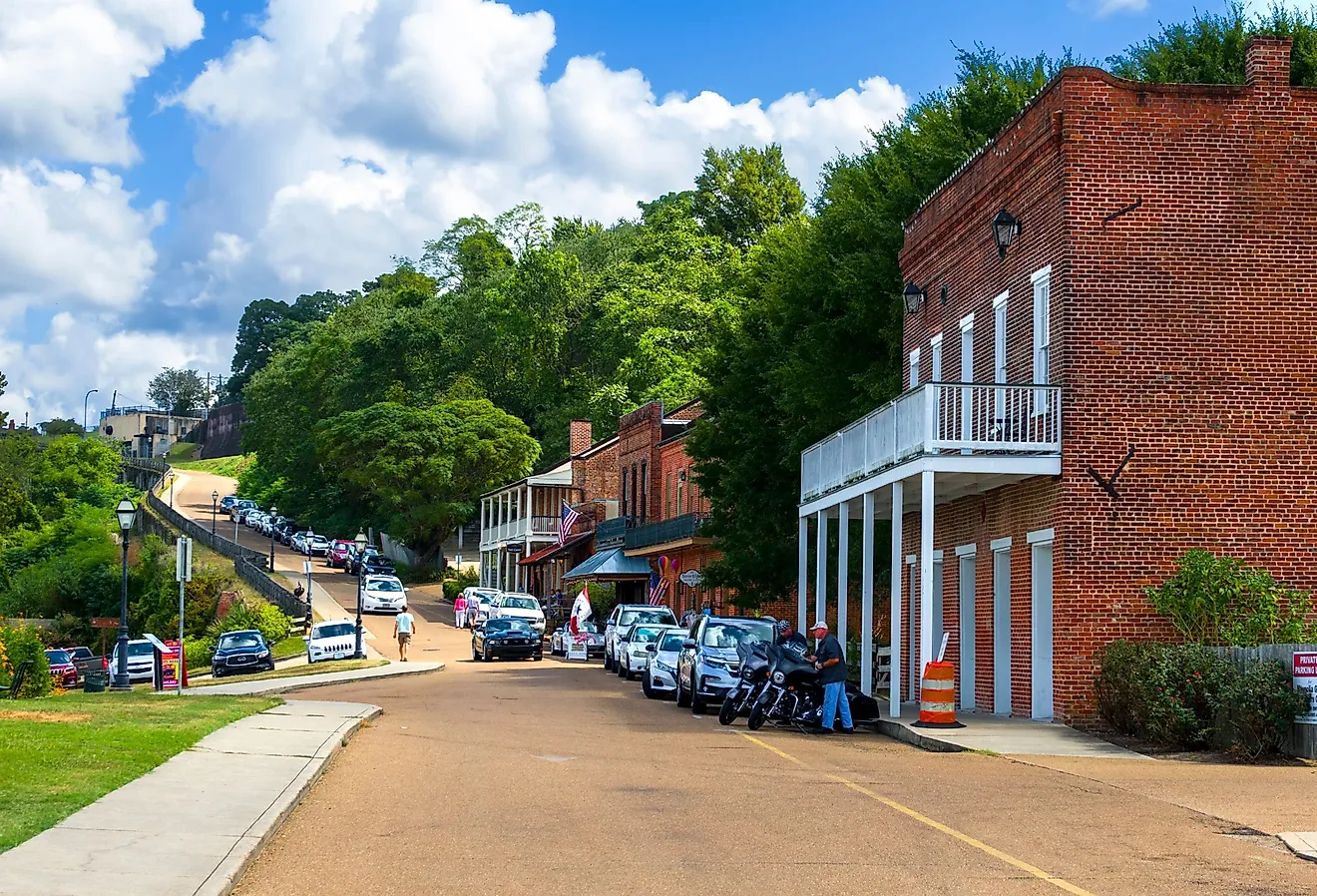
Once a thriving port town, until the changing course of the Missouri River and a series of devastating fires in the 1850s had something to say about it, Weston, Missouri, has a storied past and captivating look. This Platte County community's Historic District constitutes 24 blocks, with much of that action concentrated along Main Street.
Weston's Main Street offers a collage of delightfully weathered red, orange, and white brick buildings, underlaid by multicolored awnings. These unique exteriors are complemented by bespoke businesses within, such as Renditions Polish Pottery Shop, Weston Bend Candle Company, and Missouri Bluffs Boutique. Across the street, you might also enjoy sipping a coffee within the nature-soaked scenery of The Cozy Hollow's patio, perhaps while reading something from next door's Happy Endings Bookshop (you can't ever go wrong with a cafe/book store combo).
Keystone, South Dakota

Contrary to popular belief, the prairies represent more than flat swaths of agriculture. A tour through South Dakota's Black Hills & Badlands region shows just how dynamic the Great Plains can be. Case in point, the quirky tourist town of Keystone, South Dakota, has a main street full of woody, Old West-esque establishments that lead straight to the turnoff for Mount Rushmore, all while being backed by the steep, forested Black Hills.
Rather than a compact collection of commercial assets, Keystone's main street unfolds in stages. Entering via Highway 40 or U.S. Route 16A, motorists are treated to uninterrupted scenery before reaching the intersection of Reed and Winter Street, and thus, the beginning of this 19th-century mining town's historic core. Winding south on Winter Street (i.e., Keystone's main street), note the 1880 Train Depot on your right, and the string of American eateries, Western wear, and souvenir shops on your left. On the far end, you are sure to spot the giant Bigfoot carving outside of Dahl's Chainsaw Art. And before witnessing the massive visages of the nation's early leaders carved in rock, you may first wish to pop into The National Presidential Wax Museum to snap a few pics with the uncanny, life-size replicas made from decidedly softer material.
Val Marie, Saskatchewan

Many of the towns earned their spots thanks to revitalized, well-stocked main streets. Val Marie, on the other hand, is picture-perfect in an old school sort of way. This village in southern Saskatchewan serves as a gateway to Grasslands National Park, but otherwise it sinks into the obscurity of the vast Canadian prairies. Val Marie's Center Street has that worn and vacant feel of a classic tumbleweed town, a niche sort of beauty to be enjoyed by off-the-beaten-path travelers.

Val Marie's main drag does support a trifecta of attractions. At its entrance, the Grasslands National Park Visitor Center is an ordinary building, but one that teases the remarkable, bison-ladened wilderness awaiting to the east. Half a block down, the red-brick, circa-1927 Val Marie School is now home to the Prairie Wind & Silver Sage gift shop/book store/cafe/eco museum/art gallery/garden, a delightful space that speaks to the community, creativity, and living legacy of the Great Plains. And lastly, at the far end of Center Street, the Val Marie Grain Elevator offers photographers their money shot. Thanks to recent preservation efforts, the interior is now available to tour, acting as a living museum for anyone interested in the primary industry of the prairies.
Grand Forks, North Dakota

From a nearly forgotten windswept village, to a lively college town, Grand Forks, North Dakota shows off even more of the prairies' range. Fixed on the west side of the Red River, "The Forks" marks the transition between Minnesota and North Dakota, the Great Lakes Region and the Prairies, and more specifically, the historical range of the Tallgrass Prairies and the slim buffer zone known as the Mixed Prairies.

The Downtown Grand Forks Historic District is based around the intersection of Demers Avenue and Third Street. But the latter parallels the Red River, has a similar quantity of youthful watering holes, and is accented by various art installations. Start at the Town Square, which is marked by a large stainless steel paddlewheel sculpture and hosts a jam-packed farmers market every Saturday through the summer, and then snap a few pictures of the sunglasses-wearing colossal head next to the colorful town mural.
Emporia, Kansas

The seat of Lyon County, Kansas, marries a little bit of the now-expected sandstone aesthetic with bright, bubbly businesses popular across these prairie streets. Emporia's top thoroughfare, appropriately called Commercial Street, shines in multi-block spurts, but really hits its stride between about 6th and 9th Ave. Here, mid-1800s tones unite with the youthful energy of a college town (i.e., Emporia State University).
Across this string of two-story historic structures, you will find clusters of synergistic outlets that follow the basic template of: coffee shop, bar or cool restaurant, and artsy establishment. Punctuating the picture-perfect downtown are stately churches, such as neighboring St Andrew's Episcopal and Emporia Presbyterian.
Drumheller, Alberta

Drumheller is a quintessential summation of North America's prairie towns. Driving out from Calgary, Drumheller's stunning Badlands scenery contrasts with the miles of golden fields seen en route. Then, upon entering its main street (i.e., Third Avenue), you will find a place where rustic meets quirky, meets 21st-century sensibilities.

Beginning at Valley Brewing, you will come to simultaneously appreciate Alberta's proud craft beer scene and to understand why Drumheller is the "Dinosaur Capital of the World." Perched atop the brewery is a voracious-looking velociraptor statue, and residing in the adjacent green space is a colorful brontosaurus. More of these cartoonish spectacles can be seen peppered throughout downtown (capped off by a colossal T-Rex), and serve as a nod to the region's abundant fossil caches.
Proceeding westward, Drum Distilling and Black Mountain Roasters are two additional indulgences that also happen to have rather photogenic exteriors. And a few galleries/tea shops/dinosaur statues on, the Napier Theatre, with its delightfully nostalgic marquee, signals the conclusion of Main Street.
Pay Attention to the Prairies
Vast as this centralized ecosystem may be, the prairies are easy to overlook when it comes to tourism. But as these scattered communities have shown, the core of North America conceals natural and architectural beauty that is as arresting as it is diverse. So for a fresh look at this timeless terrain, pay a visit to these eight picture-perfect main streets in the prairies.