8 Of The Most Captivating Small Towns In Croatia
Croatia has become one of Europe's most beloved destinations, and while Dubrovnik and Split grab the headlines, the country's real magic lives in its small towns. This is a coastline of walled medieval ports, pastel harbors, and hilltop villages perfumed with truffles, many of them so well preserved that walking in feels like traveling back several centuries. Centuries of Venetian, Roman, and Croatian history have layered up into places that are compact, atmospheric, and endlessly photogenic. From the Istrian peninsula in the north to the sun-soaked south, here are eight of the most captivating small towns in Croatia, each with a character all its own.
Rovinj, Istria

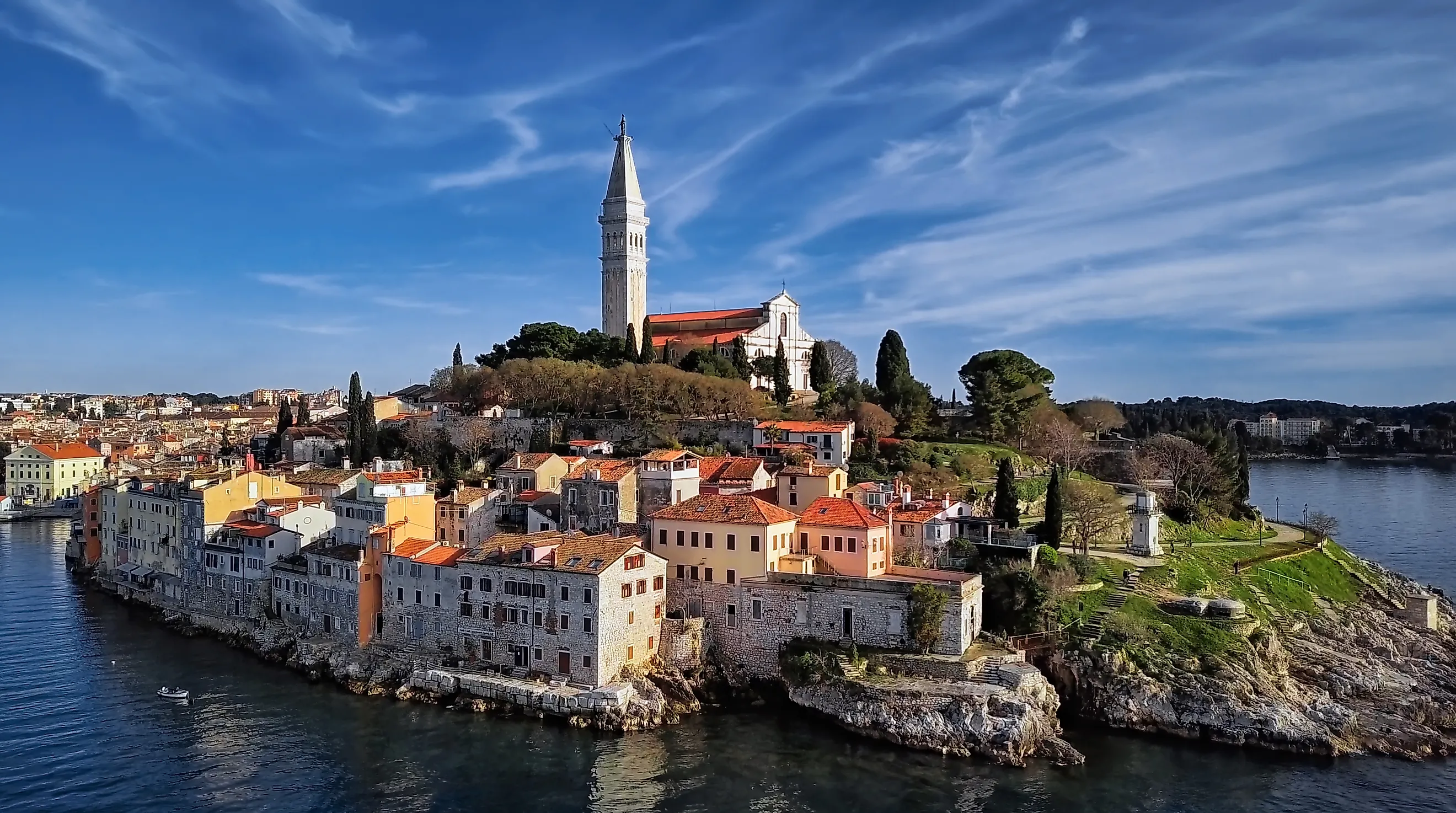
If Croatia has a poster child for small-town beauty, it is Rovinj on the western coast of Istria. Its old town crowds onto what was an island until the 18th century, a jumble of ochre and rose houses rising directly out of the turquoise sea to form one of the most photographed waterfronts in the country. Cobbled Grisia Street climbs from the harbor to the Church of St. Euphemia, whose 200-foot bell tower is modeled on the campanile in Venice, a reminder of the centuries of Venetian rule that still shape the town. Rovinj is officially bilingual in Croatian and Italian, and that dual heritage flavors everything from the street signs to the excellent seafood.
Motovun, Istria

Head inland into the green heart of Istria and you will find Motovun, a medieval village crowning a steep hill above the Mirna River valley. Its name comes from a Celtic phrase meaning "town in the hills," and the setting is everything: vineyards, oak forests famous for their truffles, and morning mist pooling in the valley below. Ringed by 13th-century Venetian walls that you can pay a small fee to walk, Motovun rewards the climb with wide valley views and the aroma of freshly shaved truffle drifting from its restaurants. Each July it hosts a well-loved film festival, and a short drive away sits Hum, billed as the smallest town in the world.
Trogir, Dalmatia

Just up the coast from Split, Trogir squeezes thousands of years of history onto a small island wedged between the mainland and the island of Čiovo. Its remarkably preserved core is so complete that the whole thing is a UNESCO World Heritage Site, and its car-free stone streets make wandering an absolute pleasure. The showpiece is the Cathedral of St. Lawrence, a Romanesque-Gothic masterpiece famous for the intricately carved stone portal that Master Radovan completed in 1240. Out on the western tip stands the 15th-century Kamerlengo Castle, a Venetian fortress whose courtyard now hosts summer concerts and theater beneath the open sky. Locals proudly call it a "museum town," and it is easy to see why.
Šibenik, Dalmatia

Set where the Krka River meets the sea, Šibenik has a distinction its neighbors cannot claim: rather than being founded by Greeks or Romans, it was established by Croatians, first mentioned in the 11th century. Its UNESCO-listed historic core is a warren of connected stone streets and squares centered on the extraordinary Cathedral of St. James, built entirely of stone without a scrap of timber or brick. The medieval main street, known as Kalelarga, remains one of the country's most memorable main streets, lined with cafes and shops. Ringed by hilltop fortresses and sitting at the doorstep of Krka National Park's waterfalls, Šibenik has quietly become one of Dalmatia's most rewarding stops.
Korčula, Dalmatian Islands

Out on its own island, the walled town of Korčula is so strikingly beautiful that it is often nicknamed "Little Dubrovnik." Jutting into the sea on a small peninsula, its medieval center follows a clever fishbone street plan, with lanes angled to catch cooling breezes while blocking harsh winds. Venetian stonework, a fortified gate, and a compact tangle of alleys make it a joy to explore on foot. The town also stakes a famous, if hotly debated, claim as the birthplace of the explorer Marco Polo. In summer, visitors can catch a performance of the Moreška, a centuries-old sword dance that has been performed here for generations.
Ston, Pelješac Peninsula

Guarding the neck of the Pelješac Peninsula, the little town of Ston hides a genuinely astonishing feature: a chain of defensive walls stretching more than three miles over the hills, sometimes called the "European Great Wall." Built by the wealthy Republic of Dubrovnik to protect the valuable resource beyond them, the walls are among the longest in Europe and can be walked today. That resource was salt, and Ston's salt pans have been worked continuously since ancient times, still harvested by hand. The surrounding Mali Ston Bay is equally prized for its oysters, considered among the finest in the world, making this a town that delights history buffs and food lovers in equal measure.
Cavtat, Southern Dalmatia

Just 20 kilometers southeast of Dubrovnik, Cavtat offers much of the same Adriatic magic with a fraction of the crowds. Set on a pair of green peninsulas, this relaxed resort town wraps a palm-lined waterfront promenade around a calm harbor bobbing with boats. The pace here is unhurried, built around long seafront walks, swims off the rocks, and dinners of fresh fish at waterside konobas. Above the town, the Račić family mausoleum, sculpted by the renowned artist Ivan Meštrović, is a quiet highlight, while the ancient roots of the settlement reach back to the Greek colony of Epidaurum. For travelers who want the Dubrovnik Riviera without the bustle, Cavtat is the answer.
Omiš, Central Dalmatia

Dramatically framed by soaring gray cliffs at the point where the emerald Cetina River rushes into the sea, Omiš has one of the most spectacular settings on the Dalmatian coast. In the Middle Ages, this natural fortress made it a feared pirate stronghold, and the corsairs who once terrorized the Adriatic launched their raids from here. Today you can climb to the ruined Mirabela and Starigrad fortresses clinging to the rock for a bird's-eye view, or head up the gorge for rafting and zip-lining. The town is also a heartland of klapa, the traditional Croatian a cappella singing recognized by UNESCO, which still echoes off the cliffs on summer evenings. Beaches, a river, mountains, and history all meet in one compact, memorable place.