11 Of The Most Adorable Small Towns In Croatia
Croatia keeps its best stories in places you can cross on foot in an afternoon. Trogir packs a UNESCO old town onto an island barely larger than a city block. Omiš taught the country a style of unaccompanied singing that still echoes off its cliffs every summer. Samobor turned painted gingerbread hearts into a craft the rest of Croatia copies. The eleven towns here trade in that kind of specific local pride, the sort that comes from one tradition done well for a very long time.
Rovinj

Color is the first thing anyone notices about Rovinj, where houses in faded ochre and rose rise straight out of the Adriatic to form one of the most photographed waterfronts on the Istrian coast. The streets climb toward the Church of St. Euphemia, whose Venetian bell tower borrows its shape from St. Mark's in Venice and confirms which empire once ran the place. Grisia Street is the giveaway to the town's character: every summer, painters and sculptors hang their work along its stone staircases, turning the climb into an open-air gallery. Down at the harbor, the Batana Eco-Museum keeps the batana, the flat-bottomed wooden fishing boat that locals still treat as a hometown emblem.
Trogir

Settle on the fact that an entire UNESCO-listed old town sits on an island you can walk across in ten minutes, linked to the mainland by short bridges, and Trogir starts to make sense. Greek colonists founded it in the 3rd century BC, and the centuries since left a tight grid of medieval lanes and Renaissance palaces built by local stonemasons. That masonry tradition reaches its height at the Cathedral of St. Lawrence, where the Radovan Portal carves a whole medieval world into the doorway. A few minutes' walk through the alleys leads to the Convent of St. Nicholas, which has guarded its religious art and stone carving for close to a thousand years, and then to the Kamerlengo Fortress standing watch at the island's western edge.
Omiš

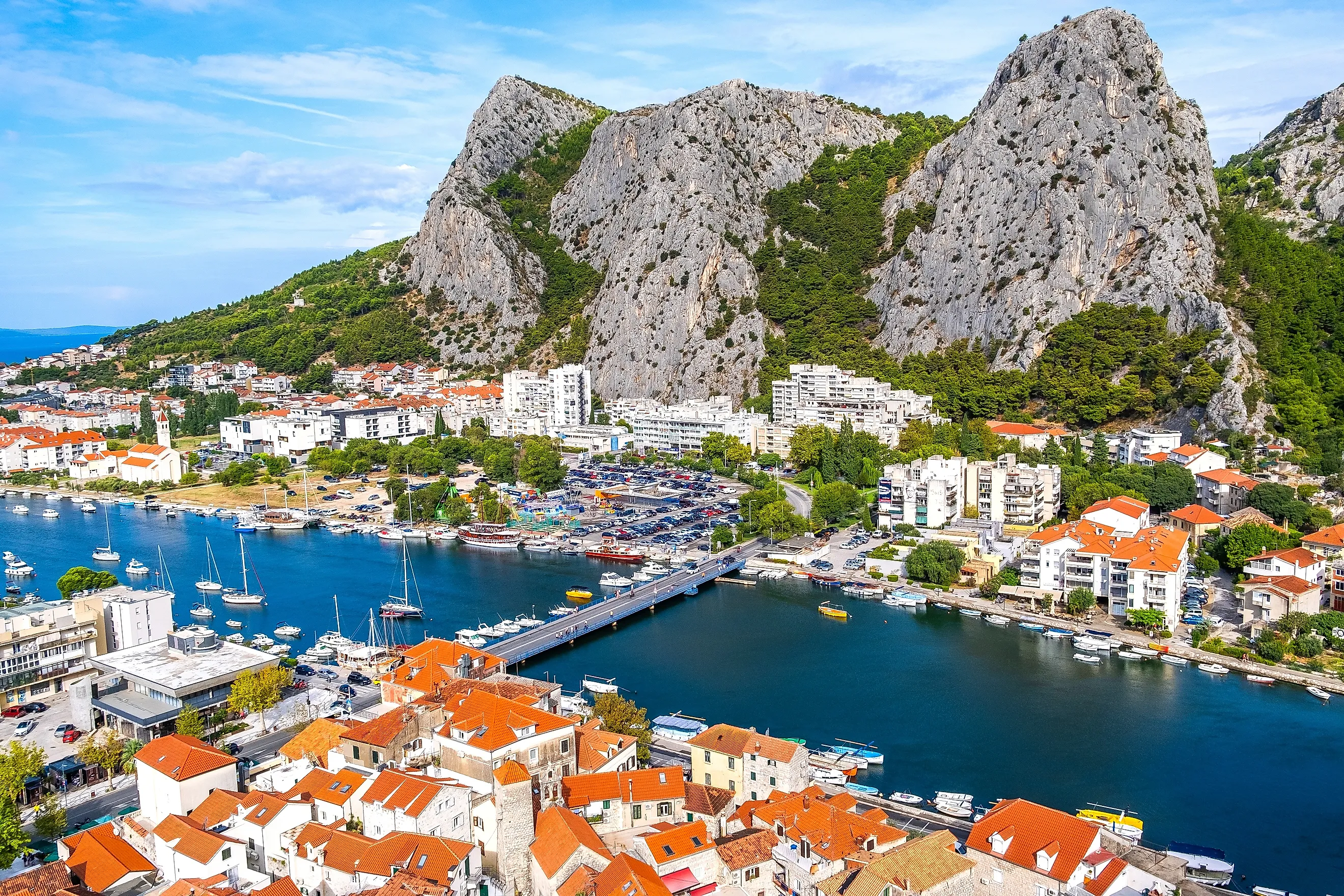
Pirates used to run Omiš, hiding their boats in the Cetina River gorge and slipping out to raid Adriatic shipping before Venice finally shut them down. The setting still looks the part, with limestone cliffs dropping to the Adriatic Sea and the Cetina canyon now drawing rafters and climbers instead of raiders. The tradition the town is proudest of, though, is musical. Omiš is the home of Dalmatian Klapa, an unaccompanied vocal harmony, and every summer its squares fill for the Festival of Dalmatian Klapa, where groups sing against the walls of the Mirabella Fortress that once guarded the river mouth.
Cavtat

Twenty kilometers south of Dubrovnik, on a pine-covered peninsula that was the Roman town of Epidaurum, Cavtat has drawn Croatian artists for more than a century. The painter Vlaho Bukovac was born here in 1855, and his childhood home is now the Bukovac House Museum, frescoes he made as a teenager still on the walls. Up at the cemetery on the peninsula's highest point stands the Račić Mausoleum, the sculptor Ivan Meštrović's first complete architectural work, built between 1920 and 1922 from white Brač stone with no wood anywhere in it. The two sites bracket the town: one the cradle of a painter, the other the masterwork of a sculptor.
Skradin

Most visitors treat Skradin as the boat dock for Krka National Park and miss the town entirely, which is their loss. The stone streets on the bank of the Krka River lead up to Malena Square, where family-run cellars have spent generations bottling small-batch herbal liqueurs and the indigenous white wine Debit. The Church of the Nativity of the Blessed Virgin Mary holds a collection of sacred folk art and an 18th-century organ. The waterfalls upriver get the postcards, but the slower pleasures are down here in the town.
Samobor

Just west of Zagreb, Samobor is the keeper of one of Croatia's most recognizable crafts. Around King Tomislav Square, artisans still make Licitars, the brightly painted gingerbread hearts pressed into carved wooden molds that UNESCO recognizes as part of Croatian cultural heritage. The other reason locals send you here is edible: a slice of Samoborska kremšnita, the town's custard cream cake, at the historic Kavana Livadić. Come for the hearts, stay for the cake, which is roughly how the town has worked for generations.
Krk

Croatia's largest island gave the country one of its founding documents. The town of Krk and the wider island were a stronghold of the Glagolitic script, the oldest known Slavic alphabet, and the nearby Baška Tablet from around 1100 carries one of the first recorded uses of the Croatian name in Croatian. Medieval walls and the Frankopan Castle still dominate the old town, recalling the powerful noble family that ruled here for centuries. The Cathedral of the Assumption preserves the stone inscriptions that tie the place to that literary past, while folk costumes and old wind instruments turn up at celebrations along Krk Harbor.
Ston

The wall at Ston runs more than five kilometers up and over the hillside, among the longest defensive fortifications in Europe and built in the 14th century by the Republic of Ragusa for one unglamorous reason: salt. From the battlements you look straight down on the geometric grid of Solana Ston, where salt has been harvested by hand the same way since the Middle Ages. Walking past the Gothic-Renaissance Rector's Palace, you can reach the working basins, including the Mundo Pool, the crystallization basin whose salt was traditionally given free to anyone in town who needed it.
Grožnjan

By the early 1960s Grožnjan had nearly emptied out, an Istrian hill village of medieval gates and crooked stone alleys with almost no one left in it. Then in 1965 the town invited artists to move into the abandoned houses, and the place came back as a working art colony. The Fonticus Gallery now shows local visual art inside a 16th-century space, and each summer the Spinotti-Morteani Palace becomes a concert hall for young musicians, building toward the Jazz is Back! festival that fills the squares with music. Pass through the main gate, the Porta Maggiore, and the rescue is everywhere you look.
Baška Voda

The Biokovo massif rises almost straight up behind Baška Voda, putting some of the most vertical scenery on the Dalmatian coast directly above a quiet fishing town. Along the palm-lined waterfront, the community keeps up the maritime and fishing traditions it was built on, and you can trace that history at the local archaeological collection and St. Nicholas Church, named for the patron saint of sailors. Biokovo Nature Park is a short drive inland, with mountain trails that climb to wide views back over the Adriatic.
Slunj

Water built Slunj, and water still runs it. Where the Slunjčica River drops into the Korana, the district of Rastoke spreads across the falls: wooden homes and walkways and traditional watermills set right over the rushing streams, connected by the Rastoke Bridge. For centuries, millers built their houses directly into this waterscape and used the current to turn the stones that ground local grain. At the Jareb Mill, run by the same family for generations, you can step inside a working millhouse and watch the old stone-grinding go on exactly as it has for ages.
The Pull Of A Small Place
What ties these eleven towns together is not size but conviction: each one has held onto a single thing and kept doing it well. Omiš still sings the harmonies it taught the rest of Dalmatia. Ston still rakes salt from basins worked since the Middle Ages. Slunj still grinds grain on water-powered stones. The walls, the canyons, and the harbors are the setting, but the reason to go is the work that keeps happening inside them.