12 Offbeat Texas Towns To Visit
In Bastrop, the gas station from the original 1974 Texas Chainsaw Massacre is now a barbecue joint. In Marfa, a permanent Prada storefront sits alone on a desert highway, sealed shut, with 2005 merchandise still in the window. In Rocksprings, three million Mexican free-tailed bats fly out of a 350-foot sinkhole every summer evening. Texas has dozens of towns that do not match any of the usual cowboy or oil-money storylines, and the twelve below are some of the strangest, scattered across the Panhandle, Hill Country, and Gulf Coast.
Bastrop

Bastrop sits about 30 miles southeast of Austin on the Colorado River. The gas station that doubled as the Sawyer family's storefront in the 1974 Texas Chainsaw Massacre still stands here, on State Highway 304 in nearby Bastrop County. After decades of dereliction, the building reopened in 2012 as a barbecue restaurant called The Gas Station, with original signage left intact and Leatherface masks sold alongside the brisket. The downtown historic district has dozens of pre-1900 commercial buildings, and the Bastrop Opera House (built in 1889) still stages community theater seasons year-round.
Bastrop State Park borders the town and protects part of the Lost Pines, an isolated stand of loblolly pines about 100 miles west of their main range in East Texas. The park is also the principal habitat of the endangered Houston toad, which active recovery efforts are trying to bring back from the 2011 wildfires that burned most of its breeding grounds. Trails connect the campgrounds, swimming areas, and the Lost Pines Overlook.
Port Isabel

Port Isabel is the gateway to South Padre Island, set on the inland side of the Queen Isabella Causeway. The town leans into pirate folklore partly because the Gulf actually was a smuggling and privateering corridor in the early 1800s, with Jean Lafitte taking refuge in the area, and partly because tourism is now the local economy. Pirate's Landing Fishing Pier extends 1,500 feet into Laguna Madre Bay and is the longest pier in Texas. The Black Dragon, a working replica of a 17th-century galleon, runs themed cruises out of the marina with mock cannon fights, sword duels, and treasure hunts for kids.
The Port Isabel Historical Museum, in the 1899 Charles Champion building, holds one of the larger public collections of US-Mexican War relics; the building itself was at various times a general store, US Customs office, and post office. Just up the road, the Port Isabel Lighthouse, built in 1852 and 70 feet tall, is the only Texas lighthouse open to the public. From the top, the view covers South Padre Island, the causeway, the Brownsville Ship Channel, and SpaceX's Boca Chica launch site.
Wimberley

Wimberley is in the Hill Country, where Cypress Creek runs through the center of town. Its two main natural attractions are short drives apart. Blue Hole Regional Park is a swimming hole fed by Cypress Creek and shaded by old-growth bald cypress, with reservations required during the May-to-September swim season. Jacob's Well, four miles northwest, is an artesian spring where water emerges from a 12-foot-wide opening in the creek bed and feeds a submerged cave system that drops 137 feet and runs about 4,500 feet of mapped passage; it is the second-longest fully submerged cave in Texas.
The cave's depth and tight chambers have made it one of the more dangerous cave-dive sites in the United States, and only research divers permitted by Hays County are allowed below the surface. The EmilyAnn Theatre and Gardens, just outside the town center, runs an outdoor amphitheater with a life-size chessboard set into the lawn and stages a free Shakespeare festival each summer.
Marfa

Marfa is in the high desert of Presidio County, three hours from any major airport. It became an art town because of Donald Judd, who moved there in 1971 and spent the next two decades installing his own work and that of contemporaries inside repurposed military buildings on the old Fort D.A. Russell base. The Chinati Foundation now operates that complex; its permanent installations include 15 outdoor concrete pieces by Judd that span a quarter-mile of grass and 100 mill aluminum boxes housed in two former artillery sheds.
The town's other oddities are unrelated. Prada Marfa, a permanent installation by Elmgreen and Dragset 26 miles outside town, is built to look like a Prada boutique but is sealed and contains 2005 merchandise that has never been sold or restocked. The Marfa Lights, a still-unexplained optical phenomenon visible most clear nights from a TXDOT viewing platform on US-90, draw enough visitors that the platform has its own parking lot. The Marfa Myths music and arts festival, run by the New York record label Mexican Summer, takes over venues across town each spring.
Terlingua

Terlingua, in Brewster County near Big Bend, was a quicksilver mining town in the early 20th century and was nearly empty by the 1940s when the mines closed. Since the 1970s it has been gradually repopulated by a mix of artists, river guides, and people specifically looking to live without grid power or zoning. The original townsite, known as the Terlingua Ghost Town, still has standing adobe ruins from the mining era scattered between active homes and businesses.
The Starlight Theatre, originally a 1930s movie house, now operates as a restaurant and live music venue. Each November since 1967, Terlingua hosts the Original Terlingua International Chili Championship, which started as a publicity stunt between Texan and New York food writers and has run annually since. The cookoff regularly draws several thousand people to a town with a permanent population of around 60.
Jefferson

Jefferson, in Marion County in northeast Texas, was an inland river port in the mid-1800s. Steamboats reached it via the Red River and Big Cypress Bayou, and at its peak in the 1870s it had over 7,000 people; today the population is about 2,000. Most of the downtown's pre-Civil War commercial and residential buildings are still standing, which is part of why the town now markets itself heavily on hauntings: the historic structures have the right vintage and atmosphere for ghost tours, and the building stock is dense enough to make a walking circuit work.
The Excelsior House Hotel, in continuous operation since 1858, claims to be the oldest hotel in East Texas and is the centerpiece of the local ghost-tour industry. The Historic Jefferson Hotel, the Grove (an 1861 home open for tours), and several other buildings make the regular itinerary. The Jefferson Ghost Walk runs nightly tours that work through the haunted locations in sequence with the relevant backstory at each stop.
Cedar Creek

Cedar Creek is a small community in Bastrop County, about 25 miles southeast of Austin. Its claim to fame is functional rather than scenic. Berdoll Pecan Farm runs a 24-hour pecan pie vending machine on Highway 71 that gets restocked daily and dispenses full-size pies to anyone who shows up at three in the morning with a card. The vending machine has been operating since 2010 and has grown into a regional curiosity.
A few miles away is The Dinosaur Park, which has roughly two dozen life-size dinosaur sculptures distributed along a wooded walking trail. The Capital of Texas Zoo, also in Cedar Creek, is a small private zoo with several hundred animals, mostly rescues and surplus from larger institutions. None of these are the kind of attractions that anchor a destination, but together with the older Lost Pines Resort they have given Cedar Creek more weekend traffic than its size suggests.
Canyon

Canyon, in Randall County in the Texas Panhandle, is the access town for Palo Duro Canyon State Park. Palo Duro is the second-largest canyon system in the United States. It runs about 120 miles long, up to 20 miles wide, and 800 feet deep at most points, formed by the Prairie Dog Town Fork of the Red River cutting through the Caprock Escarpment. The state park covers around 30,000 acres of canyon floor and rim and contains over 30 miles of trails, including the round-trip route to the iconic Lighthouse rock formation.
Canyon is also home to West Texas A&M University, where the Bain-Schaeffer Buffalo Stadium opened on campus in 2019 and seats 8,500 with overflow to 12,000. The Buffaloes play at the NCAA Division II level. The Panhandle-Plains Historical Museum, on the WT campus, is the largest history museum in Texas and holds the most extensive collection of pre-1900 Texas Panhandle artifacts anywhere.
Bellville

Bellville is in Austin County, about 70 miles west of Houston, and was settled largely by German immigrants in the mid-1800s. The downtown has a high concentration of pre-1900 commercial buildings around the Austin County Courthouse square. The Historic Austin County Jail, built in 1896 and used as a working jail until 1982, is now a museum with cell blocks and the original gallows preserved.
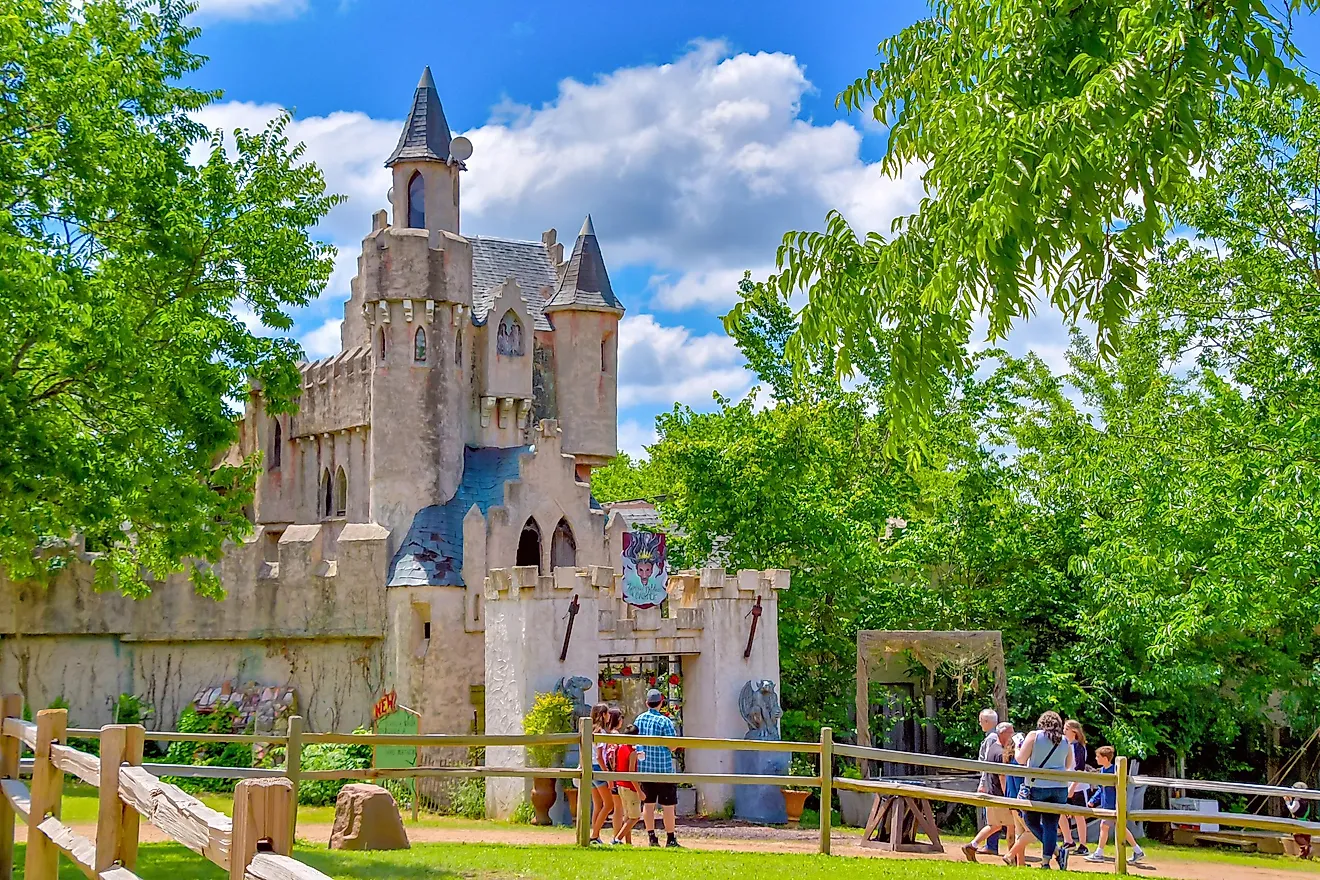
The town's most idiosyncratic attraction sits a few miles outside it: Newman's Castle, a private medieval-style stone castle that owner Mike Newman began building in 1998 and now opens for guided tours. The structure has a working drawbridge, a chapel, six towers, a moat, and a working trebuchet on the lawn. Bellville's German heritage shows up in several annual festivals; the Frühling Sängerfest singing festival, held at the historic Concordia Hall, is one of the larger ones.
Sonora

Sonora is the seat of Sutton County in the western Hill Country, off Interstate 10 about halfway between San Antonio and Big Bend National Park. Eight miles west of town is the Caverns of Sonora, a National Natural Landmark and one of the more decorated show caves anywhere. The cave is known specifically for its concentration of helictites: branching crystal formations that grow against gravity, often found in extreme density and complexity. Bill Stephenson, founder of the National Speleological Society, called it "the most indescribably beautiful cave in the world" after his first visit.
In town, the Sutton County Historical Society Museum occupies the historic Miers Home and covers ranching and frontier history. The Eaton Hill Nature Center and Preserve, on the edge of Sonora, has about three miles of hiking trails through the ranch country surrounding the town, with marked points covering local geology, plants, and the Outlaw Trail used by 19th-century rustlers.
Waxahachie

Waxahachie, the seat of Ellis County 30 miles south of Dallas, has one of the densest concentrations of late-19th-century buildings in Texas. The Ellis County Courthouse, completed in 1897, is a Romanesque Revival landmark with elaborate carved sandstone faces in its archways, the work of stone carver Harry Herley. The downtown historic district holds dozens of buildings from roughly the same period, mostly preserved because the local economy declined enough in the early 20th century that few were torn down for redevelopment.
The Munster Mansion, on the edge of town, is a private home built in 2002 as a near-exact replica of the house from the 1960s sitcom The Munsters; the owners run public tours twice a year. The Scarborough Renaissance Festival, on a permanent 35-acre site outside Waxahachie, runs eight weekends each spring and brings around 200 vendors, jousting, and mock combat to the site.
Rocksprings

Rocksprings, the seat of Edwards County, sits on the Edwards Plateau between the Hill Country and the Chihuahuan Desert. The town has a population of about 1,200 and calls itself the Angora Goat Capital of the World; the region produces roughly 90% of US mohair, and the American Angora Goat Breeders Association is headquartered here. The Devil's Sinkhole, eight miles north of town, is a single-chamber vertical cavern that drops 350 feet from a 50-by-65-foot opening at ground level. It is a National Natural Landmark and home to a colony of Mexican free-tailed bats that ranges from three to six million animals depending on the season.
The bats emerge in a swirling column at sundown most evenings from May through October. Access to the sinkhole is by guided tour only, run by the Devil's Sinkhole Society from a visitor center in Rocksprings; reservations are required. In town, the Historic Rocksprings Hotel from 1916 still operates, and the 1891 Edwards County Courthouse anchors the square. Both were among the few buildings to survive the F5 tornado that destroyed nearly all of Rocksprings on April 12, 1927 and killed 76 people.
Worth The Drive
Texas tourism marketing tends to focus on a few well-known regions. The towns above show how much variation sits outside that frame. They share little in common beyond not fitting any of the standard storylines: a barbecue restaurant in a horror-movie gas station, a sealed Prada boutique no one can shop at, a vending machine for whole pecan pies, a hole in the ground full of bats. Most are within a four-hour drive of either Austin, San Antonio, El Paso, or Amarillo, which makes a long weekend manageable from anywhere in the state. The full list runs longer than twelve.