8 Must-See Historic Towns in the Rockies
The Rockies' most historic towns each grew out of a different chapter of the American West. Buffalo Bill Cody founded the Wyoming town that carries his name in 1896 and aimed it straight at Yellowstone. Aspen and Telluride got rich on Colorado silver before ski lifts gave them a second life. Taos reaches back furthest, built around an adobe pueblo lived in for about a thousand years. Walk into any of theses eight towns and the founding story is right there in the streets and the museums.
Jackson, Wyoming

Jackson keeps its frontier bones around the town square, where 1800s log and timber buildings still stand. Long before any of it, the Crow and Bannock hunted the valley, and in the early 1800s mountain men passed through, including John Colter, Jim Bridger, and David Edward Jackson, whose name stuck to the valley. Their routes helped open the country that became Yellowstone National Park, the world's first national park, established in 1872. Permanent settlers reached the valley around 1884, the town took the Jackson name in 1894, and incorporation came in 1914.
The Jackson Hole History Museum lays out the pioneer and ranching past, and Miller Cabin preserves the home of Robert Miller, one of the valley's first homesteaders and a hand in organizing the town. Grand Teton and Yellowstone are close enough to fold into the same trip for hiking, wildlife watching, and backcountry routes.
Cody, Wyoming

Cody owes its existence to a showman who passed through in the 1870s and never forgot the view. William F. "Buffalo Bill" Cody, an Army scout and bison hunter, returned in 1896 with a group of investors and laid out the town that still carries his name, a few hours from Yellowstone's east gate. The Buffalo Bill Center of the West gathers five museums under one roof: the Cody Firearms Museum, the Buffalo Bill Museum, the Plains Indian Museum, the Draper Natural History Museum, and the Whitney Western Art Museum.
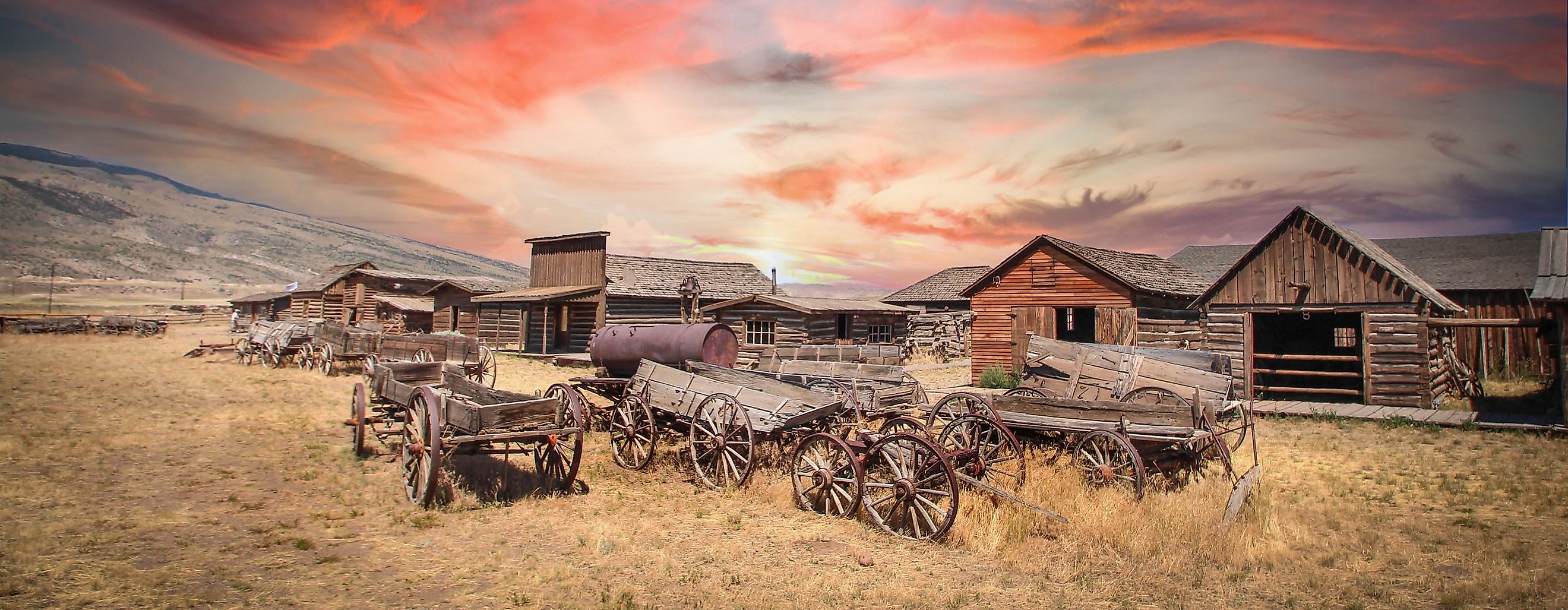
Working through all five takes a day and rewards it, with rooms of firearms, frontier art, and Plains Indian artifacts. Old Trail Town, on the edge of Cody, collects original 1890s frontier buildings, including a cabin once used by the Hole-in-the-Wall Gang.
Red Lodge, Montana

Red Lodge grew up on coal, and its main street still shows it. The valley was Crow land before European explorers arrived, and a post office opened in 1884 as the town formed around the mines that powered the regional economy late in the 19th century. The Carbon County Historical Society and Museum traces that mining past through preserved tools, photographs, and underground exhibits.
The Red Lodge Historic District still holds century-old buildings from those frontier years. The Pollard Hotel, built in 1893, was one of the town's first major buildings and still operates today. South of town, the Beartooth Highway climbs to nearly 11,000 feet and opens only in summer as a route toward Yellowstone.
Park City, Utah

Park City wears its silver-boom past on a Main Street rebuilt after fire. The route first carried Mormon pioneers toward Salt Lake City, and some stopped to settle the area they called Parley's Park after Parley P. Pratt. The town incorporated in 1884 as Park City and grew as a mining hub until the great fire of 1898 forced a near-total rebuild. The Victorian, Queen Anne, and Spanish Revival buildings along Main Street today date from that rebuilding.
The Park City Museum walks through the fire, the mining boom, and the silver rush that built the town. The McPolin Farmstead preserves 1920s farm buildings just outside town, and Deer Valley and Park City Mountain Resort draw skiers to slopes laced with old mine workings.
Aspen, Colorado

Aspen began in 1879 as a silver camp in the Colorado Silver Boom, first called Ute City for the Ute people, then renamed for the aspens on the slopes around it. Silver built it fast, the 1893 crash nearly emptied it, and skiing revived it in the mid-20th century. The 1889 Hotel Jerome still operates downtown, one of the few buildings to come through the crash intact.
The Wheeler/Stallard Museum, an 1888 Queen Anne mansion, holds the local history collection, and the 1889 Wheeler Opera House still books shows and tours. The Aspen Art Museum adds rotating contemporary work in a building by Pritzker Prize winner Shigeru Ban.
Taos, New Mexico

Taos carries the longest history of any town here, built around an adobe pueblo continuously lived in for about a thousand years. Human presence in the valley reaches back thousands of years before that. Spanish conquistadors arrived around 1540 hunting the legendary Seven Cities of Gold, and Spanish settlers founded the town of Taos around 1615. It grew into a meeting point for Pueblo, Hispanic, and later Anglo-American trade. Taos Pueblo remains the heart of it, a UNESCO World Heritage Site of multi-storied adobe homes.
Taos Plaza, the 18th-century San Francisco de Asis Church, and the Harwood Museum of Art fill out the historic core with regional art and Pueblo-era trade history.
Georgetown, Colorado

Georgetown earned the title Silver Queen of the Rockies, and the buildings that made it rich still line the streets. Miners settled the valley in 1859 for gold, struck rich silver in 1864, and incorporated the town in 1868. The Georgetown-Silver Plume Historic District preserves the structures from the silver era that ran between 1864 and the crash of 1893.
The 1875 Hotel de Paris Museum holds more than 5,000 artifacts of early Colorado life, with 3D tours available. The Hamill House Museum keeps its 19th-century interiors, and Cooper's on the Creek pairs mining-era photographs with meals beside the creek.
Telluride, Colorado

Telluride packs a box canyon in the San Juan Mountains with Victorian mining-era buildings. The Ute hunted deer and elk here for generations, and Spanish explorers named the region in the 1700s without settling it. Prospectors made the first gold claim above the valley in 1875, and that camp grew into the town of Telluride.
The Telluride Historical Museum works out of an 1896 building that once served as a miners' hospital, with exhibits on the boom years. The Telluride Historic District preserves the Victorian streetfronts, and the 1895 New Sheridan Hotel still pours drinks at one of the oldest bars in Colorado.
The Frontier Never Fully Left These Streets
These towns reward anyone who looks past the lift lines. Georgetown still wears its Silver Queen wealth in the Hotel de Paris and the Hamill House. Park City rebuilt its whole Main Street after the 1898 fire and kept the Victorian fronts. Red Lodge holds its coal-era buildings below the Beartooth switchbacks, and Jackson keeps its log storefronts around the square. The skiing and the scenery pull the crowds, but the founding stories explain why each place looks the way it does. Make time for the museums.