8 Most Hospitable Towns In Italy
In Spello, the whole town stays up all night laying flower petals down the streets for arriving guests. In Santo Stefano di Sessanio, you bake the village bread yourself. These eight small towns treat a visitor as a temporary local. In Italy, you earn the welcome by pitching in.
Spello, Umbria

Once a year this Roman hill town of about 8,200 on the flank of Mount Subasio hands its streets over to its guests. For the Infiorata, held on the feast of Corpus Domini, nearly a thousand residents work through a single night to carpet a mile of narrow streets with pictures made entirely of flower petals. Neighbors, families, and local guilds each take an assigned stretch of pavement, and anyone who arrives the evening before is often waved down to kneel and help lay petals. The rest of the year, residents keep the "City of Flowers" title alive on the geranium-draped balconies along every lane. Two Roman gates, the triple-arched Porta Consolare and the Porta Venere with its twin towers, have stood at the entrances for 2,000 years. Inside Santa Maria Maggiore, the Baglioni Chapel holds a cycle of Pinturicchio frescoes counted among his finest work.
Locorotondo, Puglia

A tidy ring of whitewashed houses sits atop a low hill in the Valle d'Itria. The Italian Touring Club gave Locorotondo an Orange Flag partly for how easily its old town takes in visitors on foot. The social center is Piazza Vittorio Emanuele II, an open-air drawing room framed by nineteenth-century palazzi, where the town's tourist point shares the square with cafes and a coat of arms set into the pavement. Along Via Nardelli, a belvedere that locals fondly call the "lungomare" despite the sea being far off, the view opens over a valley of vineyards, dry-stone walls, and thousands of trulli. Owners of the masserie and trullo guesthouses down in that countryside built their reputations on an open table. Locorotondo also makes its own crisp white DOC wine, first designated in 1969 and best sampled in a vaulted cellar trattoria over a plate of orecchiette.
Orta San Giulio, Piedmont

This village of roughly 1,200 sits on a quiet peninsula reaching into Lake Orta, and it holds an Orange Flag awarded expressly for how graciously it hosts visitors. Life gathers in Piazza Motta, a lakefront square open on one side to the water and lined with cafes and gelaterias. The frescoed Palazzo della Comunità of 1582 stands over it, and traders have filled the square every Wednesday for centuries. A short boat ride crosses to the Isola San Giulio, where a Benedictine monastery sits at the head of a cobbled path marked with hand-lettered signs for the "Way of Silence." Above the village, the UNESCO-listed Sacro Monte di Orta climbs through woodland past 20 frescoed chapels dedicated to the life of Saint Francis, with lake views between the trees. At aperitivo hour, residents and guests fill Piazza Motta again as the tables spread toward the shore and the light fades over the island.
Sant'Agata de' Goti, Campania

Travelers to this Campanian borgo of about 11,000 tend to remark first on the warmth of its residents, and the town backs that reputation with two festivals built around bringing everyone together. Its own Infiorata carpets the streets with petals, while the Giostra del Cavaliere fills the historic center with a costumed medieval joust that pulls the whole community into the staging. The houses sit along a dramatic tuff ridge, and the classic view of them rising straight from the rock is best caught from the Ponte sul Martorano. In the center, the Cathedral of Santa Maria Assunta was founded in 970 and keeps a columned crypt beneath its later Baroque shell, while the Romanesque church of San Menna preserves a Cosmatesque mosaic floor counted among the oldest in Italy. The Castello Ducale, part Lombard and part Norman, sits at the heart of a town that holds an Orange Flag for its hospitality. Cafes in Piazza Umberto I pour the local Falanghina del Sannio.
Corinaldo, Le Marche

Corinaldo sits on a hillside above the Nevola valley inside nearly a kilometer of intact fourteenth-century brick walls, and its Orange Flag reflects a town that has made welcome a civic craft. The most theatrical corner is La Piaggia, a steep stone staircase of a hundred steps, halfway up which sits the Pozzo della Polenta, a well wrapped in local legend. Residents lean into that legend with a warm sense of humor: Corinaldo cheerfully calls itself the "town of fools," and its summer Contesa del Pozzo della Polenta fills the streets with costumed processions, taverns, and games that turn the whole borgo into a shared table. Visitors can walk the ramparts almost end to end, looking out over the hills between the towers and gates. As the birthplace of Saint Maria Goretti, the town has long made a point of receiving pilgrims at her sanctuary with care.
Petralia Soprana, Sicily

Petralia Soprana is the highest village in Sicily's Madonie mountains, above 1,100 meters, with a population near 3,000. Its hospitality shows itself slowly, over cheese and cinnamon biscuits at a bar in the square. Voted the winner of RAI's "Borgo dei Borghi" title in 2018, the town centers on Piazza del Popolo, a gathering point ringed by the battlemented town hall and the noble Palazzo Pottino, whose costumed guides walk visitors through rooms once used to receive a king. Three panoramic terraces, at Loreto, Carmine, and Piazza Duomo, look out toward Mount Etna smoking on the horizon. The Chiesa Madre dedicated to Saints Peter and Paul frames the eastern square with its twin bell towers, one of them medieval, linked by a columned portico. Family trattorias in the alleys serve the warm welcome the town is known for, plating up arancini and the local sfoglio pastry for anyone who climbs this far into the mountains.
Santo Stefano di Sessanio, Abruzzo

This fortified stone village in the Gran Sasso highlands, home to little more than a hundred year-round residents, holds one of Italy's most celebrated experiments in hospitality. In the early 2000s a visionary restoration made it a landmark albergo diffuso, a "scattered hotel" that spread guest rooms, a restaurant, and a reception across abandoned houses throughout the village, all furnished to preserve the mountain-peasant character of the place. Guests learn to bake bread, spin wool, and cook Abruzzese dishes, sharing tables in a way that dissolves the line between visitor and resident. Residents showed the same communal spirit after the 2009 earthquake, when they pulled together to help one another through the damage. The Medici Tower, toppled in the quake and rebuilt with its original stone, again stands above the Medici gate. Shops along the lanes sell the prized local lentils, and the surrounding national park opens onto trails for walkers, cyclists, and riders on horseback.
Greve in Chianti, Tuscany

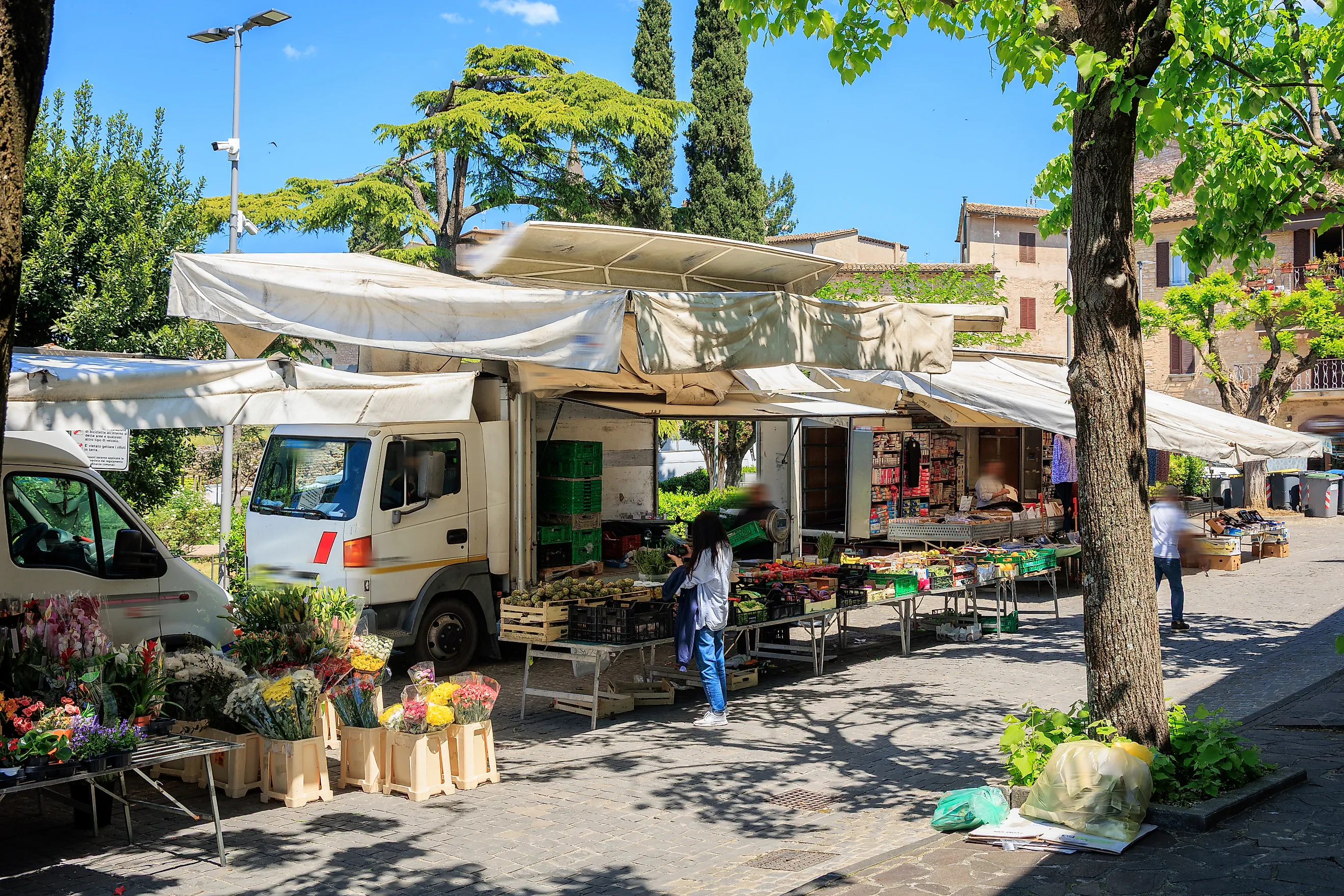
The gateway to the Chianti Classico wine country built its reputation on the welcome of the table, and its membership in the Cittaslow "slow city" movement makes that ethos official. The heart of this town of about 13,400 is the triangular Piazza Matteotti, whose asymmetric arcades, each raised by a different owner over the centuries, hold wine shops, butchers, and cafes rather than a museum's worth of monuments. Every Saturday a market of local produce fills the square. Each September, growers from across the zone gather for the Chianti Classico Expo to pour their Sangiovese for visitors under the loggias. At the historic Falorni butcher and its adjoining enoteca, the tasting counter lines up dozens of local labels beside boards of finocchiona and cinta senese. A short walk uphill reaches the fortified hamlet of Montefioralle, its stone lanes coiled around an ancient castle, an easy stroll that ends over a glass of Chianti.
What Sets These Towns Apart
The welcome in these eight towns is something a visitor takes part in rather than watches. In Spello and Sant'Agata de' Goti that means kneeling on the pavement to lay flower petals beside the neighbors who dreamed up the design. In Santo Stefano di Sessanio it means sleeping in a restored village house and learning to bake its bread. In Locorotondo, Orta San Giulio, Corinaldo, and Greve it means a seat at a long table where residents outnumber tourists. Petralia Soprana keeps the same bargain over cheese and biscuits at a mountain bar. The traveler who joins the festival or pulls up a chair at aperitivo is the one who leaves feeling less like a guest and more like a returning friend.