10 Unforgettable Small Towns to Visit in Virginia
Virginia has small towns where the reason to visit is immediately visible. In some destinations, it is geological, such as Luray. In others, it is cultural or historical, like in Galax.
Each town on this list is small enough to experience without planning and specific enough that the visit centers on one clear thing. You might spend an afternoon underground listening to music produced by cave formations, walk straight through a town on a long-distance trail, or watch a freight train pass through a mountain instead of around it. Read on to these 10 unforgettable small towns to visit in Virginia.
Luray

Luray is positioned directly between Shenandoah National Park’s Thornton Gap entrance and the Massanutten Mountain range, making it both a cave destination and a mountain access point. The center of gravity is Luray Caverns, discovered in 1878 and still privately operated. The caverns are known worldwide for the Great Stalacpipe Organ, the only full-scale underground musical instrument on earth. It spans 3.5 acres and uses electrically triggered rubber mallets to strike tuned stalactites. The result is music produced by the cave itself, something not replicated anywhere else in the U.S. Visitors also pass features like Titania’s Veil and the Saracen’s Tent, all on paved, well-lit paths that make the experience accessible.

Within the same grounds, the Luray Valley Museum offers a focused look at rural Appalachian life through preserved barns, wagons, and early farming tools. Alternatively, the Car and Carriage Caravan Museum adds another layer, with over 140 restored vehicles ranging from 18th-century carriages to early Ford automobiles, making it one of the most complete collections of its kind in the country. Luray also serves as a calm eastern entry point to Shenandoah National Park. The Thornton Gap entrance is less than 15 minutes away, giving access to Skyline Drive and trails like Marys Rock, a 3.7-mile round-trip hike with open valley views.
Grottoes

Grottoes is where the South River cuts through the Blue Ridge foothills, and is nationally known for hosting one of the earliest tourist cave sites in the country. The town’s defining landmark is Grand Caverns, which has operated continuously since 1806. It is the oldest show cave in the United States, still open to the public. Unlike most commercial caverns, Grand Caverns preserves historic graffiti carved by 19th-century visitors, including signatures dating back over 200 years. The guided route covers roughly half a mile and highlights massive flowstone formations, underground rooms used for Civil War gatherings, and rare shield formations that are uncommon in U.S. caves.
Above the cave system sits Grand Caverns Park, an over 100-acre public park with access to the South River. The park includes more than five miles of wooded trails, picnic shelters, and fishing access along a slow, clear stretch of river. It is also a known site for birdwatching, especially during spring migration. Next to the main cave, Fountain Cave Adventure Tours promises a more immersive spelunking option where you crawl and explore lesser-seen sections of the limestone system. These tours are physically demanding but provide insight into how early visitors might have first encountered the underground world.
Galax

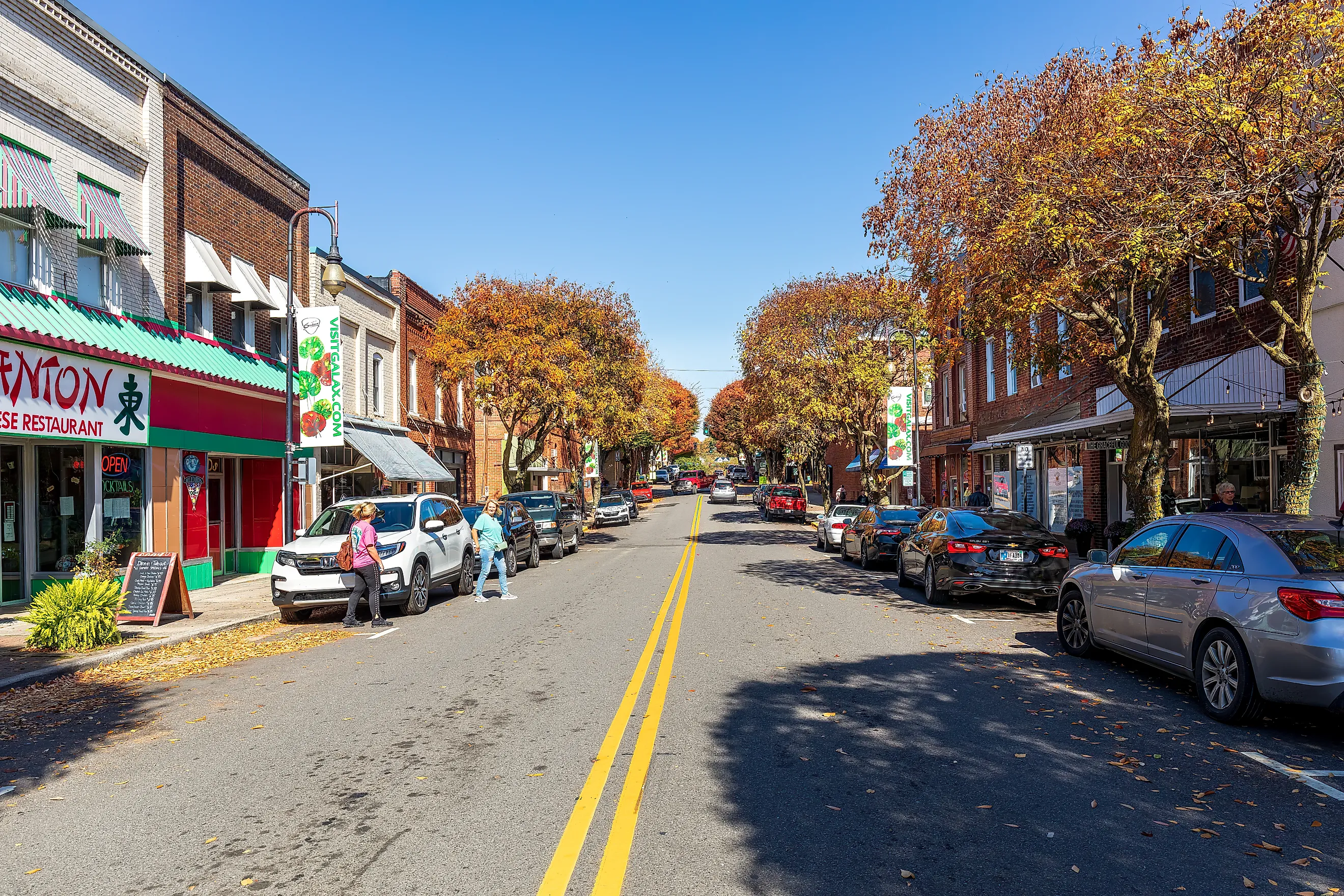
Galax developed as a rail and manufacturing town that later became a national center for traditional Appalachian music. The most distinctive experience is the Old Fiddlers’ Convention, held every August at Felts Park. Running since 1935, it is the longest continuously operating old-time fiddlers’ convention in the United States. Musicians camp on site for a full week, with informal jam sessions that happen day and night. Music history continues at the Rex Theater, a restored 1940s movie house that now hosts weekly bluegrass and old-time performances.

Galax is also a key access point for New River Trail State Park. The paved multi-use trail runs 57 miles total, with a restored depot in town serving as a trailhead. This stretch follows the New River through farmland and bluffs and is especially popular for cycling and flat, long-distance walks. For hands-on culture, Chestnut Creek School of the Arts has workshops in woodworking, pottery, and instrument building, keeping local craft traditions active.
Damascus

Damascus is organized around movement, with Main Street functioning as a shared corridor for hikers, cyclists, and residents rather than a boundary between them. The Appalachian Trail passes directly through downtown, allowing hikers to step off a 2,190-mile route and into grocery stores, cafés, and outfitters without leaving the trail. This direct integration is rare in the U.S. and creates constant turnover without congestion. Several other national trails, including the Iron Mountain and U.S. Bicycle Route 76, intersect within a few blocks.

Intersecting downtown is the Virginia Creeper Trail, a 34.3-mile rail trail connecting Whitetop to Abingdon. Damascus sits near the midpoint, making it the busiest access point. The Whitetop-to-Damascus downhill section is especially popular for cycling, dropping over 2,000 feet in elevation along Whitetop Laurel Creek. The town also hosts the headquarters of Mount Rogers National Recreation Area, which manages over 150 miles of trails, including access to Virginia’s highest peak. The visitor center provides detailed maps, trail conditions, and seasonal guidance rather than generic displays.
Breaks

On the Virginia-Kentucky line, Breaks is built around a single geographic feature rather than a traditional downtown. Everything here points toward the gorge carved by the Russell Fork River. The defining draw is Breaks Interstate Park, which protects a five-mile-long canyon reaching depths of more than 1,600 feet, making it the deepest gorge east of the Mississippi River. The park’s overlooks are not symbolic stops. Stateline Overlook and Tower Tunnel Overlook provide direct views into sheer rock walls and river bends far below.
Hiking is focused and purposeful. Prospector’s Trail, a two-mile round trip, descends into the gorge and exposes layered sandstone cliffs and narrow ravines shaped by centuries of water flow. The Russell Fork River itself is internationally recognized for whitewater rafting. During scheduled releases from the dam, the river hosts Class V rapids that draw expert paddlers from across the country. This combination of controlled releases and extreme terrain is rare in the eastern U.S.
Chincoteague

Chincoteague is a working island town on Virginia’s Eastern Shore, tied directly to a protected barrier island rather than inland development. The town’s defining relationship is with Assateague Island National Seashore, where wild ponies roam freely across marshland and dunes. While the island itself is federally managed, Chincoteague is the sole access point on the Virginia side, and the ponies are cared for by the local volunteer fire company. The annual Chincoteague Pony Swim is unmatched in the U.S., with horses swimming the Assateague Channel into town waters before being paraded through Chincoteague.

The Chincoteague National Wildlife Refuge delivers structured access to coastal ecosystems. The 3.25-mile Wildlife Loop provides flat walking and cycling routes through salt marsh and pine forest, while the 1.5-mile Woodland Trail passes through interior habitats rarely seen from the beach. Finally, the seasonally open Museum of Chincoteague Island focuses on oyster harvesting, boatbuilding, and pony history, with exhibits built around real tools and photographs rather than recreated scenes.
Tangier Island

Tangier Island is smack dab in the middle of the Chesapeake Bay, accessible only by boat or small aircraft, and has remained physically and culturally isolated for centuries. The most singular experience is hearing the local dialect, a preserved form of early English shaped by 17th-century settlers and sustained by limited outside contact. Linguists have studied Tangier for decades because this accent does not exist anywhere else in the United States and is still spoken in everyday conversation, not performances.

The Tangier History Museum and Interpretive Cultural Center provides context for the island’s way of life. Exhibits focus on watermen culture, oyster harvesting tools, handmade crab scrapes, and photographs documenting erosion and land loss. James Parks Marine operates as a working dock and repair point for local watermen rather than a visitor-facing marina. Boats are hauled, patched, and relaunched within view of footpaths, making maintenance part of the daily landscape. Crab pots, fuel drums, and skiffs are staged in open view. Meals on the island often happen at Lorraine’s Seafood Restaurant, a long-running spot acclaimed for soft-shell crab, crab cakes, and oyster dishes sourced directly from local boats.
Warm Springs

Warm Springs is a compact Bath County village organized around a single natural resource that has shaped its layout and purpose for more than two centuries. The core experience is the Jefferson Pools (or Warm Spring Pools), the oldest continuously operating hot spring baths in the United States. The pools are fed by naturally heated mineral water emerging at about 98 degrees Fahrenheit and are housed in separate men’s and women’s bathhouses built in the 1760s. Bathing sessions are limited and quiet, with no jets, no chemical treatment, and no modern spa features, making the experience closer to how visitors bathed during the colonial era, including Thomas Jefferson himself.

Nearby, the Warm Springs Gallery and Garden Café acts as a combined cultural and social space. The gallery highlights Appalachian and regional artists working in wood, clay, and mixed media, while the café operates with a short menu and garden seating that draws both locals and visitors into the same small space. A short walk away, Warm Springs Presbyterian Church stands as one of the oldest structures in town. Built in the late 18th century, the simple stone church reflects the settlement patterns that grew around the springs and remains in active use.
Saltville

Saltville occupies a broad valley in southwest Virginia where natural salt deposits once drew Ice Age animals and early humans to the same ground. Archaeological work here has documented mastodon remains found alongside stone tools, making Saltville one of the most important sites in North America for studying early human-megafauna interaction. The Museum of the Middle Appalachians is the best place to understand why. The museum’s extensive Ice Age exhibits include full-size casts and actual fossils of mastodons, woolly mammoths, giant beavers, musk-oxen, and other creatures that were attracted to prehistoric salt springs more than 15,000 years ago. These remains from the late Pleistocene Epoch make Saltville one of the longest-studied fossil localities in North America and contribute to ongoing research into early human-megafauna interactions, a type of evidence that few other American towns can claim.
History continues at the Saltville Battlefields Historic District, where Civil War battles were fought over the town’s salt works in 1864. Interpretive trails weave past earthworks, salt furnace remnants, and overlook points that explain why salt production was vital to both Confederates and Union forces. Furthermore, the Salt Trail stretches roughly 8.7 miles between Saltville and Glade Spring along a repurposed rail corridor. It’s a flat multi-use path used for walking, cycling, and enjoying wetlands and farmland vistas.
Duffield

Duffield lies in western Scott County along U.S. Route 23, with rail lines, creek access, and state park land concentrated tightly around the town’s edge. Just outside town is Natural Tunnel State Park, home to one of the most unusual geological formations in the United States. The Natural Tunnel is an 850-foot-long limestone passage carved by Stock Creek and large enough to carry an active railroad line. Freight trains still pass through the tunnel several times a day, creating a rare combination of natural formation and modern infrastructure that cannot be found elsewhere in the country. A chairlift provides access to the tunnel floor, while overlook platforms allow views from above.

Duffield also serves as a practical base for reaching Devil’s Bathtub, one of Virginia’s most distinctive natural features. The hike to the Bathtub is about seven miles round trip and follows multiple stream crossings before reaching a cylindrical rock pool carved smooth by rushing water. Its shape and depth are unlike those of typical swimming holes in the eastern U.S. In town, the Daniel Boone Wilderness Trail Interpretive Center documents early frontier movement through the region. The displays give knowledge on Boone’s role in opening western routes and the importance of Duffield as a waypoint along the Wilderness Road.
These unforgettable small towns to visit in Virginia stand out because each offers something you cannot experience elsewhere. You can hear cave walls turned into music in Luray, walk straight through Damascus on the Appalachian Trail, or watch wild ponies swim into Chincoteague. Galax keeps old-time mountain music alive, Saltville preserves Ice Age mastodon sites, and Duffield pairs an active railroad with a natural tunnel. Together, they show Virginia through geology, history, and living traditions.