8 Coolest North Carolina Towns For A Summer Vacation
A summer ferry out of Beaufort lands on Shackleford Banks, an island where wild horses outnumber people. In Highlands, several waterfalls are a short walk from downtown, with a cliff-top trail up Whiteside Mountain just outside it. At Nags Head, the tallest sand dune on the East Coast rises straight off the beach, with shipwrecks a short kayak offshore. Every July, an outdoor arts festival takes over Boone, a short drive from carriage trails on the Blue Ridge Parkway. Each of these North Carolina towns turns a hot afternoon into an itinerary.
Highlands

A luxury hotel in Highlands, North Carolina
Highlands stands at 4,118 feet on the Eastern Continental Divide, one of the highest incorporated towns east of the Mississippi. Summer temperatures there rarely climb past the high 70s. The town receives more than 80 inches of rain a year, which feeds dense temperate rainforest and several waterfalls within walking distance of the center. Reached mainly by winding two-lane roads, Highlands has stayed small and curated, with few concessions to mass tourism.

The Bascom, a visual arts center in a converted barn, offers rotating exhibitions, studio workshops, and a sculpture trail. The Whiteside Mountain Trail, a 2-mile loop, crosses ancient exposed rock and delivers 700-foot cliff views. Wild Thyme Gourmet serves regional trout and local produce inside a restored Main Street storefront. The Highlands Biological Station, operated by Western Carolina University, includes a botanical garden, a research lab, and programming on native Southern Appalachian ecosystems.
Bryson City

Bryson City is one of the few towns in the country bordered by a national park, a national forest, and a designated Wild and Scenic River. Its spot at the southern edge of Great Smoky Mountains National Park has made it a base for tourism and conservation since the park's founding. The Appalachian Trail crosses the state-line ridge nearby at Kuwohi, the park's highest point and the peak long known as Clingmans Dome before its 2024 renaming.

The Great Smoky Mountains Railroad operates heritage diesel and steam excursions from the town depot, including the seasonal Raft and Rail trip that combines a train ride with a Nantahala River float. The Deep Creek area of the national park, three miles from downtown, offers hiking and tubing past Tom Branch, Indian Creek, and Juney Whank Falls. The High Test Deli and Sweet Shop is known for hot sandwiches and house-made lemon bars. The Swain County Heritage Museum, in the restored 1908 courthouse, documents logging railroads, Cherokee history, and early tourism.
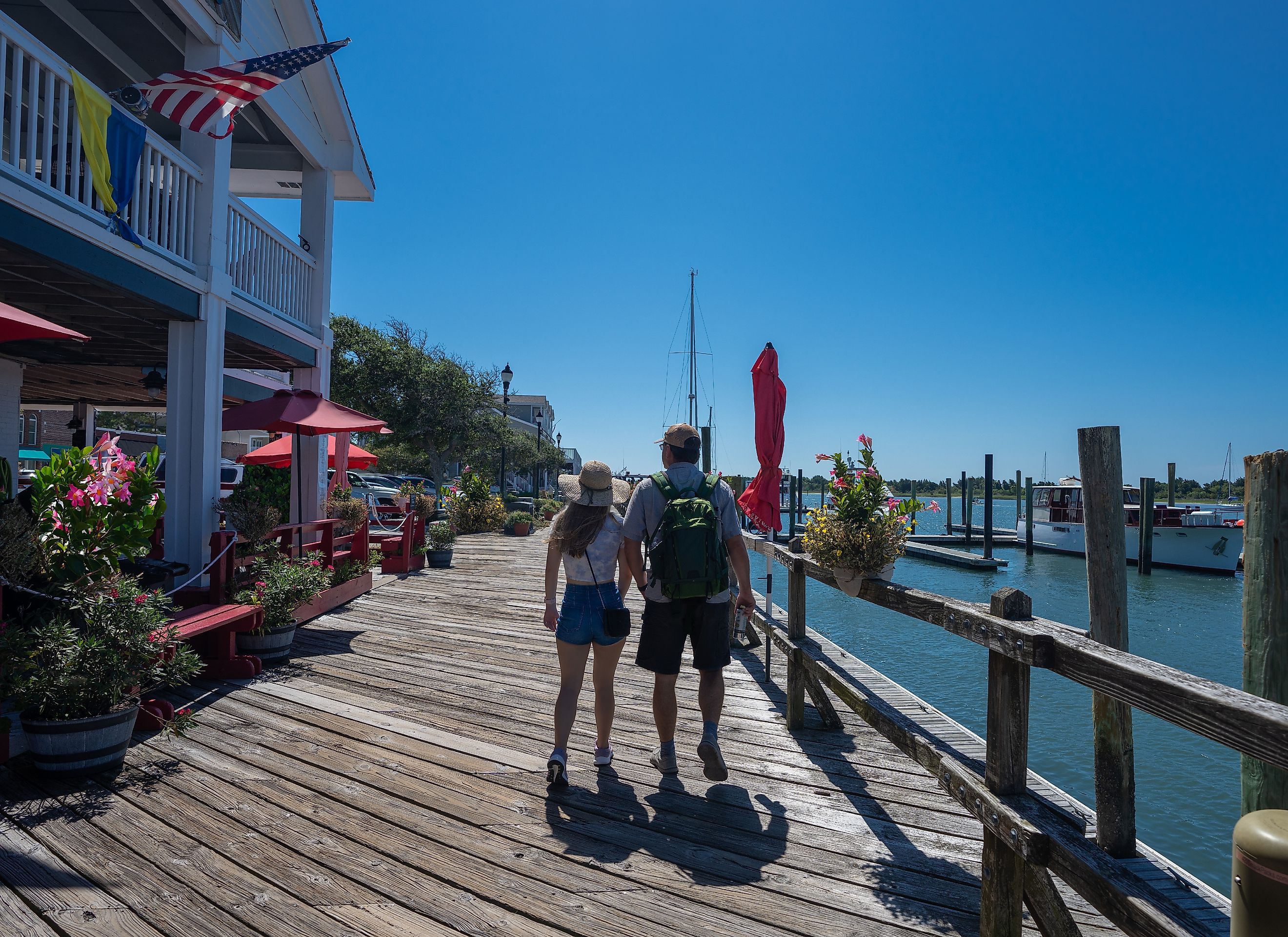
Beaufort

Beaufort is North Carolina's third-oldest town, chartered in 1722. The Old Burying Ground, from the early 1700s, contains the graves of Revolutionary War soldiers, British naval officers, and victims of yellow fever. Beaufort also has a place in pirate history. Blackbeard's ship, the Queen Anne's Revenge, ran aground nearby in 1718. Artifacts from the wreck are on display in town.

The North Carolina Maritime Museum has permanent exhibits on shipwrecks, coastal ecology, and Blackbeard's vessel. The Island Express Ferry crosses from the waterfront to Shackleford Banks, part of Cape Lookout National Seashore, home to wild horses and unbroken whelk shells. Clawson's 1905 Restaurant and Pub serves seafood platters in a restored general store. The Rachel Carson Reserve, reachable by kayak or small boat, has estuarine trails and supports more than 200 bird species.
Boone

Boone rises above 3,300 feet. The elevation puts summer highs in the 70s, among the coolest in the Southeast. The town is home to Appalachian State University, whose presence has long supported the arts, environmental research, and low-impact tourism. Its name honors Daniel Boone, who reportedly camped here in the 1760s. Some local trails still cross parts of the route he traveled.
The Appalachian Summer Festival brings ticketed music, dance, and visual-arts events to the university's Schaefer Center through July. Moses H. Cone Memorial Park, off the Blue Ridge Parkway, laces carriage trails through preserved meadows and white pine groves. Melanie's Food Fantasy on King Street serves sourdough pancakes and local eggs, often to university faculty and staff. The Hickory Ridge Living History Museum, a cluster of 18th-century cabins beside the Daniel Boone Amphitheater, has costumed interpreters demonstrating blacksmithing, weaving, and cider pressing.
Blowing Rock

Blowing Rock takes its name from a rock formation where wind off the Johns River Gorge blows straight up, often sending light objects thrown from the ledge back into the air. At 3,500 feet, the town rides the Eastern Continental Divide and claims one of the state's steadier summer climates. The Blowing Rock itself, privately managed since 1933, remains the central viewpoint, with landscaped trails and an observation tower.

Art in the Park, a juried outdoor show one Saturday a month from May through October, lines Park Avenue with work by regional painters, potters, and metalsmiths. The Blowing Rock Art and History Museum, known as BRAHM, shows exhibitions on Appalachian textiles, Cherokee crafts, and Southern portraiture. The Glen Burney Trail, reachable from downtown, drops 800 feet into a gorge past three waterfalls, including Glen Marie Falls. The Speckled Trout serves rainbow trout and seasonal vegetables with house-made preserves and local ciders.
Southport

Southport is one of the few towns on the North Carolina coast where the Cape Fear River, the Intracoastal Waterway, and the Atlantic Ocean meet. Originally named Smithville, it rebranded in the 1880s to court port investment that never arrived, which left behind a preserved grid of maritime cottages and wharves. The town has served as the backdrop for more than 40 productions, including I Know What You Did Last Summer and Safe Haven. It leans on that history for walking tours.

The North Carolina Fourth of July Festival, a multi-day event, includes a veterans' parade, a naturalization ceremony, fireworks over the river, and a shrimp-and-grits cookoff. The Fort Johnston-Southport Museum and Visitors Center occupies an 18th-century garrison that remained active through World War II. Fishy Fishy Café on Yacht Basin Drive sources clams and oysters from the nearby Lockwoods Folly River. Waterfront Park, an easy walk or bike ride, carries bench plaques marking family histories. Ships from the Military Ocean Terminal Sunny Point pass by on the Cape Fear.
Nags Head

Nags Head packs preserved maritime forest, active dune fields, and offshore shipwrecks inside a single Outer Banks town. It borders a stretch of the Graveyard of the Atlantic, where shifting sandbars and storms have wrecked thousands of vessels. The name likely traces to old decoy-lantern schemes that lured ships ashore for salvage, an early informal coastal economy. Today the Outer Banks National Scenic Byway passes through, with public access to both ocean and sound.
Jockey's Ridge State Park protects the tallest active sand dune system on the East Coast. The Nags Head Woods Ecological Preserve, a 1,400-acre maritime forest managed by The Nature Conservancy, carries boardwalks across interdunal wetlands and relic dune fields. Tale of the Whale, a waterfront restaurant on the causeway, serves she-crab soup and broiled seafood platters. From Soundside Park, a kayak across Roanoke Sound reaches the remnants of the USS Huron and other nearshore wrecks visible at low tide.
Brevard

Brevard is one of the few places in the world where white squirrels roam free. Introduced decades ago, possibly escaped carnival animals, they now carry protected status, tracked by the city and tallied in an annual count. Their presence sets the tone for a town built on odd details and deliberate preservation. At the edge of Pisgah National Forest and below the Blue Ridge escarpment, Brevard makes a practical summer base for elevation, waterfalls, and Appalachian culture.

The Brevard Music Center, a 180-acre campus, hosts more than 80 public concerts each summer, orchestral works and contemporary ensembles alike. Looking Glass Falls, a short drive away, is a roadside cascade with a plunge pool shallow enough to wade into. Highland Books, an independent bookstore in town, is known for its deep regional-history section and curated new releases. The Velvet Cup Coffee Truck, parked near Brevard College, serves cold brew and biscuit sandwiches with locally sourced ingredients.
Higher Up or Out to Sea
The cool comes from two directions here. In the mountains, Bryson City and Blowing Rock lean on elevation, waterfalls, and shade, with summer highs that never feel like the Piedmont. On the coast, Southport trades altitude for the sea breeze off three converging waterways. Brevard adds white squirrels and a full concert season to the mountain side of the ledger. The choice is really between high ground and open water. Either one drops the temperature.