The 11 Can't-Miss Towns In Germany
Germany's historic towns preserve intact city walls, Baroque churches, and Roman-era vineyards. There are even castle-topped hillsides across distinct regions. Mittenwald has turned out handmade violins since the 1600s. Rüdesheim pours Riesling along the Drosselgasse, its narrow tavern lane. In the Harz, steam trains still leave Wernigerode for the Brocken. These towns span five regions, among them Alpine castle villages, Rhine and Moselle wine towns, and the walled medieval centers of Franconia.
Schwangau, Bavaria

Two royal castles stand less than half a mile apart at Schwangau, at the foot of the Allgäu Alps. Neuschwanstein went up between 1869 and 1886 for "Mad" King Ludwig II. Hohenschwangau was rebuilt in the 1830s by his father, King Maximilian II. Both can be toured in a single day.
The Marienbrücke suspension bridge behind Neuschwanstein frames the castle across the forested Pöllat Gorge. The Alpsee at the foot of Hohenschwangau offers rowing and shoreline hiking, and on calm mornings the water mirrors the castle walls.
Schwangau marks the southern end of the Romantic Road, a scenic 217-mile route north to Würzburg. It makes a natural starting point for a longer German road trip.
Mittenwald, Bavaria

Mittenwald lies at the foot of the Karwendel range, where painted Lüftlmalerei frescoes cover nearly every building facade. The Church of St. Peter and Paul in the town center has a richly decorated Baroque interior.
Mittenwald has been a center of violin and string-instrument making since the 17th century, and master luthiers still work there. The Geigenbaumuseum, founded in 1930, traces the craft across the centuries.
The Karwendelbahn cable car climbs to 7,362 feet near the Karwendelspitze, where the summit station opens onto wide views of the valleys below.
Lindau, Bavaria

Lindau is a medieval island town on Lake Constance, which borders Germany, Austria, and Switzerland. A causeway links it to the mainland, and on clear days the snow-capped Austrian Alps rise directly across the lake.
Lindau's harbor entrance is marked by the historic Lindau Lighthouse and a stone lion, the emblem of Bavaria. The island's old town preserves a heritage-protected medieval street and half-timbered houses, and the lanes meet St. Stephen's Church, built in 1180. The Maximilianstraße, the main street, is lined with wine bars, small shops, and restaurants serving locally caught whitefish.
In summer, swimmers, sailors, and paddleboarders take to Lake Constance, with ferries to Austria and Switzerland.
Rothenburg ob der Tauber, Bavaria

Rothenburg ob der Tauber is one of only four German towns that still have a completely intact medieval city wall. Its sentry walk circles the old town for roughly 2.5 miles, past more than 40 towers and gates.
Inside the walls, St. Jakob's Church houses the Riemenschneider Altar, a late-Gothic wood carving completed in 1505. Nearby, the Medieval Crime and Justice Museum traces a thousand years of European law and punishment in often unsettling detail.
The town's winding alleys are lined with wine bars and traditional bakeries, including the year-round Käthe Wohlfahrt Christmas shop.
Dinkelsbühl, Bavaria

Dinkelsbühl is another of Germany's fully walled medieval towns, its ramparts set with towers from the 14th and 15th centuries around an old town centered on the Minster of St. George, a late-Gothic hall church. It stands about 25 miles south of Rothenburg.
The River Wörnitz traces willow-lined banks below the medieval walls. Each July, Dinkelsbühl stages the Kinderzeche, a historical pageant re-enacting how the town's children reportedly saved it from destruction during the Thirty Years' War.
Rüdesheim, Hesse

Terraced Riesling vineyards, worked since Roman times, climb the slopes around Rüdesheim, on the right bank of the Rhine where the river narrows into a gorge. The Niederwald Monument, a 125-foot statue marking German unification in 1871, stands on the hillside above and is reached by gondola, with views across the Rhine Valley and the castle-dotted slopes beyond.
The Drosselgasse, a 472-foot cobblestone lane near the river, is Germany's best-known wine alley. Wine taverns line it wall to wall, and folk music carries through the summer evenings. In autumn, the Rheinsteig and the local Riesling trails thread through the working vineyards, with tastings along the way.
Traben-Trarbach, Rhineland-Palatinate

Traben-Trarbach, on the Moselle River in western Germany, was once the second-largest wine-trading center in Europe after Bordeaux. The trade grew so large that many town-center buildings were raised over vast underground cellars, the Traben-Trarbach Underground, now open for guided tours of the old viticulture below the streets.
The town is easy to explore by bike. The ruins of Grevenburg Castle, built around 1350, look out over the Moselle Valley, a short climb above the town. North of town, Mont Royal, a fortress built for King Louis XIV in the late 17th century, adds another vantage point over the river.
Frankenberg an der Eder, Hesse

Frankenberg an der Eder's ten-towered Town Hall went up in 1509, with a tower for each of the town's guilds. The town grew up between two medieval trade routes in the forested hills of northern Hesse. Its streets look much as they did when merchants still used them.
The Liebfrauenkirche (Church of Our Lady), begun in 1286, stands at the other end of the market square. The 13th-century Hexenturm (Witches' Tower) was part of the wall that once encircled the town.
Kellerwald-Edersee National Park, just beyond town, protects marked trails through ancient beech forest.
Monschau, North Rhine-Westphalia

Medieval, half-timbered slate houses line the Rur River through Monschau, set deep in a narrow valley in Germany's Eifel highlands. The Red House, a patrician merchant's mansion from 1752, preserves a carved Rococo staircase and original period furnishings from 18th-century Germany.
Monschau Castle, built in the Middle Ages, now serves as a youth hostel, with views over the old town from its walls. The High Fens-Eifel Nature Park surrounds the town, and its trails reach heathland and beech forest within minutes of the center. It is one of the darkest parks in Germany, dark enough for a clear view of the night sky.
Wernigerode, Saxony-Anhalt

Wernigerode is one of the Harz region's best-preserved half-timbered towns, set below a hilltop castle that has stood there since the 12th century.
Wernigerode Castle began in the 12th century and took its current form in the late 19th. Its royal apartments from before the First World War are open to visitors. The Old Town Hall on the Marktplatz, dating to the 15th century, is one of Germany's most prominent half-timbered civic buildings.
The Brockenbahn narrow-gauge steam railway leaves Wernigerode and climbs through the Harz National Park to the Brocken, the highest peak in northern Germany. The summit carries the legend of the Walpurgisnacht witches' gathering.
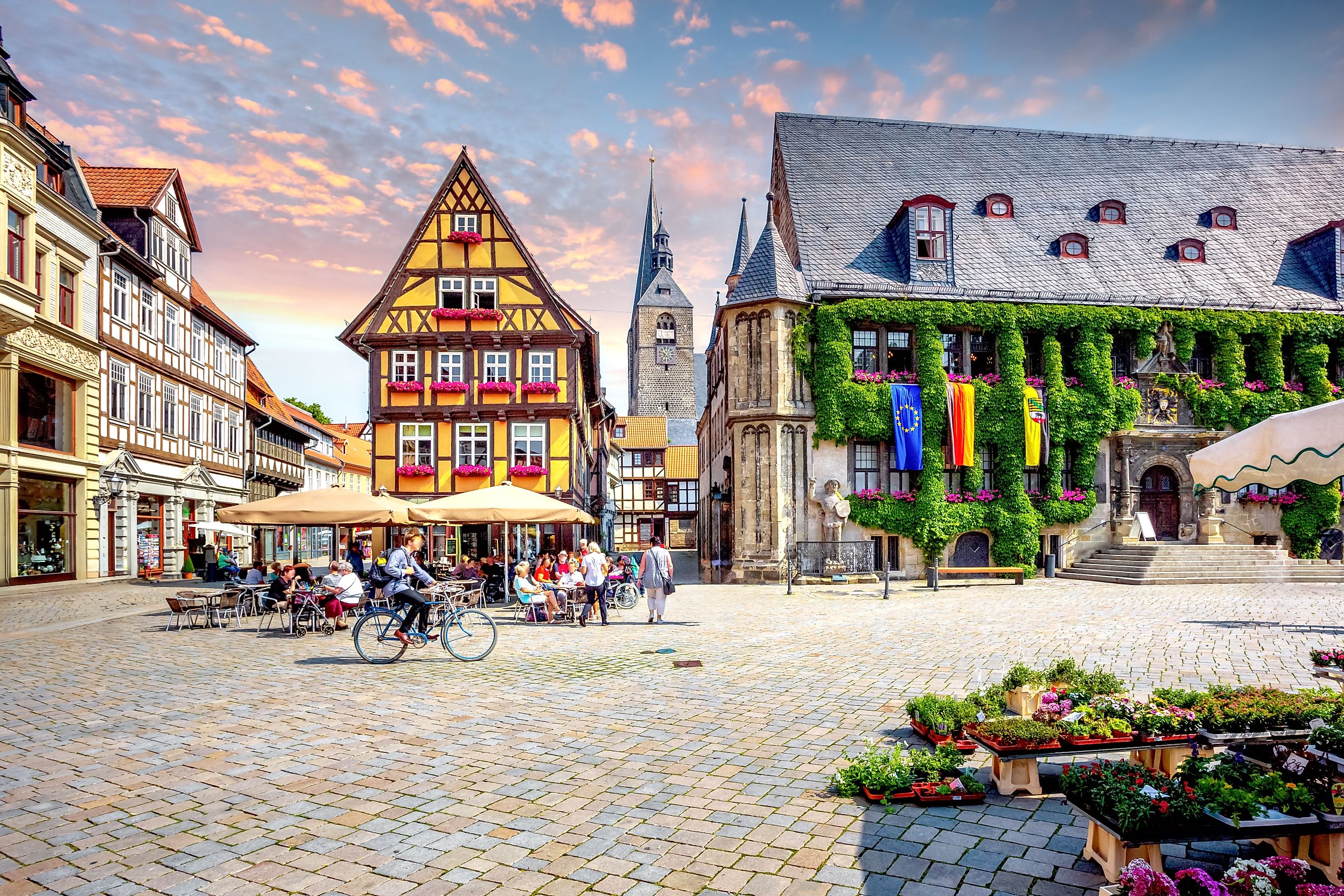
Quedlinburg, Saxony-Anhalt

Quedlinburg, one of Germany's oldest towns, is a UNESCO World Heritage Site. Its collegiate church was founded in 936 as the burial church of King Heinrich I, founder of the Ottonian dynasty and a key figure in the early medieval German state. The Stiftskirche St. Servatius on Castle Hill, the present Romanesque building completed by the 12th century, preserves some of the oldest surviving stonework of its kind in Germany.
Bad Suderode and its calcium springs lie about four miles from the center. The surrounding Harz foothills open cycling and walking routes through beech forest and meadow within easy reach of the old town.
Germany's Can't-Miss Towns
The appeal of these towns is how much of the past still stands. Rothenburg and Dinkelsbühl remain inside complete medieval walls, two of only four such towns in the country. Quedlinburg guards Romanesque stonework begun in the 10th century. Mittenwald has built violins since the 1600s. Even the 19th-century landmarks rest on older ground, like the rebuilt schloss above Wernigerode. In each, the centuries that built the town are still in plain sight.