7 Northern Ireland Small Towns With Unmatched Friendliness
The seven small towns below stretch from Northern Ireland's North Antrim coast to the lake country of County Fermanagh, and each one runs a downtown built around something specific worth visiting for: a 1608-licensed whiskey distillery, a forest park that inspired the Narnian wardrobe, a 14-kilometer mountain hike with 450 wooden steps to a viewing platform on the bog, a 6,000-year-old dune system. None of these are weekend day-trips out of Belfast as much as they are working towns in their own right, and the people in them tend to know what they are sitting next to.
Glenarm, County Antrim

Glenarm sits at the southern end of the Glens of Antrim, where the Antrim Coast Road meets the first of the nine glens that run inland off the coast. The MacDonnell family has lived at Glenarm Castle since the early 1600s, and the castle's walled garden (laid out in the 1820s) opens to the public from spring through autumn with about four acres of cultivated planting inside the original walls. The Glenarm Tulip Festival fills the front lawns and walled gardens every May, with displays of around 30,000 tulips planted across the grounds.
The Glenarm Forest is a short walk from the village square along the Glenarm River, with trails that follow the water past the Deer Park gates of the castle estate. The harbor at the foot of the village is small and working, with a marina and a stone-walled beach that locals use through the summer. The Bridge End restaurant on Toberwine Street is the standing dinner anchor in town.
Rostrevor, County Down

Rostrevor sits at the foot of Slieve Martin on the north shore of Carlingford Lough, with the Mournes rising directly behind the village. C.S. Lewis is widely understood to have drawn on this landscape (the Mournes especially) for the country of Narnia; Kilbroney Park on the southern edge of the village runs a marked Narnia Trail past wood-carved figures of Aslan, Mr. Tumnus, the Beavers, and the White Witch's castle. The Cloughmore Stone, a 30-tonne granite boulder dropped on the slope of Slieve Martin by an Ice Age glacier, is reached by a 1.5-mile trail from the park; local tradition holds that the giant Finn McCool threw it across the lough at an enemy.
St. Bronagh's Church on Church Street holds a small bronze bell, attributed to the 6th-century saint and rediscovered in an oak tree on the church grounds in the 19th century after the original chapel had been lost to time. The Fiddler's Green International Festival takes over the village every July with traditional music sessions in the village pubs and guided walks into the Mournes. The Rostrevor Inn on Bridge Street runs music sessions most weekend evenings outside festival weeks.
Portstewart, County Londonderry

Portstewart sits at the western end of the Causeway Coast, with a Victorian seafront promenade running about a mile from the harbor to Portstewart Strand. The strand is a two-mile Blue Flag beach managed by the National Trust, with cars permitted to drive directly onto the sand at the eastern end (a long-running local tradition). The Bann Estuary at Barmouth, where the River Bann finishes its run from Lough Neagh to the Atlantic, is a designated Area of Special Scientific Interest for migrating birds and lies at the far end of the strand.
The Red Sails Festival fills the seafront the last weekend in July with sea-shanty performances, kite displays, and fireworks over the harbor. The Giant's Causeway, about 12 miles east on the coast road, holds roughly 40,000 hexagonal basalt columns formed by lava flows about 50 to 60 million years ago. From Portstewart Strand, the Mussenden Temple at Downhill (a small classical rotunda perched on a cliff edge) and the Inishowen headlands of County Donegal sit in clear view across the bay on a fine day.
Newcastle, County Down

Newcastle sits on Dundrum Bay at the foot of Slieve Donard, the highest peak in Northern Ireland at 850 meters. The Slieve Donard Walk leaves from the Donard Park car park at the south end of the seafront, follows the Glen River, and climbs about 5 miles round trip to the summit cairn (allow four to six hours, depending on weather and pace). On a clear day the view from the top reaches across to the Isle of Man, the Lake District, and the mountains of County Wicklow.
For something less demanding, the Murlough National Nature Reserve sits two miles north along Dundrum Bay. The reserve protects a 6,000-year-old dune system, the oldest in Ireland, with marked trails through the dunes and onto a four-mile sand beach. Tollymore Forest Park, three miles inland from the seafront, was a regular filming location for the early seasons of Game of Thrones. The park's 18th-century stone bridges and gothic gate arches appear on-screen, and its Sitka spruce stands filled in for the Haunted Forest beyond the Wall. Quinn's Bar and Restaurant on Main Street has been a Newcastle fixture for decades.
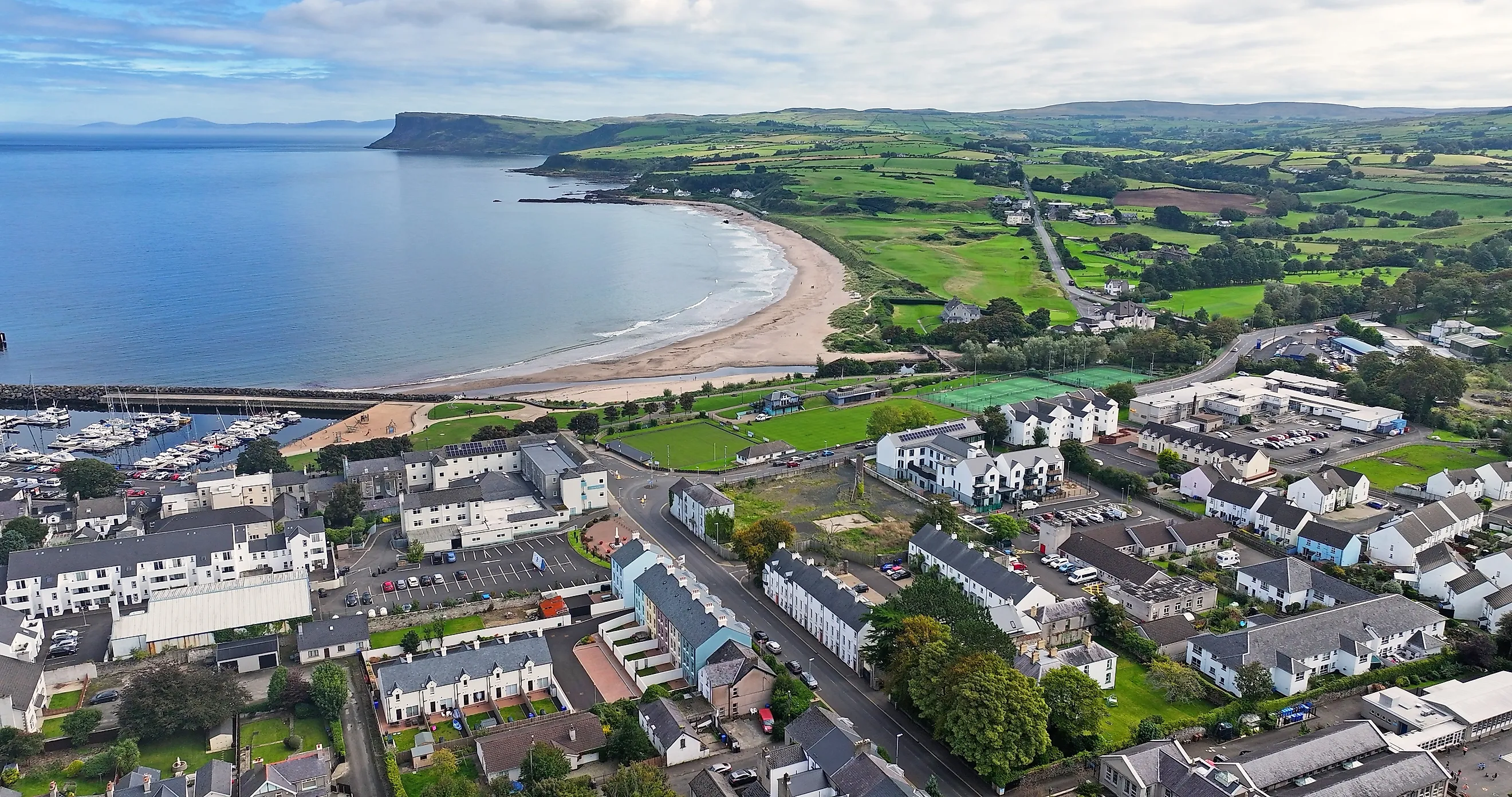
Ballycastle, County Antrim

Ballycastle is the eastern anchor of the Causeway Coast and the ferry port for Rathlin Island, the only inhabited offshore island in Northern Ireland. The ferry runs from the Ballycastle harbor to Church Bay several times a day in summer (about 45 minutes one way), with seabird-watching at the West Light Seabird Centre on the western cliffs as the main draw on the island. The ruined Bonamargy Friary, a 16th-century Franciscan house on the eastern edge of town, is open to walk through during daylight hours.
The Carrick-a-Rede Rope Bridge, run by the National Trust about six miles west of town, links the mainland to a small islet (Carrick-a-Rede, "the rock in the road") across a 65-foot chasm 100 feet above the sea. Salmon fishermen rigged the first version of the bridge in the 18th century to reach a salmon-netting station on the islet; the current bridge is rebuilt regularly and limited to eight crossers at a time. Ballycastle's Ould Lammas Fair, held the last Monday and Tuesday of August, traces its origins to a 1606 charter and is one of the oldest continuously held fairs in Ireland. The two staple Lammas snacks, dulse (dried seaweed) and yellowman (a hard, brittle honeycomb toffee), are still sold from stalls along the seafront.
Bushmills, County Antrim

Bushmills is built around the Old Bushmills Distillery, the operator of the world's oldest licensed whiskey distillery. The royal license was granted to Sir Thomas Phillips by King James I in 1608 to distil whiskey in the surrounding territory, and the present distillery operation was established on the site in 1784. Tours run year-round and finish in the visitor centre with a guided tasting; the distillery opened a second site, the Causeway Distillery, on the same property in 2023.
The 1608 inn at the south end of the village (the Bushmills Inn) keeps a fire going in the gas-lit residents' bar through the colder months and is the standing pick for an overnight in town. From the village it is two miles north along the B146 to the Giant's Causeway, and another three miles west along the same road to the cliff-top ruin of Dunluce Castle, a 16th-century MacDonnell stronghold whose kitchen wing collapsed into the sea during a 1639 storm. The Bushmills Salmon and Whiskey Festival lands the second weekend in October with seafood tastings and distillery-themed events along Main Street.
Enniskillen, County Fermanagh

Enniskillen sits on an island between Upper and Lower Lough Erne, the two lakes that make up the Erne system, in the lake country of southwestern Northern Ireland. Enniskillen Castle anchors the western end of the town center and dates to the early 1400s as a Maguire stronghold; it now houses the Fermanagh County Museum and the Inniskillings Museum. The town runs the International Beckett Festival every August, celebrating the work of Samuel Beckett, who attended Portora Royal School here as a boy.
The Cuilcagh Boardwalk Trail, also called the Stairway to Heaven, runs about 14 kilometers round trip from the trailhead off the Marlbank Road to a viewing platform on the shoulder of Cuilcagh Mountain. The wooden boardwalk section is roughly 1.6 kilometers across one of the largest expanses of intact blanket bog in western Europe, ending in a 450-step climb to the platform at 665 meters elevation. Marble Arch Caves, near the trailhead, runs guided 75-minute tours through limestone passages, an underground river, and a chamber of stalactites and stalagmites. Headhunters Railway Museum on Darling Street is exactly as advertised: a working barber shop with a railway museum in the back, run by two brothers in the same building since 1985.
The Long Weekend
The seven towns above run on a calendar of festivals, working harbors, and walking trails that anchor the year as much as the visitors who pass through. Pick the festival weekend that fits the trip (Glenarm in May, Rostrevor in July, Portstewart in late July, Ballycastle in August, Enniskillen in August, Bushmills in October), or pick the walk that fits the morning. The whiskey, the fiddle music, and the conversation tend to handle the rest.