7 Most Walkable Town Centers In Utah
Pioneer surveyors laid out these seven Utah towns on wide grids, and that layout still shapes what a walk down Main Street looks like today. In Manti, a ten-minute stroll runs from the county courthouse up to the temple on the hill. In Price, the fossil halls and the county courthouse stand within a few blocks of each other. In Cedar City, theatergoers crowd the downtown through the summer and fall for the Utah Shakespeare Festival. Settlers built each of these centers in the 1850s around a broad Main Street, with the courthouse, the meetinghouse, and the civic buildings clustered close. That planning produced downtowns where a courthouse, a museum, and a temple stand within easy reach on foot.
Manti

The Sanpete County Courthouse at 160 North Main Street is a good place to start a walk through Manti. Workers built it in 1935 from local oolite limestone in the PWA Moderne style, and its National Register nomination calls it one of the best examples of that style in Utah. Across the street at 191 North Main stands the Historic Manti City Hall, built between 1873 and 1882 in an Italianate design by A.E. Merriam. From the courthouse, a ten-minute walk up Temple Hill reaches the Manti Temple. Crews quarried its limestone from the hill and worked on it between 1877 and 1888, and its east tower reaches 179 feet, tall enough to be seen from across the Sanpete Valley.
A few blocks from the courthouse, back on Main Street, the 1910 Manti Carnegie Library, a classical revival building, is open to visitors on weekdays. Next door, the Manti Tabernacle, a Gothic-style building, is one of three 19th-century Latter-day Saint buildings still used for weekly services. Every June, thousands of people come to Manti for the Rat Fink Reunion, a car and art gathering that honors Ed "Big Daddy" Roth, a founder of Kustom Kulture.
Nephi

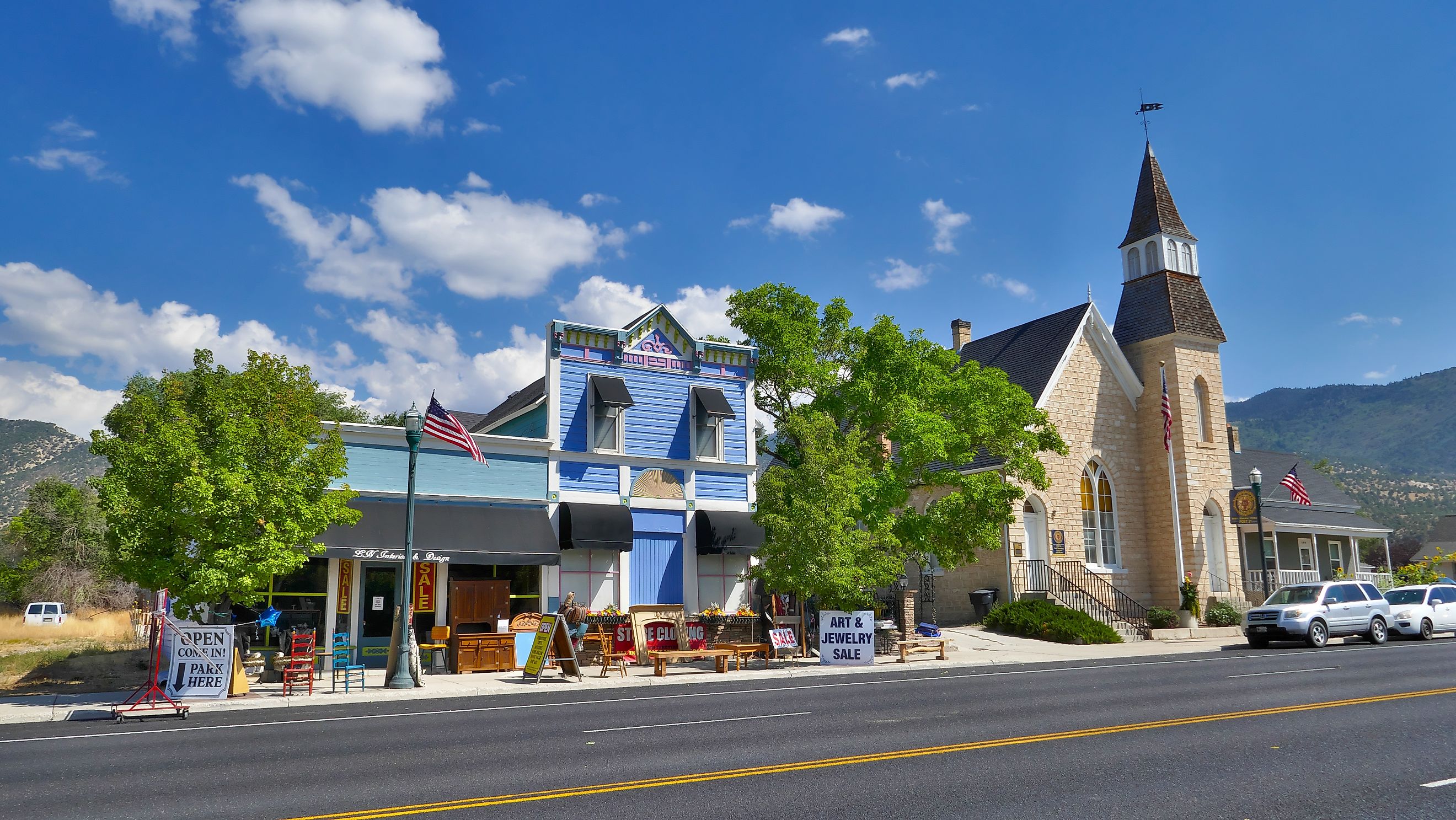
Nephi sits at the base of the Wasatch Plateau, its downtown an open grid of antique shops, boutiques, and restaurants along Main Street. The old Juab County Courthouse at 4 South Main, on the corner of Main and Center, now holds the Daughters of Utah Pioneers Museum, with early settler furniture, tools, and photographs from the 1851 settlement of the Juab Valley. A few steps away at 45 West Center stands the 1892 Juab County Jail, a two-story brick building on the National Register of Historic Places and one of the best-preserved 19th-century jails left in the state. The current county courthouse stands about two blocks northeast at 160 North Main. Head east along 600 North and the street connects to the I-15 frontage road, which leads south to the Salt Creek Canyon trailhead at the edge of town and into the Uinta-Wasatch-Cache National Forest. Few Utah Main Streets link this directly to a national forest boundary.
Price

The Utah State University Eastern Prehistoric Museum sits at 155 East Main Street in Price, a short walk from the town's civic and cultural buildings. Formerly the College of Eastern Utah Prehistoric Museum, it holds one of the state's strongest fossil collections, including Utahraptor specimens excavated in Grand County to the south. Beside it, the Price Peace Gardens stand as a memorial to the immigrant communities that came to work the area's coal mines. On the south side of Main Street, the Carbon County Courthouse is a 1919 Neoclassical building still in use as the county courthouse. The Star Theatre, a movie house from the 1920s, remains a downtown fixture alongside the shops and cafes nearby. Small restaurants and storefronts fill the blocks in between, and the full walk takes about an hour.
Mount Pleasant

Many of Mount Pleasant's downtown landmarks carry National Register of Historic Places listings, and the town's pedestrian and bicycle routes connect its parks, businesses, neighborhoods, and schools across the historic districts. Wasatch Academy, founded in 1875 at 120 South 100 West, stands two blocks from Main Street. Founded by Presbyterian minister Duncan McMillan, it is the oldest continuously operating high school in Utah, and its historic campus is a National Register district. A few blocks south along Main Street, the Mount Pleasant Recreation Center runs dance classes, swimming lessons, and open gym time on its basketball court. The Mt. Pleasant Relic Home and Blacksmith Shop at 150 South State Street displays pioneer-era architecture and blacksmithing equipment from the 19th and 20th centuries. The brick facades, wide sidewalks, and consistent 19th-century scale make nearly every block here worth covering on foot.
Fillmore

Fillmore served as Utah's first territorial capital, and the Utah Territorial Statehouse on Capitol Avenue stands as the record of that history. Workers completed its first wing in 1855, and it is the oldest surviving government building in the state. A Daughters of Utah Pioneers collection now fills its original chambers, with legislative furnishings and pioneer relics on display. The statehouse sits about one block west of Main Street, a two-minute walk from the commercial corridor. Four blocks south along Main Street, Fillmore City Park marks the center of the original town grid, which still runs out in every direction from there. The East Millard Swimming Pool sits one block away and stays open to locals and visitors through the year. The Fillmore Farmers Market sets up within the town center as well. Few towns in the state pair a former capitol building this closely with a creek and a public park.
Ephraim

Ephraim has a well-preserved 19th-century streetscape at its center, and the Ephraim Heritage Museum sits at Pioneer Park with exhibits on Scandinavian and pioneer settlement in the Sanpete Valley. Pioneer Park suits an afternoon picnic, with green lawns and a stream running through the middle of it. About two minutes' walk from the museum, Snow College fills the heart of town with students and year-round campus events; Danish settlers founded the school in 1888 as the Sanpete Stake Academy. The Ephraim Utah Temple, a 39,000-square-foot building topped by a multi-level octagonal tower and a domed cupola, is a newer landmark on the streetscape. One block north along 400 East, Ephraim City Park sits within view of the Wasatch Plateau and the San Pitch Mountains. The whole downtown fits within a radius of less than a mile.
Cedar City

Cedar City has wide pedestrian sidewalks along Main Street and through the historic district near Southern Utah University. At 635 North Main Street, the Frontier Homestead State Park Museum holds an extensive collection of horse-drawn wagons and carriages, with blacksmith demonstrations on weekends. A few blocks south along Main Street, the Braithwaite Fine Arts Gallery on the university campus shows a permanent collection spanning the pioneer era to the present, with free admission year-round. The Utah Shakespeare Festival has run in Cedar City since its first season in 1962, with performances through the summer and fall near the Engelstad Shakespeare Theatre. The summer crowds are part of why the town took on the "Festival City USA" tag. The walk connecting the Frontier Homestead, Main Street, and the Shakespeare campus runs less than half a mile, short enough to manage before or after a matinee.
The Grid That Still Works
The most interesting streets in Utah are not always the most famous. The climb from Main Street to Temple Hill in Manti, the fossil halls a couple of blocks off Price's Main Street, and the theater campus a half mile from Cedar City's downtown share one thing in common. On the wide grid that 19th-century pioneers surveyed, a courthouse, a museum, or a temple stays within reach on foot. Anyone who explores these downtowns by walking sees the towns the way their planners meant them to be seen.