7 Best Places to Live in Connecticut
Connecticut packs more variation than its size suggests. The state runs only about 110 miles end to end, but inside that footprint sit Long Island Sound coastal villages, Litchfield Hills towns hemmed in by state forest, working downtowns at the edge of New York's commuter shed, and a string of historic settlements along the Connecticut River. The seven towns below are a mix of those settings: small enough to feel like home, varied enough that the choice between them depends on what kind of place you actually want to live in. The list is meant for residents thinking about a move within the state rather than first-time visitors picking a weekend stop.
Cornwall

Cornwall sits at the western edge of Litchfield County, in the foothills of the Berkshires, and is built around the wooden covered bridge that spans the Housatonic River at West Cornwall village. The bridge, built around 1864, is one of only three surviving covered road bridges in Connecticut, and it has anchored Cornwall's identity for so long that the town's casual nickname, Home of the Covered Bridge, predates living memory. The town has a population of about 1,400 and is mostly forest. Most of Cornwall falls inside or alongside Mohawk State Forest, and the privately owned Mohawk Mountain Ski Area, with 26 trails and five lifts, is the largest ski area in Connecticut.
Housing in Cornwall is widely varied. Modest homes in the village neighborhoods can list in the upper $300,000s or low $400,000s, while larger country properties along the river and on the higher elevations frequently clear $1 million. Cornwall is rural in the way that means a longer drive for groceries and no real downtown to speak of, which is the appeal for some buyers and the deal-breaker for others.
Mystic

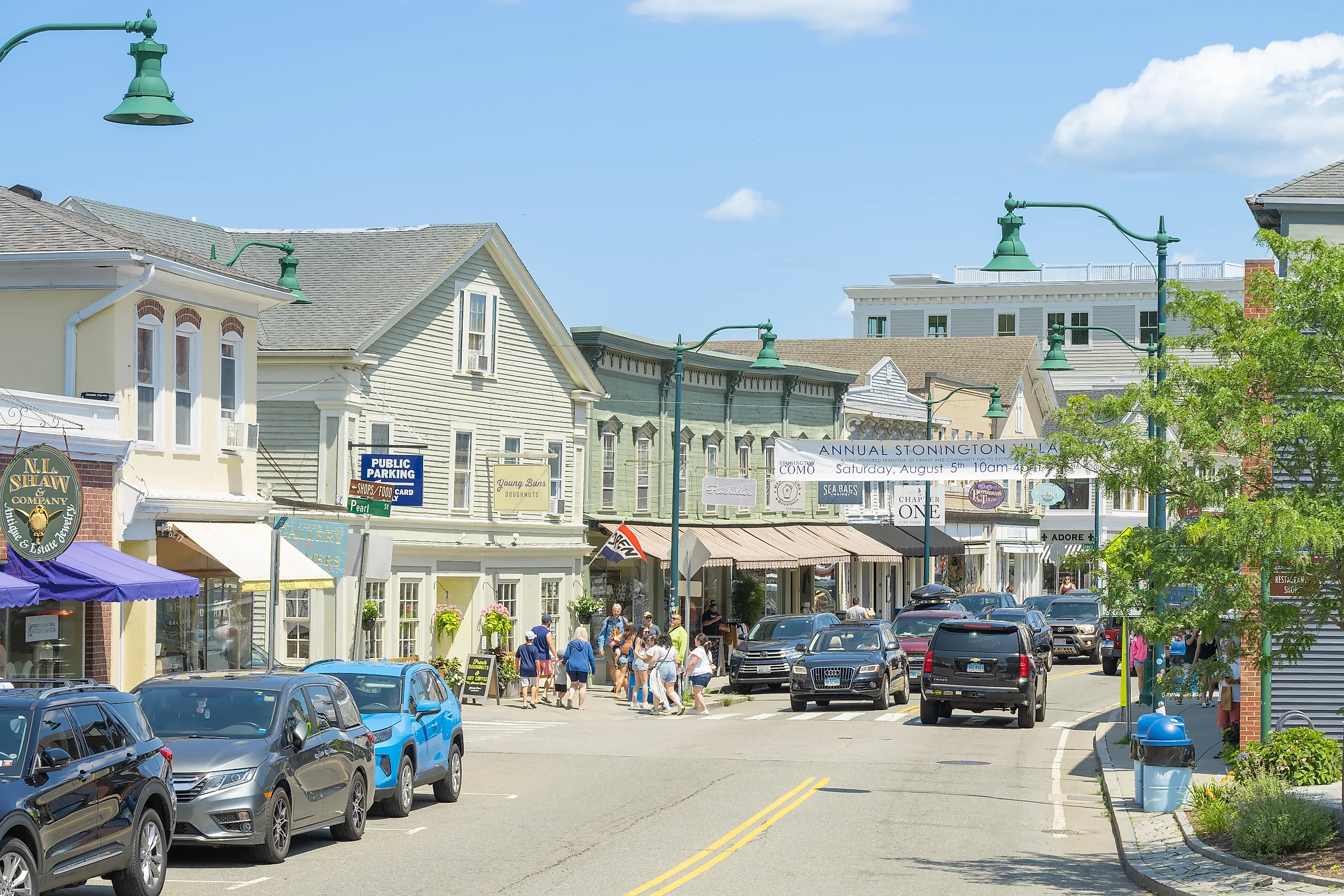
Technically Mystic is not a town. It is a village and census-designated place that straddles the line between Stonington and Groton, with a population of about 4,400. The Mystic River runs through the middle of it, and the 1922 Bascule Bridge in the center of the village raises hourly at 40 minutes past the hour through the warmer months to let masts pass underneath. Living here means choosing whether you want to be on the Stonington side or the Groton side, since they are different towns with different tax rates, school districts, and town governments, all sharing one zip code and one walking-distance downtown.
Mystic's draws are familiar to most Connecticut residents already: the Mystic Seaport Museum, the largest maritime museum in the United States and home to the 1841 whaleship Charles W. Morgan; the Mystic Aquarium; and a downtown of restaurants, bookstores, and historic captains' houses. Median list prices have hovered in the upper $500,000s to upper $600,000s through early 2026, with a wide range above and below depending on water access and lot size.
Monroe

Monroe is a Fairfield County bedroom community of about 19,500, an hour or so from Manhattan in good traffic, with award-winning public schools and a tax base that has held steady through recent reassessments. The town sits along Lake Zoar on the Housatonic River, and the 135-acre Webb Mountain Park above the lake offers hiking trails, rock outcrops for climbing, primitive campsites, and wide views down the river valley.
Monroe is best known to outsiders as the longtime home of paranormal investigators Ed and Lorraine Warren, who are buried at Stepney Cemetery. The Warrens' Occult Museum, run out of their basement on Knollwood Drive, has been closed to the public since Lorraine Warren's death in 2019. In August 2025, comedian Matt Rife and YouTuber Elton Castee announced they had purchased the property and a five-year guardianship of the collection with plans to reopen for tours and overnight stays in the fall of 2026. Monroe Center Historic District and the antique shops along Route 25 are more reliable everyday draws. Single-family homes typically list in the mid-$500,000s in 2026.
Bethel

Bethel was incorporated as a separate town in 1855, having been carved out of Danbury, and now functions partly as a Danbury suburb and partly as its own walkable downtown. The center of Bethel, around the intersection of Greenwood Avenue and Library Place, has the kind of compact main street that has become rare in Fairfield County: a working independent bookstore, a 1923 movie theater, sit-down restaurants, and the Bethel Opera House on the corner. The town has a population of about 20,000 and a Metro-North line that runs straight to Grand Central in around 90 minutes.
Bethel was also the birthplace of P. T. Barnum, who was born here in 1810 and is buried at Mountain Grove Cemetery in nearby Bridgeport. Blue Jay Orchards on Plumtrees Road runs pick-your-own apples and a cider mill from late August into November. Median home prices in 2026 sit in the high $500,000s.
Washington

Washington is the kind of small Litchfield County town that has appreciated faster than the houses inside it. The population is about 3,500, the village center known as Washington Depot has changed less than most main streets in the state since the 1950s, and Lake Waramaug, partly inside the town, anchors the western side. Lake Waramaug State Park is a short drive from the town green and stays usable from spring through October. The Shepaug River runs along the eastern side and is one of the better-protected trout streams in the state.
Property values are high. The median list price in Washington has run above $1.5 million in recent years, driven by weekenders from Manhattan who eventually moved up full-time. The Mayflower Inn and Spa, a five-star Auberge property, draws visitors from across the country. The town also has a deeper arts presence than most Connecticut towns its size, with the Steep Rock Association land trust, the Gunn Memorial Library and Museum, and Eckert Fine Art among the active institutions.
Essex

Essex sits along the lower Connecticut River, about six miles from where the river meets Long Island Sound. The town is made up of three villages: Essex Village proper at the river, Centerbrook in the middle, and Ivoryton to the west. The Connecticut River Museum at the foot of Main Street holds the local maritime collection and runs the popular RiverQuest eagle cruises in February and March, when wintering bald eagles concentrate along the lower river.
Ivoryton was a 19th-century company village built around the Pratt-Read piano-key factory; the imported African elephant ivory that came through the port is the source of the village's name. The Ivoryton Playhouse, in the heart of the village, has billed itself for decades as the oldest continuously operating self-supporting summer theater in the country, with a season that now runs spring through fall. The Essex Steam Train and Riverboat operates from the Essex station, with the Day Out with Thomas family event running for several weekends each year. Essex has a population of about 6,500. Median home prices in 2026 typically run in the high $700,000s to high $800,000s, with a strong tail of waterfront properties listing well above that.
Chaplin

Chaplin is a Windham County town of about 2,200 in the Quiet Corner of northeastern Connecticut. It was named after Deacon Benjamin Chaplin, an early settler whose 1747 house still stands. The town center, recognized as the Chaplin Center Historic District on the National Register, is one of the more intact 18th- and early-19th-century streetscapes in the state, with white clapboard houses lining Chaplin Street north and south of the meeting house.
The Natchaug State Forest and the adjacent James L. Goodwin State Forest cover much of the town, with hiking trails, horse trails, a cross-country ski area, and the Pine Acres Pond at Goodwin. The Natchaug River runs through the forest and is fishable for trout in season. Chaplin is the most affordable town on this list. Single-family homes commonly list in the low to mid-$300,000s in 2026, and the trade-off for the price is distance: this is a 35-minute drive from Hartford and longer from anywhere else.
Connecticut runs a wide range of small towns, and the seven above are a representative slice rather than a competitive ranking. Cornwall and Chaplin offer rural quiet at very different price points. Mystic and Essex sit on the water and trade on it. Monroe and Bethel work for commuters who still want a downtown. Washington is its own thing, expensive and arts-heavy. The right town depends on what you can pay, how far you are willing to drive, and what you want your weekends to look like.