10 Most Overlooked Georgia Towns For 2026
Some Georgia towns still earn their keep the way they always have. Quarrymen cut granite in Elberton. Looms weave denim in Trion. Shrimpers work the docks in Darien. None of it got dressed up for anyone, which is exactly why these places slip under the radar. They do not trade on charm; they run on the work. And the things worth seeing in each one grew straight out of that labor: a quarry you can look into, a mill village, a swimming pool shaped like Georgia and fed by a spring. Overlooked here is not a knock. It is the character.
Trion, Georgia

Almost every town has a main employer; few of them are the whole town. Trion, a place of fewer than 2,000 people in the northwest corner of the state, grew up around a single cotton mill that opened in 1845 and has run almost without a break ever since. Andrew Allgood and two partners started it, and their trio gave the town its name. Fire destroyed the mill in 1875, and the owners rebuilt it within the year. Today the Mount Vernon Mills plant on Fourth Street is the largest denim operation in the country, which is why the place answers to the nickname Denim Capital of the World, and it still pays roughly 80 percent of the town's taxes. The plant does not run public tours, but its scale is plain from the street, and the surrounding mill village still holds the houses, library, and theater the company built for its workers a century ago. For open space, Trion City Park sits along the Chattooga River, the same water that first turned the mill's wheels.
Cordele, Georgia

Cordele took shape where two railroads crossed, and its people have been shipping the harvest out ever since. Crisp County farmers send more than 200 million pounds of watermelon to markets across the country each summer, along with peaches, pecans, and peanuts, and agriculture is still the county's biggest employer. Locals bill the place as the Watermelon Capital of the World, a title the chamber of commerce says it defended against Hope, Arkansas, and Hempstead, Texas, in the 1990s. The working side of that shows at the Cordele State Farmers Market, one of the oldest and largest in the state, where the melon trucks line up from before dawn through the height of the season. The rail heritage is still on the tracks, too: the SAM Shortline Excursion Train runs vintage cars out of downtown across the middle of the state toward Plains, on the old Savannah, Americus, and Montgomery line the state rebuilt in the early 2000s. West of town, the Flint River dam backs up Lake Blackshear alongside Georgia Veterans State Park, where a military museum keeps a B-29 and a row of tanks parked out in the open air. Come summer, the Watermelon Days Festival, running since 1949, brings the crop downtown.
Elberton, Georgia

Cutting stone started here in the 1880s and simply never stopped. Roughly 45 quarries and more than 150 finishing plants work the local granite, turning out around 250,000 markers and monuments a year, and Elberton stone stands in all fifty states. The Elberton Granite Association opened the Elberton Granite Museum in 1981 to lay that story out, where antique tools sit beside finished work and members rotate a display of whatever is on the saws now. Local builders reach for the same stone. The Granite Bowl went up in 1952 out of more than 100,000 tons of blue granite, a high school football stadium seating 20,000 in a town of 4,640, and the Georgia Trust for Historic Preservation lists it as a significant historic site. Downtown, the restored art deco Elbert Theatre keeps live performances on its calendar through the year. Seven miles out, Richard B. Russell State Park spreads along a 26,650-acre reservoir with a swimming beach and an 18-hole course, and the shoreline path crosses an old steel pin bridge on the way down to the water.
Darien, Georgia

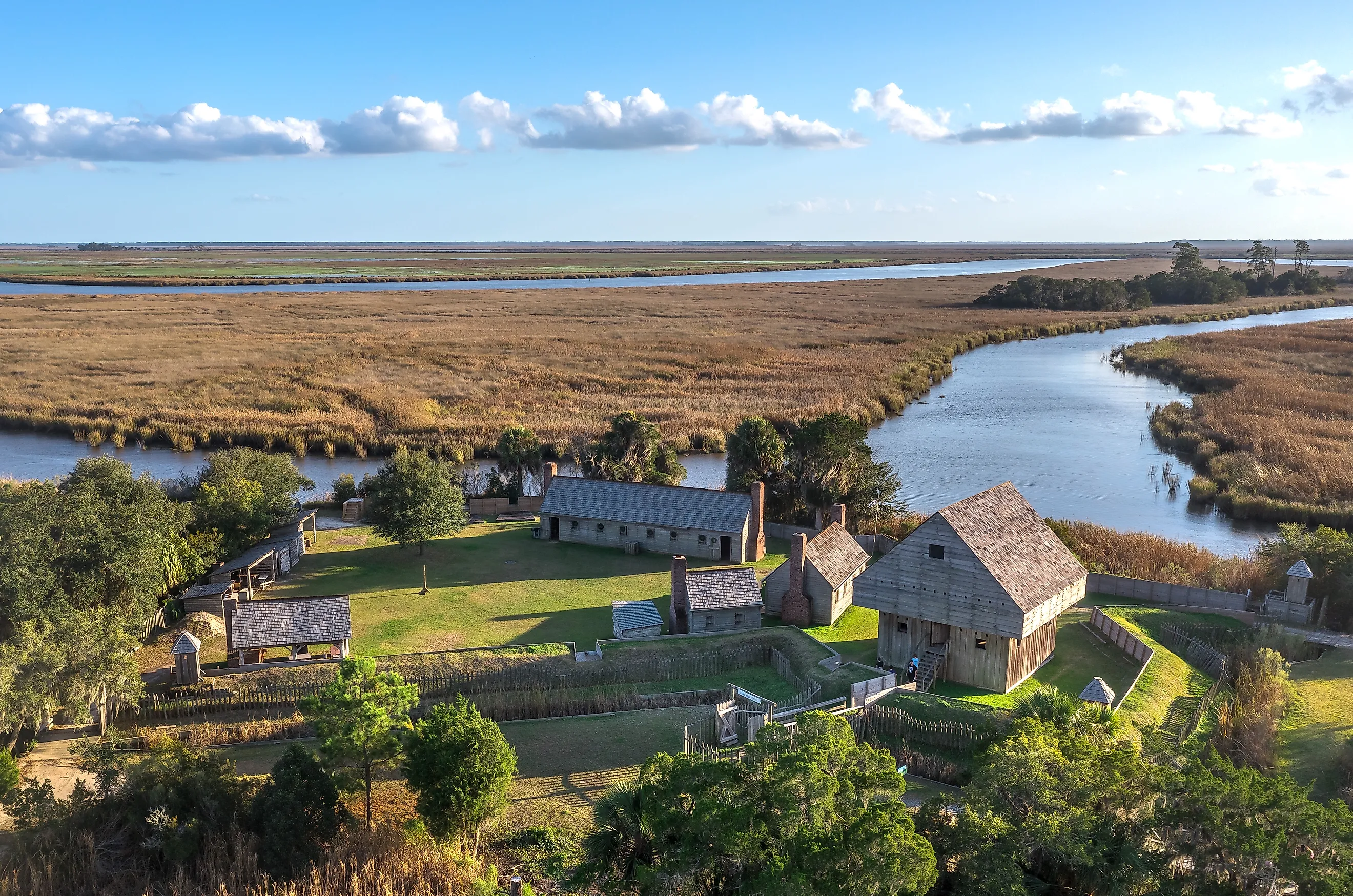
Down at the coast, the work happens on the water. Darien sits where the Altamaha River meets the Atlantic in McIntosh County, and its docks hold the largest shrimp fleet on the Georgia coast. Trawlers still go out for wild Georgia shrimp and land the catch a few hours before it reaches the tables at the waterfront restaurants, a difference that stands out plainly against the frozen imports filling most grocery cases. Every spring, before the season opens, the boat captains gather for the Blessing of the Fleet, a tradition here since the late 1960s. Crews scrub and dress their trawlers in flags and streamers, a priest blesses each boat from the highway bridge as it passes, and thousands line the banks for the parade, the fried shrimp, and the music. History runs deep on this ground too. Just east of town, the reconstructed Fort King George marks the first British outpost on the Georgia coast, and the tabby ruins of old rice and lumber works still stand along the river.
Cave Spring, Georgia

This town of about 1,200 in Floyd County takes both its name and its livelihood from the cool water rising under it. A limestone cave beneath the square feeds a spring that pushes out more than two million gallons a day, and the public utility still pipes that water to homes and businesses as the community's main supply, so the resource that named the place is the same one running the taps. The spring surfaces inside Rolater Park, where it fills a stone holding pond and then a swimming pool laid out in the shape of Georgia. The cave itself stays a constant 57 degrees year round and is open to walk into for a small fee, and locals still show up with jugs to fill straight from the source. Around the park sits a compact historic district of late-1800s storefronts and homes, plus the 1810 Vann Cherokee Cabin, one of the oldest standing structures in this corner of the state. The long-distance Pinhoti Trail passes close by.
Hawkinsville, Georgia

A century ago, trainers started wintering Standardbred racehorses here, and locals have kept the trade alive ever since. The city owns and runs the Lawrence L. Bennett Harness Horse Training Facility, the only Standardbred harness training center in the state, and it draws trotters and pacers down from the North and Midwest for the mild winters and a natural clay track. Fifteen barns shelter the horses; the training happens on a one-mile red oval and a half-mile all-weather track, and the grounds are open to tour from October through May. The roots run deep. Pulaski County held its first organized races in 1894, and the Hawkinsville Harness Horse Festival has opened the racing season every spring since 1974. In town, the Old Opera House opened in 1907 as a combined city hall and auditorium and now carries a National Register listing. Down on the water, Mile Branch Park has picnic shelters, walking paths, and campsites along the Ocmulgee River, which splits the county on its way south.
Dahlonega, Georgia

The first major gold rush in the country started here in 1828, two decades ahead of California, when prospectors poured into the Georgia hills after the metal. So much of it came out of the ground that the federal government opened a branch mint in town, and from 1838 until the Civil War, workers there struck coins from local ore. The 1836 Lumpkin County Courthouse on the square now holds the Dahlonega Gold Museum, where the exhibits lay out the claims, the stamp mills, and the coins in one place. The mining did not stop at history, either. Just outside town, guides at the Consolidated and Crisson gold mines lead the way down into the old tunnels, and the sluices are still open to pan for color the way the first miners did. In recent decades growers have planted vineyards across the same red hills, and more than a dozen tasting rooms now operate within a short drive of the square, which stays lined with cafes and shops built in the mining years.
Cairo, Georgia

Southeast of Colquitt, Cairo made its name in cane syrup. Seaborn Anderson Roddenbery sold it out of cypress barrels in his general store and put the first pure Georgia cane syrup on the market in 1889, with pickles following in 1936. The plant has since closed and reopened as a community center, but the high school still fields the Syrupmakers and the Syrupmaids, so the name outlasts the factory that earned it. Cairo produced Jackie Robinson, too. He was born on a Grady County sharecropper's farm on January 31, 1919, and a lone brick chimney is all that survives of the house, marked now by a Georgia Historical Society plaque. Major League Baseball paid for a second marker, dedicated at the Roddenbery Memorial Library in 2022, and State Route 93 carries Robinson's name. Out in the county, Tired Creek Lake spreads 960 acres of blackwater over drowned timber. Grady County finished the reservoir in 2018 after decades of false starts, and three public ramps put boats onto water that runs 30 feet deep in places.
Vidalia, Georgia

One town on this list lent its name to something sold in grocery stores across the country, and then made it illegal for anyone else to use. The sweet Vidalia onion can be grown and sold under that name only within a defined stretch of southeast Georgia, about 20 counties where the low-sulfur soil takes the bite out of the bulb, protected since the Vidalia Onion Act of 1986. It became the official state vegetable in 1990. Inside the 1,300-square-foot Vidalia Onion Museum, the exhibits run through soil chemistry, the growers, and the legal fights over the name, and the smallest registered Vidalia field grows in the ground right outside the door; admission is free on weekdays. The Vidalia Onion Festival runs four days each spring as the harvest comes in. A few blocks away, the Altama Museum of Art and History sits in a 1911 house, its rooms hung with paintings and lined with porcelain. Below the city, the Altamaha River opens into a paddling trail through cypress and tupelo, running undammed its whole length to the Atlantic.
Folkston, Georgia

People in Folkston watch trains, and they built a grandstand to do it properly. Two CSX lines merge just north of downtown into a double track that carries most of the rail traffic in and out of Florida, and residents answered it with a covered platform, the Folkston Funnel, wired with lights and ceiling fans and a scanner tuned to the train crews. Picnic tables and a grill sit alongside it. Dozens of trains roll past a day, mostly freight, and just north the track splits again toward Waycross and Savannah. Across the rails, the restored Folkston Depot is a second vantage on the same traffic, with a small railroad museum inside. Trains are only half the story. The east entrance to the Okefenokee Swamp and its national wildlife refuge lies about 11 miles southwest, where boardwalks and paddling routes run out among the peat islands and cypress, and outfitters there run guided paddle and boat trips. Once a year the Okefenokee Festival brings both halves of the town's character downtown at the same time.
Where the Work Still Comes First
Granite in Elberton, denim in Trion, onions in Vidalia, shrimp in Darien: in every one of these towns the trade came first and the thing to see came second. A quarry museum, an onion festival, a roofed stand for watching trains, a fleet of trawlers blessed before the season, all of it grew out of somebody's actual living rather than a plan to draw a crowd. That is what keeps these places from feeling staged. They are not performing a version of Georgia for anyone; they are just doing the work, on a weekday, the way they always have.