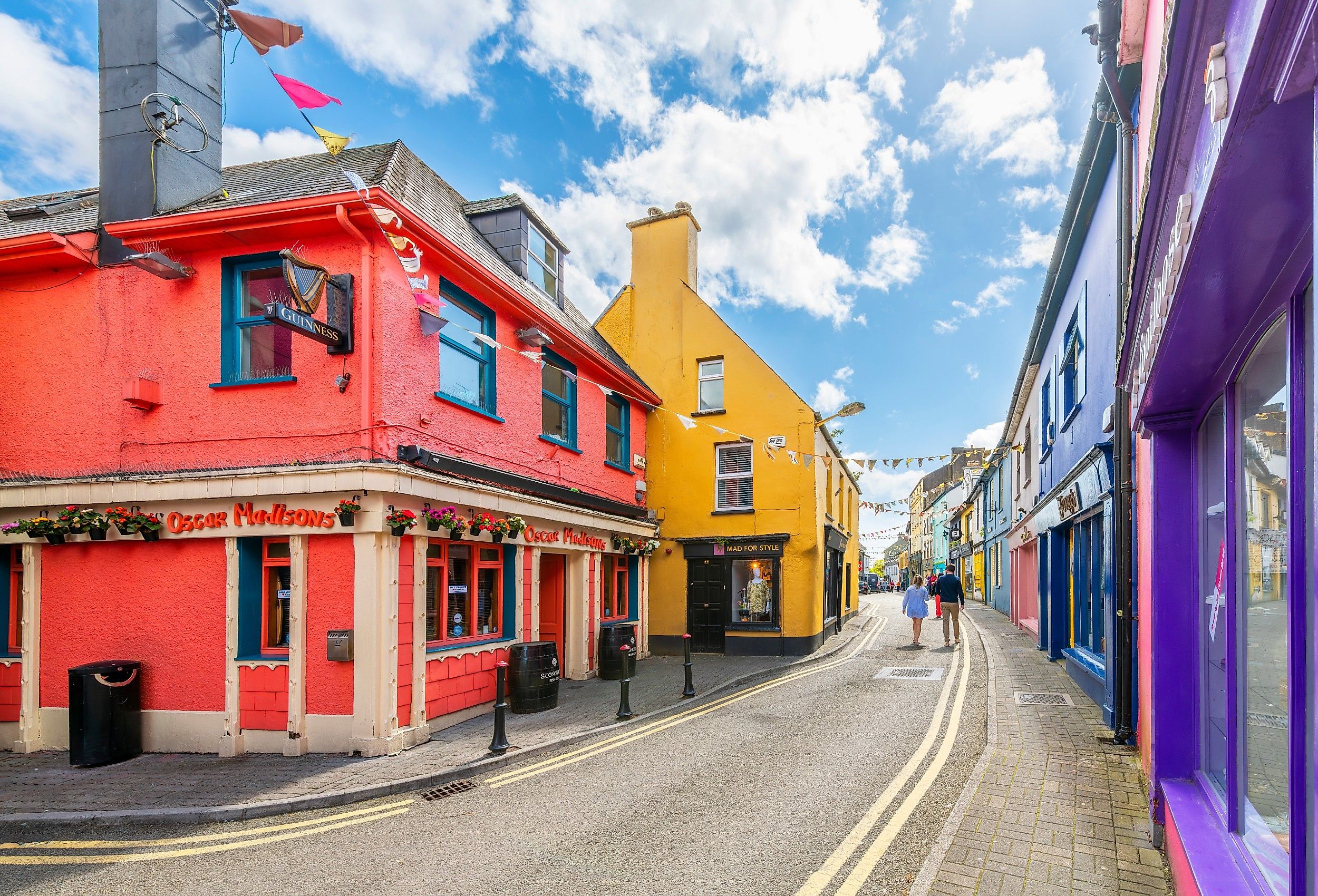
2026's 8 Best Small Towns To Visit In Ireland
The best small towns to visit in Ireland celebrate some of the country's favorite rituals, like a full Irish breakfast with a river view and a single malt whiskey tasting at the end of a distillery tour. On the Dingle Peninsula near Tralee, a farm demonstration shows how border collies are still trained to herd sheep. In Maynooth, a guided tour of St. Patrick's College, founded in 1795, leads to the centuries-old Silken Thomas yew. Ballina's Dolmen of the Four Maols has stood atop Primrose Hill since around 2,000 BCE. These eight towns, each with its own history, architecture, and green landscape, belong on any Irish itinerary in 2026.
Kinsale

Kinsale's harbor is guarded by Charles Fort, a star-shaped military fortress built between 1677 and 1682 during the reign of King Charles II. In 1690, the army of William of Orange took the fort after a 13-day siege, and the British army kept a garrison there until 1922. The fort sits about 3 kilometers (1.9 miles) southeast of town, and the coastal Scilly Walk leads there on foot. Across the harbor stands the smaller James' Fort, built between 1602 and 1607.
In the center of town, Desmond Castle was built around 1500 as Kinsale's customs house. Known locally as the "French Prison," it later held mainly French prisoners of war, 54 of whom died in a fire in 1747. Since 1997, the castle has housed the International Museum of Wine, which tells the story of Ireland's wine links with Europe and is open seasonally. Nearby, the Kinsale Museum occupies the old courthouse and has displays on the 1915 sinking of the RMS Lusitania. St. Multose Church, built in 1190, has remained in continuous use ever since.
Tralee

Tralee sits at the northeastern corner of the Dingle Peninsula on Ireland's southwestern coast. Out on the peninsula, West Kerry Sheepdog Demonstrations gives visitors a view of the mountains as they watch border collies being trained to herd sheep, and guests might also get the chance to bottle-feed the lambs. The Dingle Loop, which begins in Tralee, makes the most of the town's proximity to the coast. The loop runs about 160 kilometers (100 miles) out to Ireland's westernmost point in the North Atlantic, taking trekkers along beaches and sea cliffs and up to the peninsula's highest point at over 2,400 meters (8,000 feet).
At the Kerry County Museum, the Medieval Experience depicts life in Tralee during the 15th century, with visitors walking through streets lined with taverns, food vendors, and clothing vendors. The Archaeology Hall explains how archaeologists uncovered Tralee's past through displays of the excavation process, and visitors can pick up the tools for a hands-on dig of their own. The town's Church of Saint John the Evangelist dates back to the 13th century, and guided tours from Wednesday through Saturday cover more of its history, with an emphasis on the stained glass.
Portmarnock

This seaside town on Ireland's northeast coast is only a short drive from Dublin. The Low Rock and High Rock points are rocky beaches popular for swimming and shell hunting. Just south of them, Portmarnock Beach is better suited to long walks and lying on the sand. The beach faces east, so arrive early for a spectacular sunrise.
Portmarnock Golf Club is a walking course on a peninsula, with the Irish Sea to the east and a bay to the west. The club has several dining rooms, both formal and informal, some with a view of the greens. Away from the coast, Lakeside Memorial Park holds about 10 hectares (24 acres) of manicured gardens. Paths wind among the trees and flowers, and along the lake and river, while benches invite visitors to reflect in peace and enjoy the garden's sculptures. A café serves refreshments with a water view.
Maynooth

This university town is home to St. Patrick's College, founded in 1795. A guided tour of the college shows the Silken Thomas yew, Ireland's oldest tree, and shares stories of the science experiments of one of its former scientists. The College Chapel, the world's largest choir chapel, features Gothic Revival architecture, stained glass, and tall, pointed arches. The college's Museum of Ecclesiology holds many objects connected to former professors' research: the science gallery has a 19th-century battery and induction coil, and the Ecclesiology Gallery displays antique altar objects such as chalices and crosses.
Maynooth is also a starting point for the Royal Canal Greenway, a mostly flat route that lets walkers and cyclists enjoy both nature and small Irish towns. The greenway runs for 121 kilometers (75 miles) along the canal, through fields, and to villages that include Enfield and Mullingar. Sasta by the River Maynooth serves a full Irish breakfast and pancakes, with a view of the university, Maynooth Castle, and the Lyreen River. Across the street, The Roost serves dinner and has separate rooms for a bar, a lounge, and live music.
Newbridge

Newbridge is home to the well-known cutlery produced at the Newbridge Silverware Visitor Centre. Open all year with free admission, the center displays jewelry and cutlery, both new and vintage. The factory tour shows how the pieces are made, the Museum of Style Icons displays fashion worn by famous figures, and the Silver Restaurant serves meals and afternoon tea.
At the Curragh Racecourse, the Curragh - Behind the Scenes by Horse Country tour takes guests to see where jockeys prepare for their races and how the horses train and receive care, with breakfast included at the racecourse's restaurant. For entertainment, the Riverbank Arts Centre presents an array of performances and productions, like photography exhibits of Antarctica, comedy sketches, piano concerts, and documentary films. Liffey Linear Park has paved trails along the river, with benches for resting and watching the swans on the water, and the Fairy Walk winds through the woods.
Carlow

In Carlow, the 13th-century Carlow Castle stands on the River Barrow, and a wall and parts of two towers remain of what was once a military fortress. The Carlow County Museum traces the town's history back millions of years, with pieces such as a 340-million-year-old fossilized squid, a 19th-century printing press, and items from the town's old sugar factory. The Delta Sensory Gardens cover 1 hectare (2.5 acres) of trees, flowers, sculptures, waterfalls, and fish ponds, where visitors can unwind among the diverse vegetation. The on-site café makes it easy to stay all day. On Saturdays, the Carlow Farmers Market offers a taste of Ireland with local produce, fish, cheeses, and home-baked goods.
Clonmel

Clonmel sits on the River Suir, and its free Tipperary Museum of Hidden History surprises visitors with exhibits on country life and the 17th-century Siege of Clonmel. Paintings by Irish artists date back to the 19th century and include portraits of Irishmen as well as Irish landscapes and villages. The artifacts are wide-ranging, including a 3,000-year-old butter-making machine, 17th-century gold coins, a Victorian wedding gown, and old Christmas decorations.
Clonmel Racecourse is historic in its own right, having hosted horse races for over 150 years. Its distinctive grassy course climbs and dips, and every point along it offers fantastic viewing. Races run year-round, and some are annual, like the 3.2-kilometer (two-mile) Clonmel Oil Steeplechase in November. The 19th-century ruins of Carey's Castle, where monks once lived, still show a tower and Gothic-style arches and windows. Nearby are a picnic area and gentle walking trails through woodlands with plants such as sage and ferns. For more nature, NatureLed's guides share the history of the region's environment on excursions to the county's mountains and along rocky trails through green valleys with waterfalls.
Ballina

Belleek Woods is a mix of nature and manmade structures. This Irish forest of woodland and flowers has almost 10 kilometers (six miles) of trails for walking or cycling, a squirrel sanctuary, and a duck pond. Along the way are the beached concrete boat SS Crete Boom and a view of Belleek Castle. The early 19th-century castle holds the Marshall Doran Collection of Jurassic-era fossils and medieval armor and weapons, and an overnight stay in one of its rooms will make guests feel like royalty.
For more ancient history, head to the Dolmen of the Four Maols on top of Primrose Hill. The monument of four large, stacked stones dates back to 2,000 BCE, and legend says it is the burial site of four noble brothers. The 19th-century St. Muredach's Cathedral is built of stone from local quarries, and inside are a large Pietà statue, stained glass windows, and a main aisle lined with arches. Ballina Whiskey offers tours of its distillation process and tastings of authentic Irish single malt whiskey.
Ireland has an abundance of small towns along both of its coasts and throughout its inland regions. They still offer the customary Irish attractions one might expect, like whiskey tastings, castles, old churches, green valleys, and long stretches of sand beside the Irish Sea. These towns can also pleasantly surprise visitors with reflective gardens, a museum of Ireland's "hidden" history, and the country's oldest tree. On the next trip to Ireland, be sure not to pass up these great gems.