2026's 10 Most Scenic British Columbia Towns
Scenery in British Columbia likes to show off. One town has a granite wall climbers have been scaling for generations. Another has a lake that freezes into the longest skating trail on the planet, and another trades all of it for a pocket desert where rattlesnakes live next to the vineyards. Ten towns, ten completely different backdrops, each one grown up around the landform that made it, and all within a weekend of home.
Squamish

What Squamish is about becomes clear before a visitor reaches the town limits, thanks to the Stawamus Chief. The granite dome rises 2,303 feet straight off the valley floor, one of the largest granite monoliths in the world, and on any dry afternoon its face is dotted with climbers and the occasional BASE jumper. Down at sea level, Howe Sound does the opposite kind of work, funneling wind up the fjord until the water fills with kiteboarders and windsurfers. A former logging and mill town midway between Vancouver and Whistler, Squamish has grown into what many locals simply call the outdoor recreation capital of Canada, and the compact center keeps pace with the setting. Cleveland Avenue holds the gear shops, the bakeries, and Howe Sound Brewing, all of it framed by the snow-topped Coast Mountains. The same mountains that fill the postcard frame the daily errands, which is the quiet appeal of the place.
Invermere

Two mountain ranges hem Invermere in, the Rockies to the east and the Purcells to the west, with Windermere Lake filling the valley floor between them. Life here swings hard with the seasons. Through the warm months, 7th Avenue is the center of gravity, busy with the farmers and artisans market and the patios of spots like the Birchwood Restaurant and the Ullr Bar, where a day of mountain biking or paddleboarding tends to end. Winter rewrites the town completely. Panorama Mountain Resort draws the downhill crowd a short drive away, and the lake itself becomes the Lake Windermere Whiteway, a groomed loop that Guinness certified as the world's longest naturally frozen skating trail. Skaters, cross-country skiers, and fat bikers share nearly 30 kilometers of ice that traces almost the entire shoreline, a piece of winter infrastructure no other town on this list can match.
Tofino

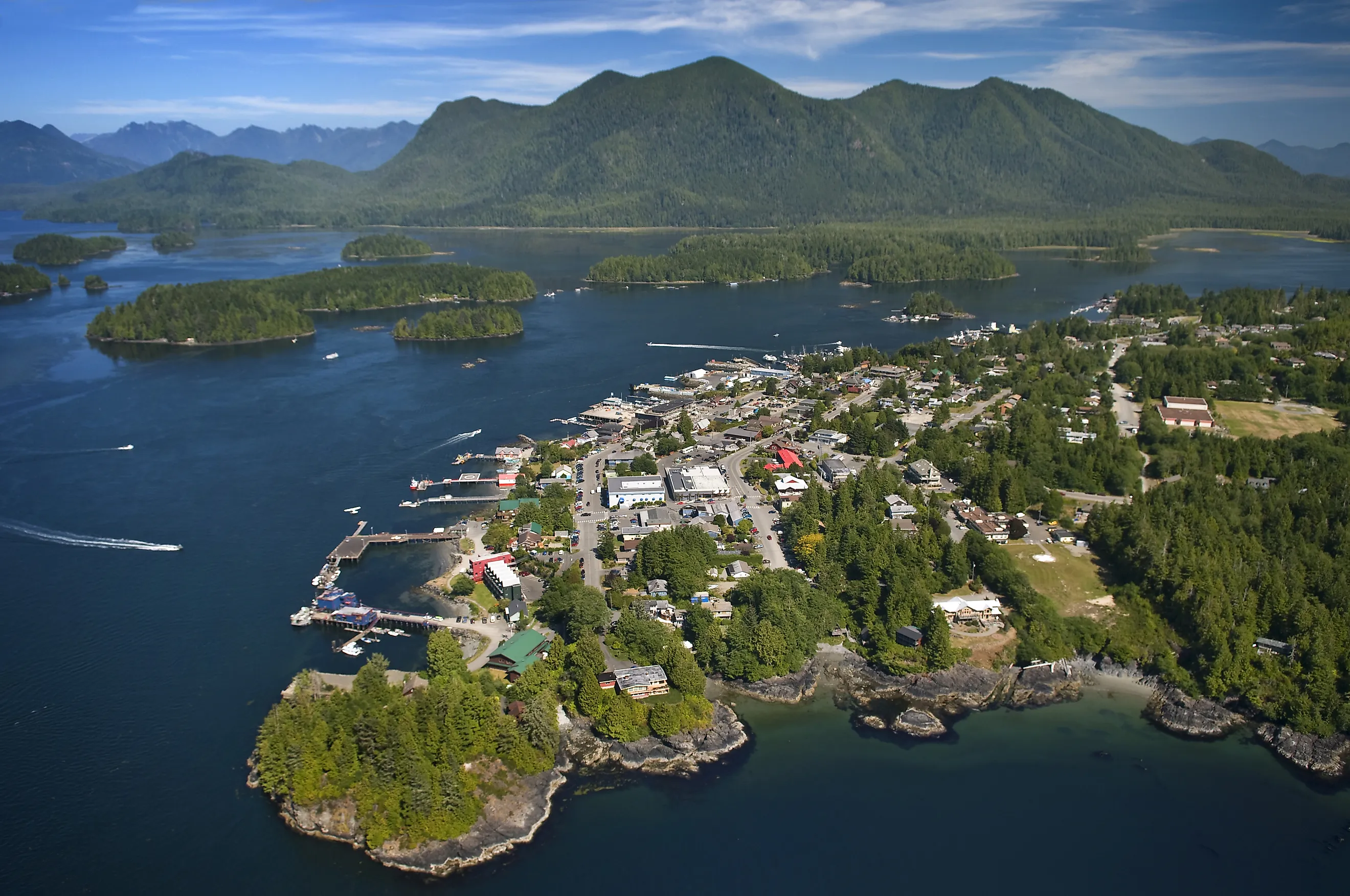
Where Squamish has its rock, Tofino has the open Pacific, and it has built an identity around weather most places would rather avoid. Perched at the end of the road on Vancouver Island's west coast, this former fishing village of Tofino pulls in surfers, hikers, and storm watchers through every month of the year. Cox Bay keeps a steady supply of waves for the serious surfers, while Long Beach, inside the Pacific Rim National Park Reserve, unrolls a wide flat expanse of sand that comes into its own when the winter swells arrive. The village has kept its clapboard bones even as the restaurants and galleries moved in, so a meal at Wolf in the Fog or a stop at the Roy Henry Vickers Gallery, which shows the work of the celebrated First Nations artist, sits a few steps from the harbor the town was founded on.
Revelstoke

Railway crews built Revelstoke, and the town has never entirely let go of that history even as skiing rewrote its economy. It sits along the Columbia River between the Selkirk and Monashee ranges, close enough to Mount Revelstoke and Glacier National Park that a summer of hiking is always within reach. The modern draw is Revelstoke Mountain Resort, which turned a quiet interior town into a name that skiers around the world recognize. The brick-lined downtown holds the balance, though. Grizzly Plaza anchors the historic core with free outdoor concerts through the summer and food vendors filling the square, and when the snow flies the Village Idiot Bar and Grill takes over as the after-ski gathering spot. On a weather day, the Revelstoke Railway Museum tells the older story of the crews who laid the line through these mountains in the first place.
Gibsons

A UN-endorsed panel once named Gibsons the world's most liveable community in the under-20,000 category, back in 2009, and the town has spent the years since making the case hold up. It sits on the Sunshine Coast where the mainland meets Howe Sound, though "mainland" comes with an asterisk: no road connects it to Vancouver, so BC Ferries handles the crossing from Horseshoe Bay. The reward for the ferry ride is a working waterfront, with a commercial fishing harbor, the shops and restaurants of Gibsons Landing, and the Gibsons Public Market all within a short stroll. The Coast Mountains stand behind the town and the water opens out in front of it, and a climb up Soames Hill Park earns a view across the Salish Sea to the Beaufort Range on Vancouver Island. That combination of scenery and small-town texture is why the harbor served as the set for the long-running series The Beachcombers, and why the current show Murder in a Small Town films here now.
Nelson

Nelson's silver-rush wealth still shows in its architecture. More than 350 heritage buildings, most dating to the boom of the late 1800s, line the tree-shaded streets above the West Arm of Kootenay Lake, giving this town of 11,000 a density of old brick and stone that few communities its size can claim. That inheritance sits beneath an arts and cafe culture that has made Nelson one of the most distinctive small cities in the province. Set against the Selkirk Mountains, it also functions as the practical hub of the West Kootenay, with the healthcare, schools, and services the surrounding region relies on. Recreation is never far from the front door here, whether that means a day at Whitewater Ski Resort, a ride on the Great Northern Rail Trail, or an afternoon on Kootenay Lake, followed by dinner at Marzano for Italian or the Outer Clove, which leans Eastern European.
Smithers

Hudson Bay Mountain looms over Smithers, and the town at its base has turned that setting into a quality of life that is getting harder to find and afford elsewhere in the province. This is the northern entry on the list, set in the Bulkley Valley, and its appeal is less about a single marquee attraction than about how thoroughly the outdoors folds into ordinary weeks. Residents ski at Hudson Bay Mountain Resort or head into the Hankin-Evelyn backcountry, and the valley offers mountain biking, renowned fishing, and paddling through the year. A downtown arts scene and locally owned businesses like Smithers Brewing Co. give the place its center, while the volunteer firefighters and search-and-rescue crews point to the community glue underneath. What Smithers offers, in the end, is the combination of northern scenery, economic steadiness, and relative affordability that keeps drawing people up the valley.
Courtenay

The Comox Glacier and the Beaufort Range hang over Courtenay, the largest community on mid-Vancouver Island's east coast, and the land beneath them turns out to be as interesting as the skyline. Local rivers rank among the best salmon water anywhere, Mount Washington Alpine Resort handles the skiing and mountain biking, and the Strait of Georgia puts the whole coast within reach of paddlers and boaters. The most unusual claim is underground: Courtenay has become a magnet for paleontology, with professionals and amateurs alike turning up prehistoric marine fossils, which is how it earned billing as the first stop on the Great Canadian Fossil Trail. Downtown slopes gently toward the Comox estuary, its streets lined with restaurants like Sixth Street Social and the Atlas Cafe alongside outfitters such as the Ski Tak Hut. The mix of glacier views, small-city convenience, and easy access to water and mountains makes for a comfortable landing spot on the island.
Ucluelet

Thirty-five minutes down the Pacific Rim Highway from Tofino, Ucluelet makes a quieter case for the same wild coast. Locals shorten it to Ukee, and the name itself, meaning "people of the safe harbor" in the Nuu-chah-nulth language, points to the working fishing fleet and processing plant that still occupy its harbor on Barkley Sound. The scenery is best met along the five-mile Wild Pacific Trail, where the swell breaks hard over the rocks and the Amphitrite Point Lighthouse marks the exposed headland on the Lighthouse Loop. Offshore, the Broken Group islands rank among the finest sea-kayaking anywhere, with the Insular Mountains rising to the east and the open Pacific stretching west. For those who would rather watch the ocean from indoors, the Black Rock Oceanfront Resort sits out on the town's dark volcanic shelf, its floor-to-ceiling windows built to frame exactly the storms that draw people here.
Osoyoos

Osoyoos closes the list with the landscape nobody expects to find in Canada: a genuine pocket desert in the southern Okanagan Valley, the northern tip of the Great Basin. The town sits on the shore of Osoyoos Lake, the warmest freshwater lake in the country at around 75 degrees Fahrenheit in high summer, which makes swimming, boating, and paddling the default way to spend a hot afternoon. The surrounding hills hold rattlesnakes, scorpions, and rare desert plants, all explained at the Nk'Mip Desert Cultural Centre. That same heat and sun feed a serious wine and fruit country, home to Nk'Mip Cellars, North America's first Indigenous-owned and operated winery, and orchards heavy with peaches, cherries, and apples at the late-summer stands. The walkable downtown strings together lakeshore beaches and parks with the Pioneer Walkway, which leads to the long-running Diamond Steak and Seafood House and its Greek and Italian menu.
Ten Landscapes, One Province
Run the list back and a pattern shows through. The granite of Squamish, the frozen lake at Invermere, the Pacific breaks at Tofino and Ucluelet, the rail-and-ski history of Revelstoke, the ferry-bound coast at Gibsons, the heritage brick of Nelson, the northern valley around Smithers, the glacier-fed rivers of Courtenay, and the desert heat of Osoyoos are not variations on one idea. They are ten separate landscapes, each with a town that grew up understanding it. That range, packed into a single province and most of it reachable in a weekend, is what keeps British Columbia near the top of Canada's travel map heading into 2026.