2026's 10 Best Small Towns To Visit In New Mexico
Sixteenth-century Spanish explorers named this country "Nuevo Mexico," hoping for the kind of treasure they had pulled from Old Mexico. The gold never turned up, but the name held, and so did the plazas, mission churches, and trade roads the colonists left behind. One of those roads, the Camino Real de Tierra Adentro, ran 1,600 miles from Mexico City north to Ohkay Owingeh (formerly San Juan Pueblo). Today the state counts more than a dozen state-designated arts and cultural districts, most of them anchored in small towns that kept their old plazas and their festival calendars. These ten reward a slow visit.
Gallup

Nearly 30 Native American art shops line the Gallup Main Street Arts and Cultural District, strung along the stretch of old Route 66 that doubles as the town's main artery. That is a dense concentration of trading posts and galleries for a town of about 22,000, and it reflects a history tied closely to the Navajo, Zuni, and Pueblo communities nearby. The Gallup Inter-Tribal Indian Ceremonial has gathered Native artists, dancers, and rodeo riders here since 1922, one of the oldest events of its kind in the Southwest.
The Red Rock Balloon Rally fills the first weekend of December, when roughly 150 balloons lift off from the red sandstone bluffs east of town. Its organizers bill it as New Mexico's premier ballooning event, though the far larger Albuquerque International Balloon Fiesta holds that title statewide; the Gallup rally is the quieter, colder, less crowded cousin, and the Friday-night Glow in the Rocks is its centerpiece. For a meal, the El Rancho Hotel is the local landmark. R.E. "Griff" Griffith, brother of film director D.W. Griffith, opened it in 1937 as a base for Hollywood crews shooting Westerns in the surrounding country, and its Silver Screen restaurant still names dishes after guests like John Wayne, Ronald Reagan, and Katharine Hepburn.
Taos

Two East Coast painters, Ernest Blumenschein and Bert Phillips, broke a wagon wheel near Taos in 1898 and stayed, and the art colony they seeded became the oldest in New Mexico. By 1915 six of them had formalized it as the Taos Society of Artists, whose founders included Blumenschein, Phillips, Joseph Sharp, E. Irving Couse, Oscar Berninghaus, and Herbert Dunton. Painters have defined the town's identity ever since, and their galleries and the cafes around them still cluster in the older adobe blocks near the plaza. The Dawn Butterfly Cafe folds a gallery and restaurant into one stop worth making first.
Taos Plaza has been the town's center since 1796, when the Spanish crown granted plots to 63 families under the Don Fernando de Taos land grant. The Enchanted Circle Scenic Byway starts here, an 84-mile loop around Wheeler Peak, at 13,161 feet the highest mountain in New Mexico, running through Questa, Red River, Eagle Nest, and Angel Fire. A resident population of about 6,500 swells during the Taos Fall Arts Festival and the Paseo, when installations and performances take over the streets.
Artesia

A drilling crew looking for a household well in 1903 punched into a pressurized aquifer instead, and the water shot into the air over Sallie Chisum's property. Local lore credits her as the "First Lady of Artesia," and the artesian wells that followed are the source of both the town's name and its livelihood; residents renamed Stegman as Artesia and used the water to irrigate cotton and alfalfa across the Pecos River Valley. The Artesia Historical Museum and Art Center traces what came next, including the oil strike of the 1920s that surfaced, once again, during water-well drilling.
Bronze statues stand throughout downtown, marking figures and episodes from the town's past, Sallie among them, and the self-guided Artesia Walking Tour starts at the old railway depot. A town of roughly 12,000 gets its main public swimming from the Artesia Aquatic Center, a large pool with waterslides and a lazy river. Evenings, the Ocotillo Performing Arts Center puts on the season's shows and houses the Artesia Arts Council.
Silver City

Captain John Bullard struck high-grade silver at Chloride Flat in 1870, and within a year a boomtown had thrown itself together around the diggings. Prospectors and gunfighters poured in behind the silver, and Billy the Kid is the town's most famous early resident; he spent part of his boyhood here and was first arrested in town in 1875. A settlement of about 9,700 still trades on that history. The Little Toad Creek Brewery and Distillery pours pints and stages live music downtown, and the Silco Theater, an Art Deco movie house from 1926, screens films again after a restoration under a statewide program that funds the repair of historic theaters.
The Gila Cliff Dwellings National Monument sits about 40 miles north up NM 15, where Mogollon people built rooms into volcanic cliff cavities in the late 1200s. It makes a full day trip. On the way up, roughly eight miles above town, the Buckhorn Saloon and Opera House has occupied its adobe since the 1860s and serves lunch in a room that still looks the part.
Socorro

The San Miguel Mission still stands on El Camino Real Street, where Franciscan friars traveling the royal road built a mission in the 1620s to live alongside the Piro Pueblo people. Socorro, Spanish for "help," is a modern town of about 8,700 where that Spanish Catholic layer sits alongside deep Native roots. The New Mexico Institute of Mining and Technology, founded on the region's late-1800s mineral strikes, anchors the town today as a respected public research college. The Capitol Bar and Brewery, a saloon dating to 1896, still serves food and stages music on the plaza.
Three historic districts converge at the central plaza, a steady gathering spot and the Saturday site of the year-round Socorro Farmers Market, held outdoors in the warmer months. Each December the Festival of the Cranes brings arts, crafts, and music to town, timed to the winter arrival of sandhill cranes at the nearby Bosque del Apache National Wildlife Refuge, just south along the Rio Grande.
Las Vegas

This is the original Las Vegas, settled in 1835 under a Mexican land grant, 70 years before its neon namesake in Nevada. The full grant name was "Nuestra Senora de los Dolores de las Vegas Grandes," Our Lady of Sorrows of the Great Meadows, and the settlement began as a fortified plaza against Apache raids before filling, by the late 1800s, with outlaws and Civil War drifters heading west. Today it is a town of about 13,000, with the old plaza and the surrounding meadows both still in place.
The Old Town Plaza sits at the center of roughly 900 buildings on historic registers, a run of Spanish Colonial and adobe architecture rarely matched in the state. The Plaza Hotel opened in 1882, and La Castaneda, a former Harvey House hotel, reopened after restoration with a restaurant and bar that read like 1890s New Mexico preserved intact. Six miles northwest, the Montezuma hot springs still steam beside the road, across from Montezuma Castle, a Queen Anne resort hotel the Santa Fe Railway built in the mid-1880s to draw visitors to the water. It now serves as a campus building for a college.
Truth or Consequences

Residents voted 1,294 to 295 to drop the name Hot Springs on March 31, 1950, renaming their town after a radio show. Ralph Edwards, host of the NBC quiz program "Truth or Consequences," had promised to broadcast his tenth-anniversary episode from the first town to take the show's name, and the springs town obliged. Edwards came back most years for the next five decades. The show is long gone, but the name stuck to this river town of about 6,000 on the Rio Grande, and locals shorten it to "T or C." An old church in the Hot Springs District now runs as a music and event venue called The Lighthouse, looking out over the water.
The rest of downtown runs to small, odd corners. The Black Cat is a combined bookshop and coffee bar, and El Cortez Theater, a movie house from 1935, still screens films and books live acts, with concessions from the Hollywood Haute Dogs stand. Public murals cover the walls between a dozen galleries, which open their doors together for the Second Saturday Art Hop each month.
Mesilla

Mesilla keeps one of the best-preserved Spanish town plans in New Mexico, an old adobe enclave of nearly 1,800 people beside the Rio Grande, just outside Las Cruces. The plaza was a crossroads in every sense: the north-south Camino Real crossed the east-west Butterfield Overland route here, the stagecoach and mail line that ran between San Antonio and San Diego through the 1850s and into the Civil War years. Old Mesilla Plaza still hosts the large Cinco de Mayo and Diez y Seis de Septiembre celebrations, though the biggest draw is the Dia de los Muertos festival that runs from late October into the first days of November.
Billy the Kid stood trial in Mesilla in 1881, convicted of killing Sheriff William Brady; the old Dona Ana County courthouse and jail where it happened is now the Billy the Kid Gift Shop. The Double Eagle Restaurant occupies the town's oldest adobe, built in 1849, its dining rooms lined with gold-leaf ceilings and velvet walls. The Basilica de San Albino faces the plaza, its present structure dating to 1906.
Los Alamos

In 1942 the federal government turned a remote mesa northwest of Santa Fe into a secret laboratory town with one purpose: to build the atomic bomb. Los Alamos remains a research hub, and its roughly 13,000 residents include one of the highest concentrations of PhDs of any community in the country. It is the outlier on this list, a science town rather than an art town, which is much of the reason to see it. The contrast with the rest of the state is the point.
The Bradbury Science Museum lays out the town's place in world history, and the Manhattan Project National Historical Park covers the wartime work in detail. The Bathtub Row Brewing Co-op is the social hub of the downtown square. Science-minded visitors can also spend an afternoon in the Los Alamos National Laboratory Research Library, open to the public on weekdays.
Tucumcari

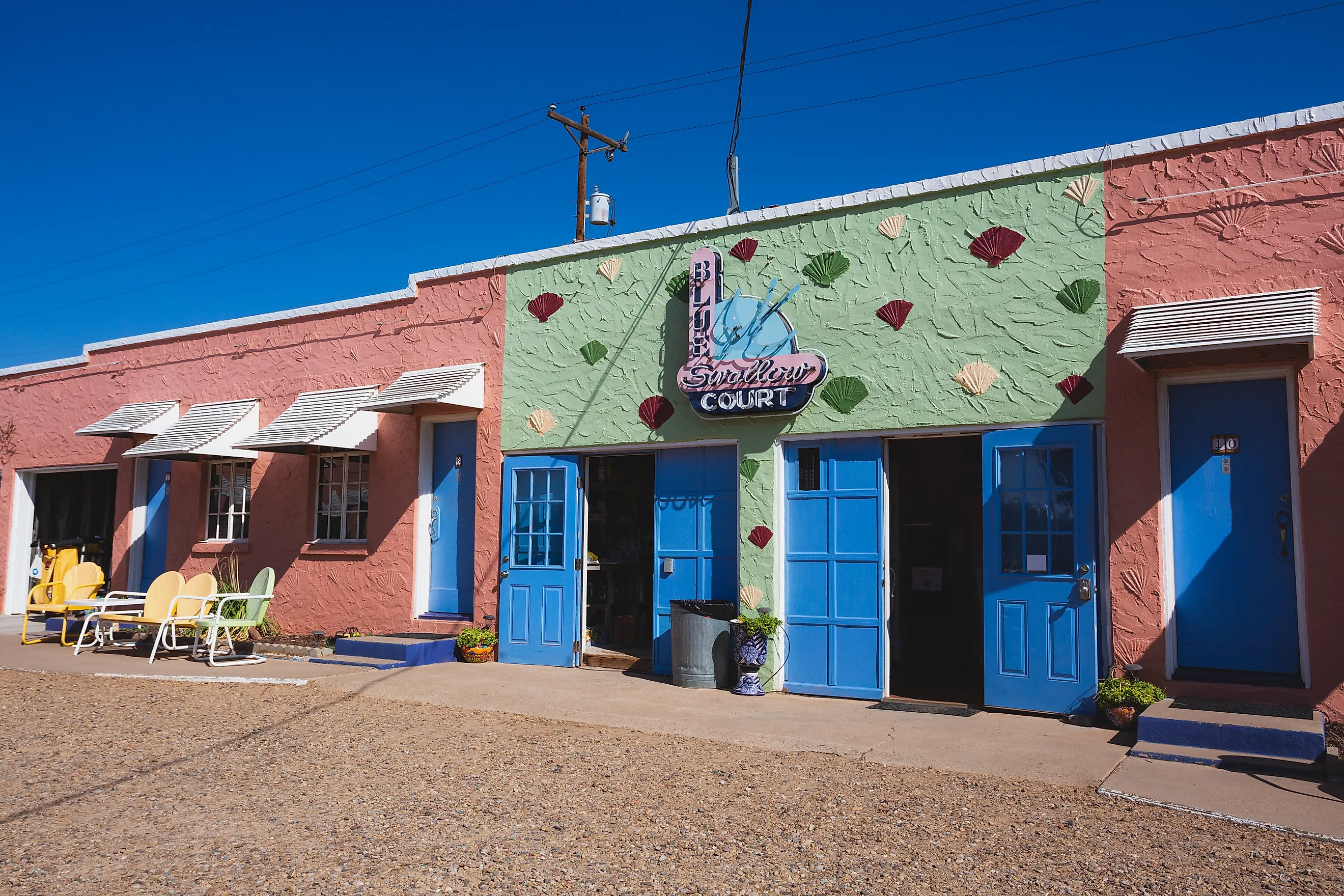
More vintage neon burns along Tucumcari's stretch of Route 66 than anywhere else on the 2,448-mile highway. The old motel slogan "Tucumcari Tonite!" still pitches the town as a stopover, and the Strip is worth a slow drive after dark. Del's Restaurant, a diner from 1956, is marked by a neon cutout of a cow on the roof, and the Blue Swallow Motel down the road has kept its neon bird in flight lit since 1939. Locals describe their town as two blocks wide and two miles long, shaped almost entirely by the highway corridor.
Close to 100 murals cover walls around town, with more planned. The largest, the Tucumcari Legend Mural by Doug and Sharon Quarles, is a painted map of the city and its history that covers an alley wall off Main Street. A population of about 5,300 lives here, thickening through the central district around the Tucumcari Historical Museum.
New Mexico Runs on Its Own Time
What connects these ten is a habit among their residents of keeping the old buildings while making room for whatever comes next, whether that is a gallery, a brewery, or a national laboratory. Taos has the state's oldest art colony, Los Alamos one of its highest concentrations of scientists, and Mesilla and Silver City some of its longest-running Wild West stories, four centuries deep. Route 66 still crosses the middle of the state, linking Gallup on the west with Tucumcari on the east. New Mexico has the highest Hispanic share of any state, roughly half its population, and the second-highest Native American share after Alaska, near 10 percent. It joined the Union late, in 1912, as the 47th state, and it has spent the years since holding onto what came before.