13 Most Welcoming Towns In New York's Countryside
The warmest welcome in New York waits past the last exit ramp. In these countryside villages a stranger gets greeted by name within a block. Shopkeepers still walk you to the thing you asked about. In Finger Lakes towns like Skaneateles the regulars pull you into the conversation at the pier. In Rhinebeck the whole village trades gossip over cheese at the Sunday market. A first-time visitor here leaves on a first-name basis with someone. These thirteen towns make you feel like a regular by the second afternoon.
Skaneateles

Clift Park puts the whole village at ease. The little lakefront green sits at the foot of downtown, with a public pier that draws morning walkers and evening loiterers to the same railing. Skaneateles Lake supplies unfiltered drinking water to Syracuse, so the clarity you see from that pier is the real thing. A block up, the Skaneateles Historical Society keeps the village's record in a former blacksmith shop, and Mid-Lakes Navigation runs narrated cruises out onto the water. The community shows up all year. The weekly farmers market gathers growers and neighbors in equal measure, the Antique and Classic Boat Show fills the harbor with restored wooden hulls, and the Dickens Christmas celebration turns the streets over to costumed carolers each December.
Hammondsport

Pulteney Square is the heart of the introductions in Hammondsport. Shops, cafes, and tasting rooms ring the green at the southern tip of Keuka Lake, and conversation between strangers is the local default. Wine has shaped this village for more than 150 years. Pleasant Valley Wine Company opened here in 1860 as the first bonded winery in the United States, and the Keuka Lake Wine Trail still runs through the surrounding hills. Aviation pioneer Glenn Curtiss grew up in town, and the museum bearing his name displays his early aircraft and motorcycles. Between a vineyard tasting and a cone from Crooked Lake Ice Cream Company, a first-time visitor tends to leave on a first-name basis with someone.
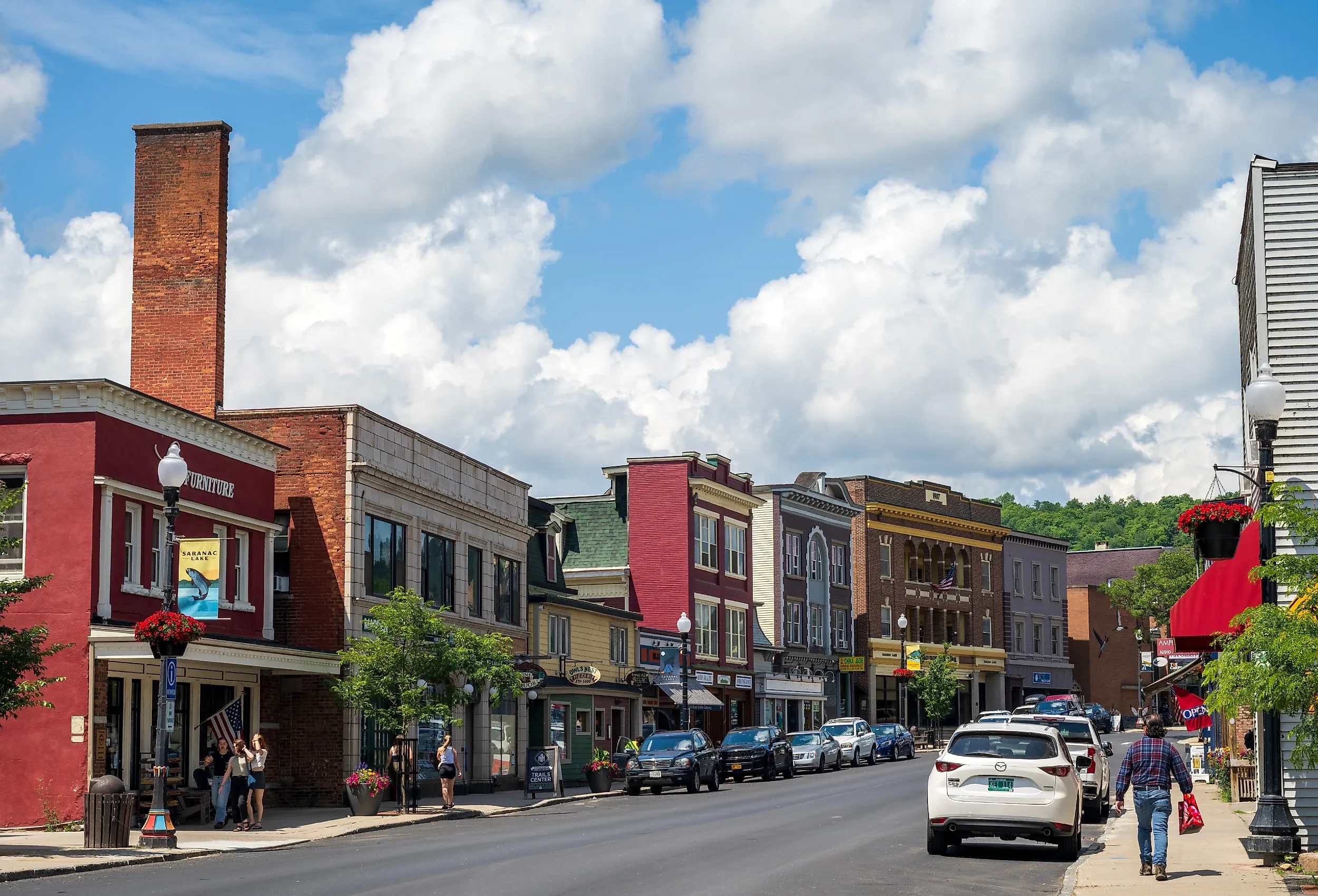
Saranac Lake

The whole village builds the party by hand. Every February the Saranac Lake Winter Carnival raises an Ice Palace from blocks that volunteers cut out of frozen Lake Flower, then fills ten days with parades, fireworks, and snowshoe softball. First held in 1897, it is one of the oldest winter carnivals in the country, and cartoonist Garry Trudeau, a native son, still designs the collectible button each year. The welcome carries through the off-season too. The Adirondack Artists Guild runs a member gallery on Main Street, Origin Coffee Co. pours espresso a few doors down, and Riverside Park gives paddlers and walkers a shared stretch of the Saranac River. The High Peaks rise on every side.
Lake Placid

A village of this global fame has no business being this relaxed. Lake Placid hosted the Winter Olympics twice, in 1932 and 1980, and the Olympic Center still holds the rink where the United States pulled off the "Miracle on Ice." Yet the town wears its history lightly. The Olympic Museum tells the story without fuss, the Cloudsplitter Gondola carries visitors up Whiteface Mountain for a look at the High Peaks, and the 2.7-mile paved loop around Mirror Lake serves as the community's front porch. Locals call it their Central Park, and you will pass runners, families, and dog walkers on any given lap. A meal at Generations Tap & Grill inside the Golden Arrow Lakeside Resort closes the day at lake level.
Cold Spring

Regulars in Cold Spring know the trick to a good afternoon here. They skip the crowded main dock and walk to the shaded benches of dog-friendly Dockside Park, where the Hudson slides past beneath Breakneck Ridge and Mount Taurus and freight barges work the channel. The village sits in the Hudson Highlands, a few miles upriver from World's End, the deepest point on the Hudson. Outdoor visitors have their pick of routes. The rock-scramble ascent of the Breakneck Ridge Trail rewards the effort with wide river views, while the ruins of the Cornish Estate wait quietly in the woods for anyone who prefers a gentler walk. Main Street's Federal-era storefronts fill the gap between the trailhead and the water.
Rhinebeck

Sunday mornings tell you everything about Rhinebeck. The Rhinebeck Farmers Market takes over East Market Street, and residents trade gossip over local cheese and cider well before the day-trippers arrive. The village keeps its independent staples close. Oblong Books has supplied local readers since the 1970s, and the walkable downtown still runs on shops people actually own. Every August the Dutchess County Fair sets up on the fairgrounds here, its permanent home, filling the village with livestock barns and midway lights for six days. The Gilded Age left its mark on the surrounding estates, but the community-first energy is what keeps visitors coming back.
Narrowsburg

A single deep bend of the Delaware River made Narrowsburg the creative heart of the western Catskills. The village's walkable Main Street rewards a slow browse. One Grand Books stocks its shelves around the "desert island" reading lists of writers and artists, and the Delaware Valley Arts Alliance shows regional work inside a restored historic building near the water. The river itself is the main event. Lander's River Trips sends canoes and rafts drifting down the Delaware, and the intimate Tusten Theatre stages performances a short walk from the launch. The Pennsylvania shore sits close enough to wave across.
Cooperstown

Baseball made Cooperstown famous, but the lake made it beloved. Otsego Lake, which James Fenimore Cooper called "Glimmerglass" in his Leatherstocking Tales, stretches north from the village edge. Visitors can take a narrated cruise aboard the Glimmerglass Queen or settle onto the veranda of the grand Otesaga Resort Hotel for a long look over the water. The National Baseball Hall of Fame anchors Main Street for the purists. Locals will point you instead toward a pint of Belgian-style ale at Brewery Ommegang just outside town, or a seat at the Glimmerglass Festival, where a full opera company plays a summer season on the lakeshore.
Canandaigua

The Seneca people called this place "The Chosen Spot," and the name has held. Canandaigua's City Pier carries a row of brightly painted 19th-century boathouses out over the water, and a stroll among them beats any view from the shore. Day-trippers spread out on the lawns of Kershaw Park while locals keep to the pier. The Granger Homestead and Carriage Museum preserves the town's early history, and The Central on Main serves an open-air courtyard downtown. An afternoon disappears easily inside the ornate formal grounds of the 50-acre Sonnenberg Gardens and Mansion State Historic Park.
Watkins Glen

The earth splits open at the edge of downtown Watkins Glen. The Gorge Trail climbs 832 stone steps through Watkins Glen State Park, past nineteen waterfalls and beneath the mist of Rainbow Falls, with gorge walls rising as high as 400 feet overhead. The village earned its place in racing history as the home of American road racing, and the International Motor Racing Research Center keeps that archive downtown. Down at the harbor, a sunset cruise carries passengers out onto Seneca Lake, the deepest of the Finger Lakes. The Rieslings of the Seneca Lake Wine Trail grow on the slopes above that deep blue water, part of what makes "The Glen" stick in a visitor's memory.
Aurora

Aurora fits its whole main street along one wide stretch of Cayuga Lake's eastern shore. The Inns of Aurora set the tone, a collection of restored 19th-century houses turned into a lakefront resort on the hilltop above the water. Meals here stay close to home. Residents and visitors share the lakeside veranda at 1833 Kitchen & Bar inside the Aurora Inn for locally sourced plates, or trade that for wood-fired pizza and a craft pint at the casual Fargo Bar & Grill. The pace rarely rises above a stroll.
Phoenicia

Phoenicia keeps the whole village pointed at one 1962 diner car. The Phoenicia Diner sits on Route 28 below Mount Tremper and Panther Mountain, serving skillet breakfasts built from Catskills and Hudson Valley farms, right down to trout pulled from the creek out back. Esopus Creek sets the summer schedule. Tubers launch from Town Tinker Tube Rentals into the whitewater, while fly-fishers work the same water for the wild rainbow trout that made the Esopus one of the most productive trout streams in the Northeast. For a dry-land afternoon, Rail Explorers runs pedal-powered carts along the tracks of the historic Ulster and Delaware Railroad.
Alexandria Bay

Alexandria Bay runs on the St. Lawrence River as the busy capital of the Thousand Islands. Boldt Castle commands Heart Island just offshore, a turn-of-the-century Rhineland-style pile that George Boldt built as a monument to his wife. Visitors who want the water without the crowded commercial docks head to the manicured paths of Scenic View Park, where the sunset lights up the castle's stone towers across the channel. Maritime tradition and riverside energy give the town its northern-countryside welcome.
The Warmth That Follows You Home
The countryside is where New York keeps its best manners. A morning pastry shared with regulars at a Catskills diner counts for more than any landmark. So does a Riesling poured by the grower who tends the vines above Seneca Lake, or a wave from a lockkeeper as a freighter slides past a Gilded Age castle. Each of these thirteen towns opens the same way. It hands a visitor a seat at the table and expects them to stay a while.