12 Storybook Towns In Georgia
Across Georgia, certain towns feel like they belong in another world. The state’s Blue Ridge mountains and Atlantic marshes shelter places where time moves differently. A Bavarian village in Helen recalls Alpine markets from a different century. Thousands of roses perfume a stately estate in Thomasville. Wild horses roam a windswept beach along the coast. The twelve towns below unfold like storybook pages along the foothills and shorelines of the state.
Dahlonega

Set in the foothills of the Blue Ridge Mountains, Dahlonega began as the site of the 1828 gold discovery that launched the first major US gold rush, nearly two decades before California. Today, the town still centers on that history. Rising over the square is the white-columned, Federal-style Lumpkin County Courthouse. Its bricks, made long ago on a nearby farm, contain trace amounts of gold. Trace the history of the early rush at the Dahlonega Gold Museum, then head out of town to follow the trails of the Chattahoochee National Forest. There, you can still spend a morning panning for gold, as the early miners did, in the water along Yahoola Creek.
Helen

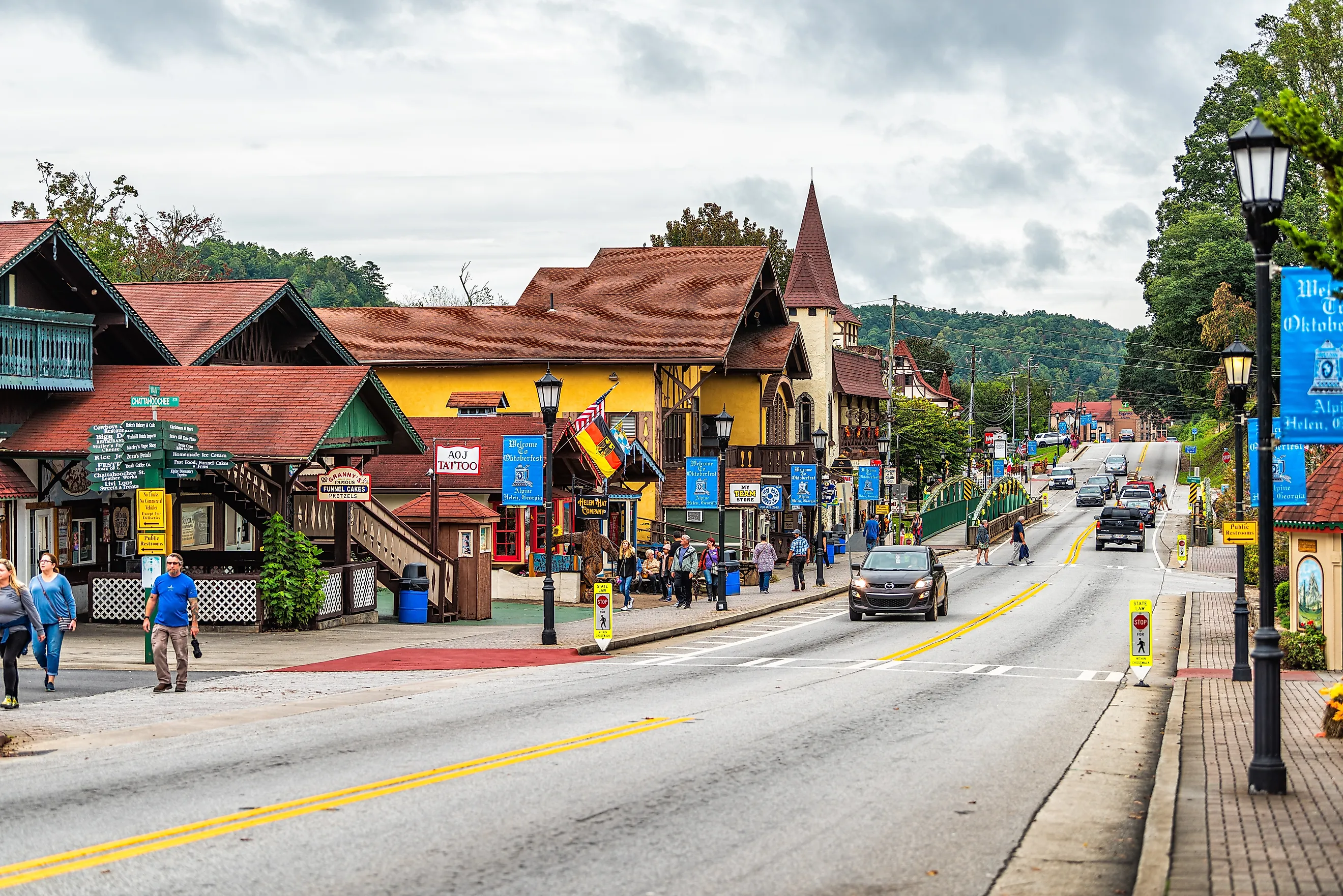
It’s always Oktoberfest in Helen, an Alpine village set against the backdrop of the Blue Ridge Mountains. About 90 minutes north of Atlanta, the town sits in a narrow stretch of the Chattahoochee River Valley, but you would never guess it by its looks. Like a storybook village, the buildings of Helen are fully Bavarian, with steep gabled roofs, dark timber framing over white plaster walls, and window boxes spilling over with flowers. Must-stop spots include Hansel & Gretel Candy Kitchen and Betty’s Country Store. Helen is inseparable from the Chattahoochee River, which runs through the center of it, and in warm weather, the laughter of floating parties drifts off the water, a soundtrack for relaxing with a beer or coffee outside.
Blue Ridge

With its tracks running straight through the center and the depot, Blue Ridge can feel like a toy train village brought to life, its streets and storefronts set neatly into the surrounding hills. Incorporated in 1887, the town sits in the far northern corner of the state, near the Tennessee line, and developed as a railroad town after the Marietta and North Georgia Railroad reached the area in 1886. The Blue Ridge Scenic Railroad still departs from the original depot. For a scenic ride, board a train and follow the Toccoa River through rolling, wooded hills, where anglers line the riverbanks in search of trout. At dusk, the lights of the Swan Drive-In Theatre and Diner flicker to life over one of Georgia’s few remaining drive-ins, in operation since 1955, where double features still play beneath the open Southern sky.
Thomasville

Located in southwest Georgia, Thomasville is known as the state’s “Rose City,” and for good reason. During the annual Rose Show and Festival, held for more than a century, the town fills with parades, displays, and gatherings amid the scent of thousands of roses in bloom. Walk the shaded avenues of the historic district, where the signature flowers climb and spill around stately Victorian homes, and step into the Lapham-Patterson House Historic Site, which preserves the scale and detail of an earlier era. Spend some time in the antique shops and cafes of Broad Street, where the wide, brick-lined paths and late 19th-century storefronts remain intact. Then take a drive to Pebble Hill Plantation. Established in 1825 by Thomas Jefferson Johnson as a working plantation, Pebble Hill later developed into a sporting estate and has been open to the public since 1983. Today, visitors can explore the land and buildings that once hosted quail hunters.
St. Marys

On the southeastern edge of the state, St. Marys developed as a port town along the St. Marys River in the late 18th century, and that heritage-filled maritime feel remains today. The St. Marys Submarine Museum reflects the town’s connection to the nearby submarine base at King’s Bay, and from the docks in town, you can catch a ferry to Cumberland Island, once home to the Carnegie family’s Dungeness estate. The feeling here is otherworldly. Survey the ruins and continue to the beach, where feral horses roam, part of a herd with roots in the island’s long colonial and plantation-era history. Back on the mainland, explore that marshland more closely at nearby Crooked River State Park, which offers kayaking and wildlife viewing in a place that feels suspended between the history of Georgia and the mystery of the sea.
Madison

East of Atlanta, legend holds that General Sherman spared the town of Madison because he found it too beautiful to burn. Part of Georgia’s Antebellum Trail, Madison retains more than one hundred preserved antebellum structures, and strolling the historic district feels like stepping into the pages of a Southern novel. Heritage Hall, built in 1811, offers one of the clearest glimpses into that earlier world, while the Madison-Morgan Cultural Center offers events and a museum, including a collection of Arts and Crafts furniture, pottery, and metalware set against wallpaper printed from William Morris’s original woodblocks. Take a drive beyond the historic district and head to nearby Oconee National Forest, which offers trails, lakes, and open spaces suited to bird watching, hiking, and water sports.
Rome

The small city of Rome, known as the City of Seven Hills, was established in 1834 at the confluence of the Etowah, Oostanaula, and Coosa Rivers. Walk to the center of one of its bridges to view the merging of the rivers, then climb the 107 steps of the town Clocktower for the best vista of the hills that give Rome its nickname. The popular Riverwalk features a paved network of bridges, overlooks, and shaded stretches that keep the rivers always in view. Other attractions include the Rome Area History Center and the Chieftains Museum, the former home of Cherokee leader Major Ridge. Be sure to grab a selfie at the Capitoline Wolf, an exact replica of the well-known sculpture in Rome, Italy.
Darien

Among Georgia’s oldest towns, Darien sits along the Altamaha River, one of the largest free-flowing rivers on the East Coast. The town sits within an ancient tidal marsh, and the rising and falling tides give the town an ethereal, timeless feel. Stroll the docks where shrimp boats still move in and out with the currents, then stop in at the nearby Fort King George, first established by the British in 1721 as their southernmost outpost, where reconstructed buildings and grounds give a sense of the early military settlement. The McIntosh Art Association (Old Jail Art Center) offers visitors a look into period jail cells, as well as a collection of local artifacts and displays on the town’s development, along with rotating art exhibits. The town’s location amid salt marshes also means boat tours and kayaking, where adventurers can wind through narrow tidal channels bordered by tall grasses to watch for herons and alligators, or enjoy the age-old local pastimes of fishing and crabbing.
Washington

In Washington, Georgia, it can feel as though the book of American history opens right in the center of town. Here, entire blocks of antebellum structures stand preserved in time. Explore the Robert Toombs House Historic Site, where guided tours tell the story of one of Georgia’s most influential figures. Nearby, the Washington Historical Museum holds Civil War artifacts, period furnishings, and archival materials. At Kettle Creek Battlefield, walking trails cross open fields and wooded areas where a 1779 Patriot victory helped weaken British control in Georgia. Nearby stretches of the Little River and surrounding backroads offer kayaking and walking trails beneath tree-lined routes that follow historic paths through the county.
Senoia

There is something about Senoia that is reminiscent of a Southern Gothic novel, with tree-lined streets casting long shadows, locals gathering at vintage cafes and lunch counters, and a sense that the place has never quite moved on. That feel has made Senoia a natural fit for the screen. The town and the surrounding countryside have appeared in a range of film and television productions, drawn by the same preserved streetscapes and small-town character that define the town today. Senoia is best known as “Woodbury” in the blockbuster series “The Walking Dead,” and visitors can join guided walking tours that trace filming locations, passing familiar storefronts, alleyways, and streets instantly recognizable to fans.
Be sure to stop into the Senoia Historical Society Museum, housed in the historic Carmichael House, which features a collection of period artifacts, furnishings, and history. Beyond the town center, Senoia opens into green spaces. Seavy Street Park offers shaded walking paths, ponds, and open lawns. Try your luck with catch-and-release fishing at nearby Marimac Lakes.
Blairsville

Blairsville feels like stepping into the pages of an old Scenic Places of America guidebook, where every vista is like a postcard. Tucked into a corner of the Blue Ridge Mountains, the town sits near Brasstown Bald, Georgia’s highest peak, which rises to 4,784 feet. From the parking area, a steep half-mile walk leads to the observation deck, where the view opens across layered ridgelines into North Carolina and Tennessee, the mountains fading into soft blue in the distance. Blairsville serves as a natural base for exploring the mountains, where trails follow streams and lead through storybook landscapes of woodlands and waterfalls that appear as if from out of nowhere. Be sure to bring your bathing suit to stop for a swim at the base of Helton Creek Falls, then continue to Vogel State Park.
Jekyll Island

Off the coast of southeast Georgia, Jekyll Island lies just south of Brunswick, part of the Golden Isles chain. In 1886, members of the Jekyll Island Club, including J. P. Morgan and William Rockefeller, turned the island into a private winter retreat, and for several decades it functioned as one of the most exclusive clubs in the country. You can revisit that world today at the original clubhouse, which still stands at the center of the historic district. After a pause here, jump on a bike and ride the loop road for a different vibe. You will soon see the famous turtle crossing signs along the roadside, where during nesting season traffic slows to protect their crossings. At the Georgia Sea Turtle Center, in a former power plant in the historic district, staff treat injured turtles, many of them affected by boat strikes, fishing line, or illness, and you can see the recovery tanks where they are held before release. Eventually, every visitor to the island ends up at the ancient beaches to walk the iconic landscape, dotted with the bleached, skeletal-like remains of trees pulled down by erosion.
A Southern Storybook
Georgia’s preserved landscapes and towns are among the state’s greatest attractions. Its villages, hamlets, and coastal communities transport visitors to another age, filled with ethereal landscapes and storybook scenes. From courthouse squares to marshy coasts, each offers something transcendent and a glimpse into another world, suited to a weekend getaway or an extended escape.