6 Most Relaxing South Dakota Towns
South Dakota knows how to slow down. Hot Springs runs an 87-degree natural mineral pool that has drawn visitors since 1890. Spearfish anchors itself with a working fish hatchery dating back to 1896. Mitchell rebuilds its Corn Palace exterior every year out of actual corn. These are six of the state’s most relaxing small towns.
Aberdeen

Aberdeen sits in the James River valley of northeastern South Dakota, known locally for being the closest thing the state has to an Oz theme park. Storybook Land, a free-admission public park on the north side of the city, is built around L. Frank Baum’s connection to the area. Baum lived and published in Aberdeen in the 1880s, and the park features a full Wizard of Oz land with a yellow brick road, the Emerald City, and Dorothy’s House. The same park complex includes a castle, fairy-tale attractions, and a small petting zoo.
Downtown, the Hagerty & Lloyd Historic District holds some of Aberdeen’s oldest homes and buildings, including the Margaret and Maurice Lamont House, a Tudor Revival. Richmond Lake Recreation Area, about 10 miles northwest of town, adds hiking, biking, and camping on a reservoir that is the local summer anchor.
Hot Springs

Relaxation is built into Hot Springs. You can soak in the warm natural waters of the Evans Plunge Mineral Springs, which have drawn visitors for over a century. Established in 1890, the spring-fed waters naturally hold a year-round 87-degree temperature. In addition to the thermal springs at Evans Plunge, you have hot tubs, steam rooms, slides, and more.
Beyond the soak, the Mammoth Site is an active paleontological dig featuring remains of Ice Age giants. Consider booking a stay at the historic Red Rock River Resort Hotel & Spa, a sandstone building constructed in 1891. Family-owned and located downtown, the hotel offers quality care and a well-preserved interior. It’s within walking distance of Evans Plunge and other hot spring locations.
Lead

A close neighbor to the busier Deadwood, Lead is a town every bit as historic and far more relaxing. It’s an old mining town at its core, with several modern amenities along its historic Main Street. The Black Hills Mining Museum showcases the area’s gold rush, while the Homestake Opera House, which hosts year-round tours, concerts, dances, and educational events, is a century-old building that once held a bowling alley, billiards hall, and more.
For families, the Sanford Lab Homestake Visitor Center takes a deep dive into the region’s history, its people, and the ongoing scientific research conducted in its underground laboratories. Lead is the right town for South Dakota’s Wild West history without the commercial trappings.
Spearfish

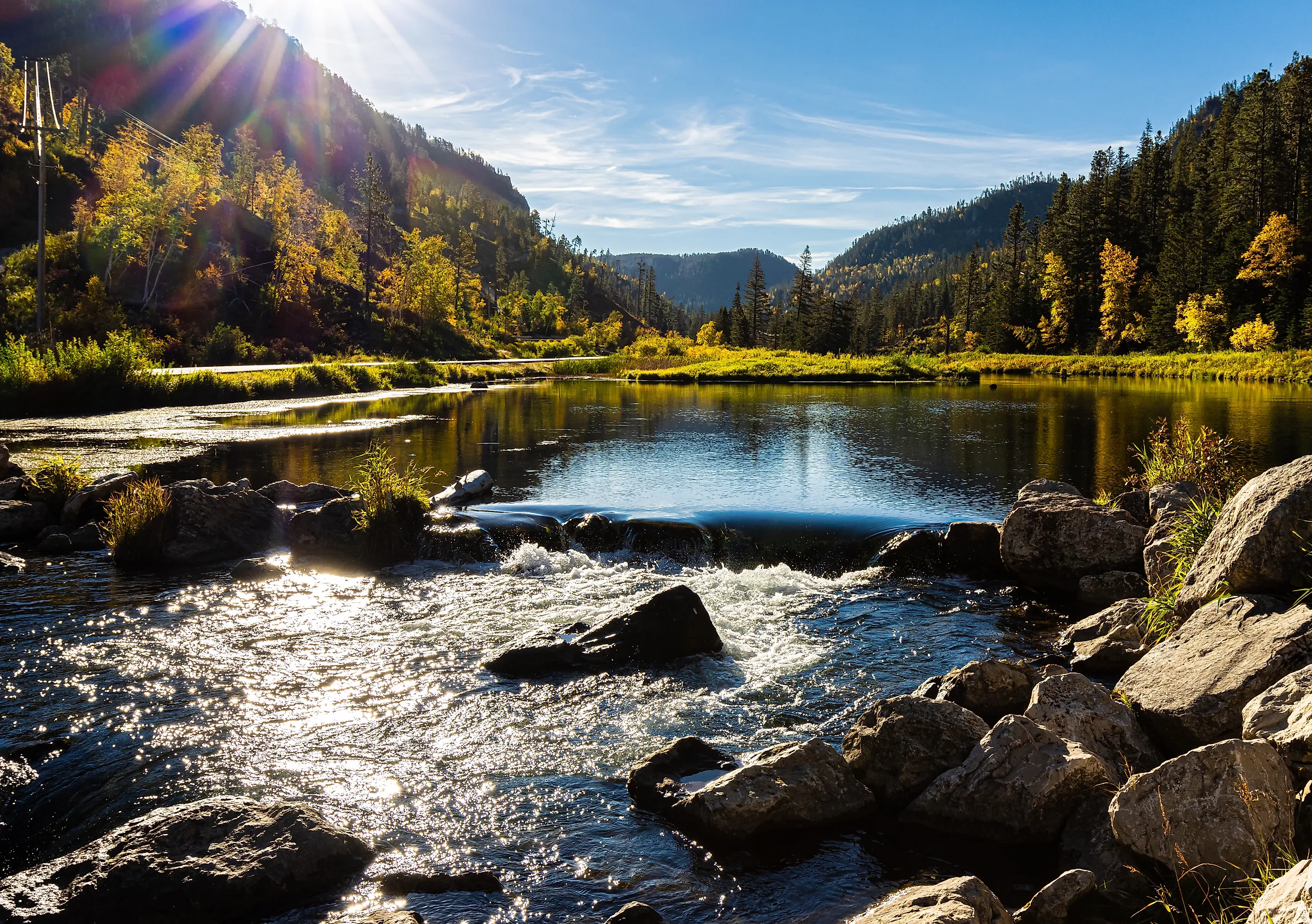
On the northern edge of the Black Hills, Spearfish sits at the mouth of Spearfish Canyon, a 19-mile limestone gorge cut by Spearfish Creek that drops several notable waterfalls along its length. The Spearfish Canyon Scenic Byway follows the canyon floor, past Bridal Veil Falls and Roughlock Falls, and provides one of the most reliably beautiful and uncrowded drives in the state. The D.C. Booth Historic National Fish Hatchery, established in 1896 and now run as a historic site, anchors the town’s history with restored buildings, raceway ponds full of visible trout, and the Von Bayer Museum of Fish Culture.
Downtown Spearfish has a walkable core along Main Street with local restaurants including Killian’s Food and Drink and Lucky’s 13 Pub. For shorter outings, Spearfish City Park features the hatchery at one end, a sculpture walk along the creek, and shaded picnic grounds. Combined with its easy access to Deadwood, Lead, and the rest of the northern Black Hills, Spearfish offers a strong base for anyone wanting to relax without giving up access to outdoor activities.
Custer

Custer is the gateway to Custer State Park, a 71,000-acre preserve in the southern Black Hills that holds one of the largest publicly owned bison herds in the country, roughly 1,300 head, along with elk, pronghorn, and mule deer. The Wildlife Loop Road runs 18 miles through open grassland and mixed pine, with frequent wildlife sightings. Jewel Cave National Monument, 15 miles west of town, has more than 215 mapped miles of passages, ranking it among the longest cave systems in the world.
Downtown Custer itself is compact, with Sage Creek Grille serving elk-stuffed mushrooms and other regional dishes; it has been a fixture on Mount Rushmore Road for two decades. The Crazy Horse Memorial, still under construction since 1948, sits 15 miles north on Highway 385. For outdoor activity, Custer is the closest town to both the 109-mile Mickelson rail-trail and the trailhead for Black Elk Peak, the highest point in South Dakota at 7,242 feet.
Mitchell

Mitchell is home to the Corn Palace, a civic auditorium on Main Street whose exterior is redesigned every year out of actual corn, grain, and native grasses by a rotating group of local artists. The original structure dates to 1892, with the current building completed in 1921. New murals go up each summer. The building hosts high school basketball, concerts, and the annual Corn Palace Festival in late August. Admission is free year-round.
Woolworth’s Caramel Apples, next door, has been making the same recipe since the 1950s. The Dakota Discovery Museum a few blocks away covers regional history with a restored 1886 one-room schoolhouse, 1900 farmhouse, and 1909 Italianate home, plus a collection of Native American art and early 20th-century prairie paintings by Oscar Howe and Harvey Dunn.
Visit Relaxing South Dakota Today
These six towns split fairly cleanly between two South Dakotas: the prairie side, Aberdeen and Mitchell, and the Black Hills side, Hot Springs, Lead, Spearfish, and Custer. The prairie towns are anchored by one or two strong local institutions and a quieter pace. The Black Hills towns are anchored by the landscape itself. Either side rewards a weekend, and together they give you a fuller picture of the state than Mount Rushmore alone ever could.