11 of the Quietest Washington Towns
Washington's quietest small towns sit along its coastlines and around its evergreen forests. La Conner captures that quietness perfectly, with its setting on the Swinomish Channel and a waterfront boardwalk that makes the town feel peaceful and photogenic. North Bend offers a foothills version, with Mount Si, evergreen forests, and nearby trails creating a mountain backdrop. Stehekin may be the most remote example, with its boat-access-only location at the head of Lake Chelan and its deep connection to the North Cascades. Starting with Winthrop in north-central Washington, here are 11 of the calmest towns in the state.
La Conner

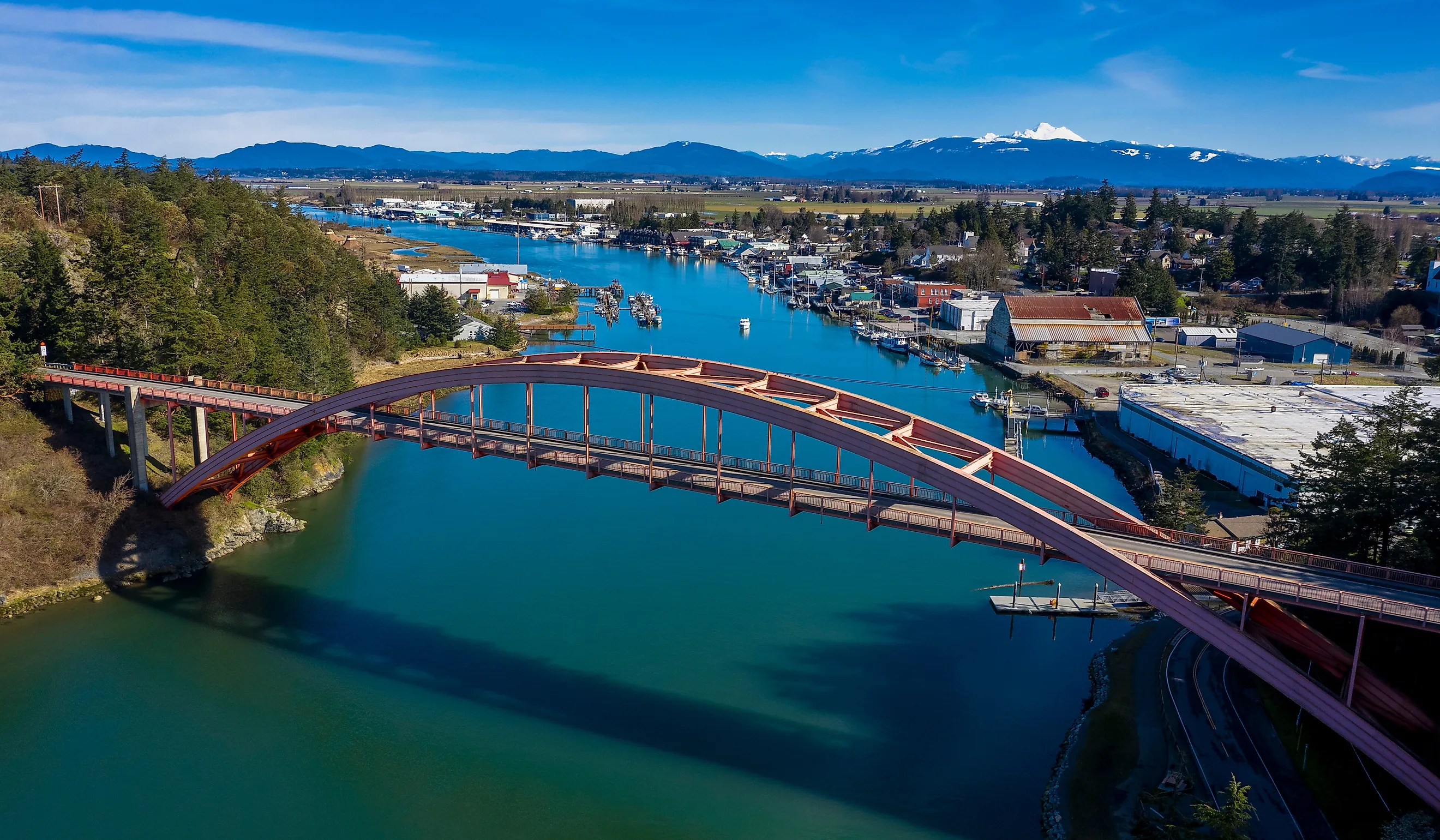
La Conner is one of Washington's most peaceful escapes, set along the quiet Swinomish Channel with pastel storefronts and soft coastal light. Visitors often wander to the Rainbow Bridge, an orange steel arch built in 1957 that rises over the channel and appears in nearly every iconic photo of the town. The bridge connects La Conner to the Swinomish Reservation and serves as both a scenic viewpoint and the visual anchor of the waterfront. The Museum of Northwest Art is a contemporary, light-filled gallery dedicated to the artists and creative traditions of the Pacific Northwest. Outdoor visitors can walk the historic First Street boardwalk while watching fishing boats drift by, and the surrounding Skagit Valley farmland adds an extra layer of quiet, especially during sunrise and spring tulip season.
Bow-Edison

Bow-Edison is a neighboring pair of hamlets set amid tidal flats, dairy farms, and misty lowlands in the Skagit Valley. The area is known for its Samish Bay shoreline and small art galleries, including Smith and Vallee Gallery, one of the most respected creative spaces in the region, blending contemporary Northwest art with small-town Skagit character. Taylor Shellfish Farms, a regional oyster producer, has a rustic waterfront-adjacent location nearby where travelers can sample some of the freshest shellfish in the Pacific Northwest. Cafes and bakeries like Tweets anchor a tiny but lively main street that feels miles away from city noise.
Winthrop

In the Methow Valley, Winthrop combines an Old West-themed boardwalk downtown with sweeping mountain quiet. Wooden boardwalks and frontier-style buildings sit against a backdrop of the Chewuch River, the rolling hills of Pearrygin Lake State Park, and the Methow Valley Trails system, a network of roughly 200 kilometers of maintained trails that turns the town into one of Washington's most active quiet destinations, especially in winter when the trails become a cross-country skiing destination. The Shafer Historical Museum adds another layer, with a hillside collection of pioneer buildings and artifacts that brings the Methow Valley's frontier past to life on a sun-drenched property above town.
North Bend

North Bend is a foothills community surrounded by evergreen forests and Cascade peaks. Nature lovers come for the silhouette of Mount Si, the reflective waters at Rattlesnake Ledge, and the pastoral calm of Snoqualmie Valley farms during blueberry season. Pop culture fans know the town as the setting for David Lynch's Twin Peaks, and Twede's Cafe on North Bend Way still serves the "damn fine" cherry pie the show made famous. The Snoqualmie Valley Museum offers a quieter cultural stop between hikes, with exhibits on Indigenous heritage, early logging communities, and the development of the valley's small towns.
Eastsound

Eastsound, on Orcas Island, is a village framed by glassy bays and forested ridges. The calm waters of Cascade Lake in Moran State Park are the island's most popular freshwater spot, with swimming, paddling, and summer lake culture. Moran State Park itself covers more than 5,000 acres of lakes, old-growth forest, and waterfalls, and Mount Constitution inside the park is the highest point in the San Juan Islands at 2,409 feet. The Orcas Island Historical Museum, the island's only heritage center, houses roughly 6,000 artifacts, documents, and photographs.
Langley

Langley, perched above Saratoga Passage on Whidbey Island, is an artsy seaside town. Seawall Park, Langley's signature waterfront green space, offers quiet walks along the bluff. Each June, the Whidbey Adventure Swim draws swimmers to the shoreline for a 1.2-mile or 2.4-mile race in the cold, fast-moving waters of Saratoga Passage. Nature lovers come for the views from Langley Marina and for whale-watching opportunities near South Whidbey Harbor. The historic Clyde Theatre, a single-screen cinema on First Street, anchors the town's arts scene with old-school charm and a loyal local following.
Port Townsend

Port Townsend is one of Washington's quietest Victorian seaports, with foggy mornings, maritime calm, and preserved 1880s architecture. Photographers flock to Fort Worden State Park, a 433-acre bluff-top expanse overlooking Admiralty Inlet where forested trails, wide beaches, and historic coast artillery architecture converge. The Point Wilson Lighthouse within the park marks the junction of the Strait of Juan de Fuca and Puget Sound. First lit in 1879 and rebuilt in 1914, the current 46-foot reinforced-concrete tower is still an active navigational aid. The ornate homes of the Uptown Victorian district and the Port Townsend Bay waterfront round out the setting, and the bay still supports working boatbuilders and independent marine trades.
Stehekin

Stehekin is one of the most remote communities in the state, accessible only by boat, floatplane, or trail. Its isolation comes from its location at the head of Lake Chelan, deep in the North Cascades. You can spend the morning wine tasting, the afternoon paddling across glassy water, and the evening watching alpenglow settle over peaks that feel impossibly close. Hikers can explore the Stehekin Valley Road, a narrow corridor that runs from Stehekin Landing into the lower North Cascades and serves as the community's lifeline. Stehekin Landing, the gateway to the valley, is where ferries from Chelan, floatplanes, hikers, and cyclists all converge before dispersing into the surrounding wilderness.
Roslyn

Roslyn, a former coal-mining town in the Cascade foothills, is best known to TV fans as Cicely, Alaska from the 1990s series Northern Exposure. The Roslyn Cemetery is one of the most culturally significant burial grounds in Washington State, a 15-acre hillside comprising 26 separate but adjoining cemeteries reflecting the miners' ethnic heritage, with ornate European stonework alongside simple wooden crosses and wrought-iron fences. Downtown preserves storefronts from the show's era, including Cicely's Gift Shop in the former "Roslyn Cafe" building. Nearby Lake Cle Elum, a glacially carved reservoir in Kittitas County, adds scenic appeal with steep Cascade foothills and quiet shoreline recreation. The Roslyn Museum adds historical context, staffed by knowledgeable volunteers who often share firsthand stories about the region's mining past.
Port Gamble

Port Gamble is a tiny Victorian village that feels like a preserved 19th-century coastal settlement. Its quiet streets overlook Hood Canal, which stretches roughly 65 miles along the edge of the Olympic Peninsula. The Port Gamble Historic Museum anchors the story of one of Washington State's oldest company towns, founded in 1853 as a lumber-mill community. St. Paul's Episcopal Church, built in 1879 and 1880, reflects the East Coast heritage of the settlers who shaped the town, and its steeple and stained-glass windows still anchor the historic skyline. Port Gamble Bay, about 2.7 miles long, is edged with eelgrass beds and pocket estuaries that support salmon and shellfish, and kayakers skim its surface beside the Victorian buildings on the western shore.
Dayton

Dayton is one of eastern Washington's most tranquil small towns, surrounded by rolling wheat fields and the soft Palouse hills. The restored Dayton Historic Depot, built in 1881, is one of Washington's oldest surviving railroad stations and now houses a museum covering regional transportation and agricultural history. The Columbia County Courthouse dominates downtown with its 1887 Italianate design, making it the oldest working courthouse in Washington State. The nearby Blue Mountains give the town a mix of pastoral and mountainous scenery, and the quiet main street is especially photogenic in golden-hour light.
Eleven Towns, One Quiet Corner
Washington's quietest towns offer something rare: room to breathe. The eleven towns above cover a wide range, from lakeside communities deep in the Cascades to maritime villages shaped by tides and timber to pastoral island settlements where the pace slows naturally. Each one proves that quiet still has a place in Pacific Northwest travel, whether you want forest trails, ferry crossings, local cafes, or small-scale downtown streets that still feel like themselves.