9 Oldest Founded Towns To Visit in the Rockies
Taos traces its roots back more than a thousand years, to a multistory adobe pueblo that ranks among the oldest continuously inhabited places in the country. The town itself came much later, formally established in 1795 at the northern edge of the New Mexico mountains. Golden, in Colorado, followed in 1859 and briefly served as the territorial capital before Denver claimed the role. Farther north, Bozeman grew up in 1864 as a supply stop along the trail that carried miners into Montana's gold country.
The Rocky Mountains stretch some 3,000 miles across six US states, Montana, Idaho, Wyoming, Colorado, Utah, and New Mexico, before continuing into Canada. Plains people such as the Blackfoot, Crow, and Cheyenne ranged through the eastern ranges for generations, and Lewis and Clark crossed the region in the early 1800s ahead of the miners and homesteaders who founded most of its towns. These nine are among the oldest in the Rockies, each one wearing its founding date in its old buildings, museums, and main streets.
Taos, New Mexico

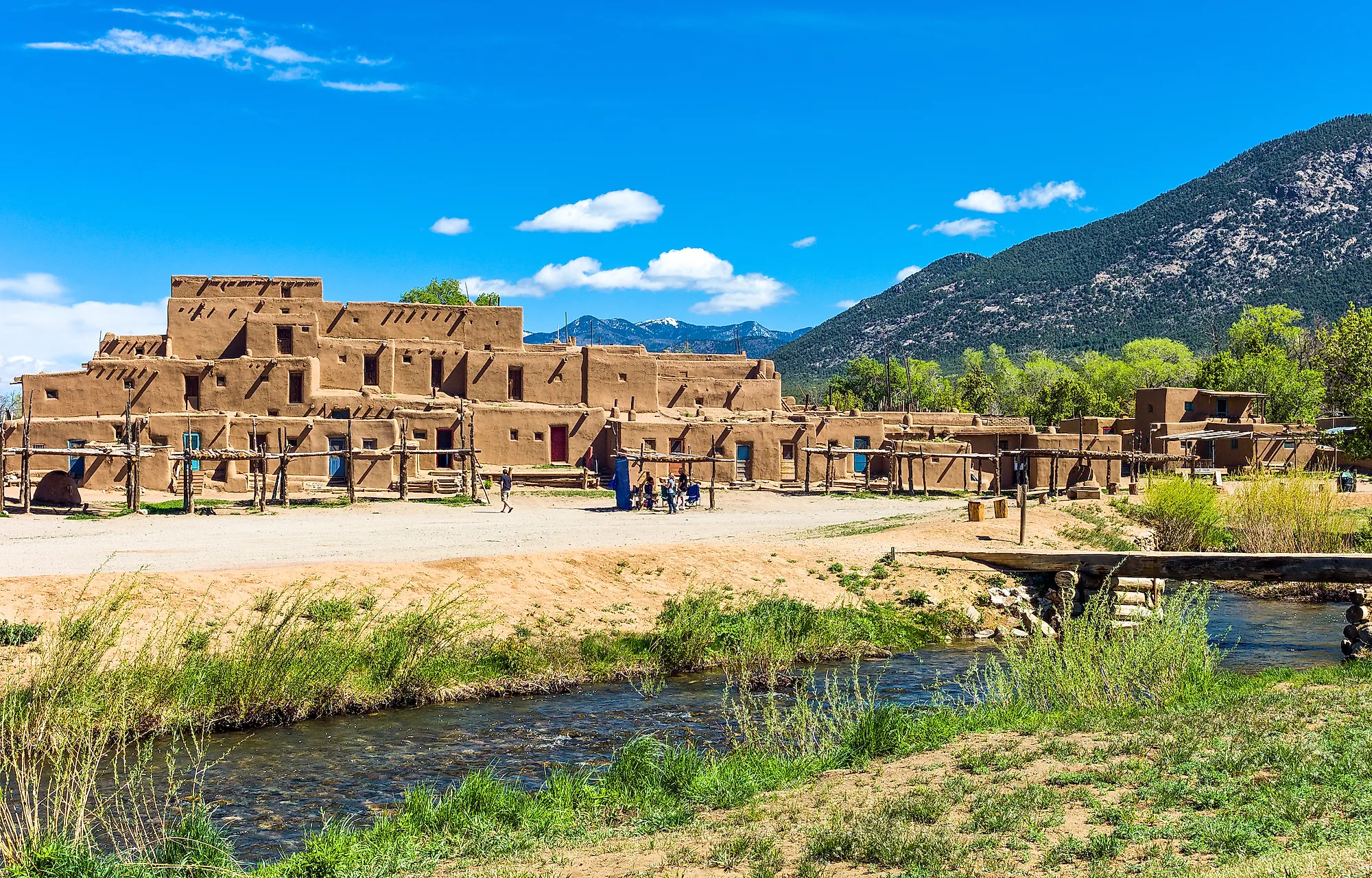
Taos is a town of history, art, and culture at the northern end of New Mexico, in the Sangre de Cristo range of the southern Rockies. Its origins reach back more than a thousand years, though the town itself was not formally established until 1795. The most notable landmark is Taos Pueblo, a multistory adobe village that Native people raised and have lived in continuously for roughly a millennium. Up to five stories tall and joined into large connected units, the pueblo is both a National Historic Landmark and a UNESCO World Heritage Site, and its grounds carry a history that predates European arrival.
The pueblo is not all there is to Taos. The San Francisco de Asis church in nearby Ranchos de Taos, about four miles south, has stood for more than 200 years and ranks among the most photographed adobe buildings in the Southwest.
Boulder, Colorado

Boulder is one of Colorado's larger cities, home to more than 100,000 people across roughly 27 square miles. It is a home-rule city that governs its own affairs and serves as the seat of Boulder County. The city lies at the base of the Rocky Mountain foothills, about 5,430 feet above sea level. Prospectors arrived at the mouth of Boulder Canyon in late 1858 during the Colorado gold rush, and the Boulder City Town Company was organized in early 1859. Long before that, the Ute occupied the valley by the 1500s, later joined by the Arapaho and Cheyenne, whose bands wintered along the Front Range.
What began as a mining camp grew into a college town after the University of Colorado was established in 1876 and opened its doors in 1877. The University of Colorado Museum of Natural History lays out the region's deep past, with exhibits and programs for all ages, and the historic campus gives the older part of town much of its character.
Black Hawk, Colorado

Black Hawk is one of the oldest towns in the Rockies, up in Gilpin County in the mountains west of Denver. Fewer than 200 people live within its 2.6 square miles. Prospectors moved into the area in 1859 after gold turned up in nearby Gregory Gulch, one of the richest strikes of the Colorado rush.
Today the old mining town is better known for its casinos, which came after Colorado voters legalized limited-stakes gambling in 1991 and now pull in visitors from well beyond the state. The mountain scenery around it still appeals to anyone who loves the outdoors.
Golden, Colorado

Golden lies along Clear Creek in Jefferson County, at the base of the Front Range, with a population near 20,000. Prospectors established the mining camp as Golden City on June 16, 1859, during the Pike's Peak gold rush, and named it for Thomas L. Golden, an early prospector. For a short time it was one of the most important towns in the territory, serving as capital of the provisional Jefferson Territory and then the official Colorado Territory, until the seat of government moved east to Denver in 1867.
Golden started as a mining town but soon turned to farming and milling as well. The Buffalo Bill Museum and Grave, on nearby Lookout Mountain, and the Clear Creek Whitewater Park both speak to the outsized part this small town played in the state's early history.
Georgetown, Colorado

Georgetown lies along Clear Creek in the Front Range, about 45 miles west of Denver at an elevation of roughly 8,500 feet. George and David Griffith found gold here in 1859, and the town took the family name. The real fortune came in 1864, when rich silver lodes turned up in the surrounding mountains and earned Georgetown its nickname, the Silver Queen of the Rockies.
Unlike many boom towns, Georgetown never burned, so hundreds of its Victorian buildings still stand. It is the heart of the Georgetown-Silver Plume National Historic Landmark District, and the restored Georgetown Loop Railroad climbs the narrow canyon to neighboring Silver Plume, gaining more than 600 feet in about two miles. The 1875 Hotel de Paris, now a museum, recalls the town's silver-era wealth.
Cañon City, Colorado

Cañon City lies along the Arkansas River in Fremont County, at the eastern end of the Royal Gorge between the Front Range and the Wet Mountains, with about 17,000 residents. Gold seekers first laid out the townsite in 1858, and after the claim changed hands, the town was established in 1860. Today it is a popular base for whitewater rafting on the Arkansas.
Cañon City lost a bid to become the state capital and was awarded Colorado's first territorial prison instead, which opened in 1871 and still operates at the edge of downtown. The nearby Downtown Historic District, listed on the National Register, preserves blocks of buildings raised between the 1870s and the 1920s.
Idaho City, Idaho

Main Street in Idaho City, Idaho. Image credit: Wikimedia Commons
Idaho City lies in the Boise Basin about 35 miles northeast of Boise, in the mountains of the Idaho Rockies. Prospectors founded it in October 1862 after a gold strike in the basin touched off one of the richest rushes since California's. Within a year its population passed 7,000, briefly making it the largest city in the Pacific Northwest, larger even than Portland.
The gold is long gone and only a few hundred people remain, but the 1860s buildings survive. The Idaho City Historic Walking Tour passes brick storefronts rebuilt after a string of fires, the 1864 Ponderosa Saloon, and a pioneer cemetery, and the Boise Basin Museum occupies a former schoolhouse packed with relics of the rush. Boise National Forest surrounds the town on all sides.
Virginia City, Montana

Virginia City lies in Alder Gulch in the mountains of southwestern Montana, where the richest placer gold strike in the Rocky Mountains began in 1863. Thousands of prospectors poured in within months, and by 1864 some 10,000 people crowded the gulch. Between 1865 and 1875, Virginia City served as the capital of Montana Territory before the seat of government moved to Helena.
The gold faded and the capital left, but Virginia City never became a true ghost town. More than 200 of its 1860s buildings survive, preserved as a National Historic Landmark District and largely owned by the state of Montana. Wooden boardwalks, old saloons, and a narrow-gauge railroad to neighboring Nevada City make it one of the best-preserved gold-rush towns in the West.
Bozeman, Montana

Bozeman lies in Gallatin County, Montana, near the southern end of a wide valley that early settlers called the Valley of the Flowers. John Bozeman, along with Daniel Rouse and William Beall, platted the town in 1864 as a supply point for miners heading to Montana's gold fields along the Bozeman Trail. Clark's party had passed through the Gallatin Valley on the expedition's return in July 1806, though permanent settlement came decades later. Locals like to call it one of the most livable places in the country, with cycling, hiking, and a lively downtown all close at hand.
Montana State University arrived well after the town's founding, in 1893, and it gives present-day Bozeman a college-town feel. The Museum of the Rockies traces the area's history and its famous dinosaur finds, and the surrounding Custer Gallatin National Forest opens onto miles of backcountry.
The Oldest Corners of the Rockies
The story of these towns reaches back long before their founding dates. The Rocky Mountains themselves rose during the Laramide Orogeny, a mountain-building period that began roughly 70 million years ago, as the ancient Western Interior Seaway drained away. Most of what followed was written in gold and silver. Boulder, Black Hawk, Idaho City, and Virginia City all began as mining camps, and Cañon City and Georgetown grew from the same rush. Each has carried its early history forward in its old buildings and museums, and together they mark the long human presence in the Rockies.