The Most Charming River Towns In California
Californians have been beating the summer heat on their rivers for well over a century. The Sacramento River rolls past Red Bluff in the north. The Russian River bends through the redwood resort country around Monte Rio. The San Lorenzo threads through the woods of Felton and Boulder Creek. Down the Central Coast the Salinas River runs beside Paso Robles and Atascadero. Out in the eastern desert the Colorado River marks the edge of the state at Blythe and Needles. Each of these eight towns turned its stretch of water into a story worth stopping for.
Red Bluff

Right on the banks of the Sacramento River sits the William B. Ide Adobe State Historic Park, named for the man who led the short-lived Bear Flag Republic in 1846. Its visitor center, mid-19th-century adobe home, and blacksmith shop lay out the daily grind of an early Tehama County settler. The town itself grew up as a river port and remains a common stop for travelers headed north toward Mount Shasta, about an hour and a half away by car.
Red Bluff keeps its other histories close, too. The Victorian-era Kelly-Griggs House Museum, once home to two local families, has run as a nonprofit since 1965. A few minutes away, the Historic Chinatown Alley is tied to the Helen and Joe Chew Foundation, which supports higher education and the Chinese-American community here. Its free New Year celebration fills the alley with food trucks, performances, and color each winter.
Monte Rio

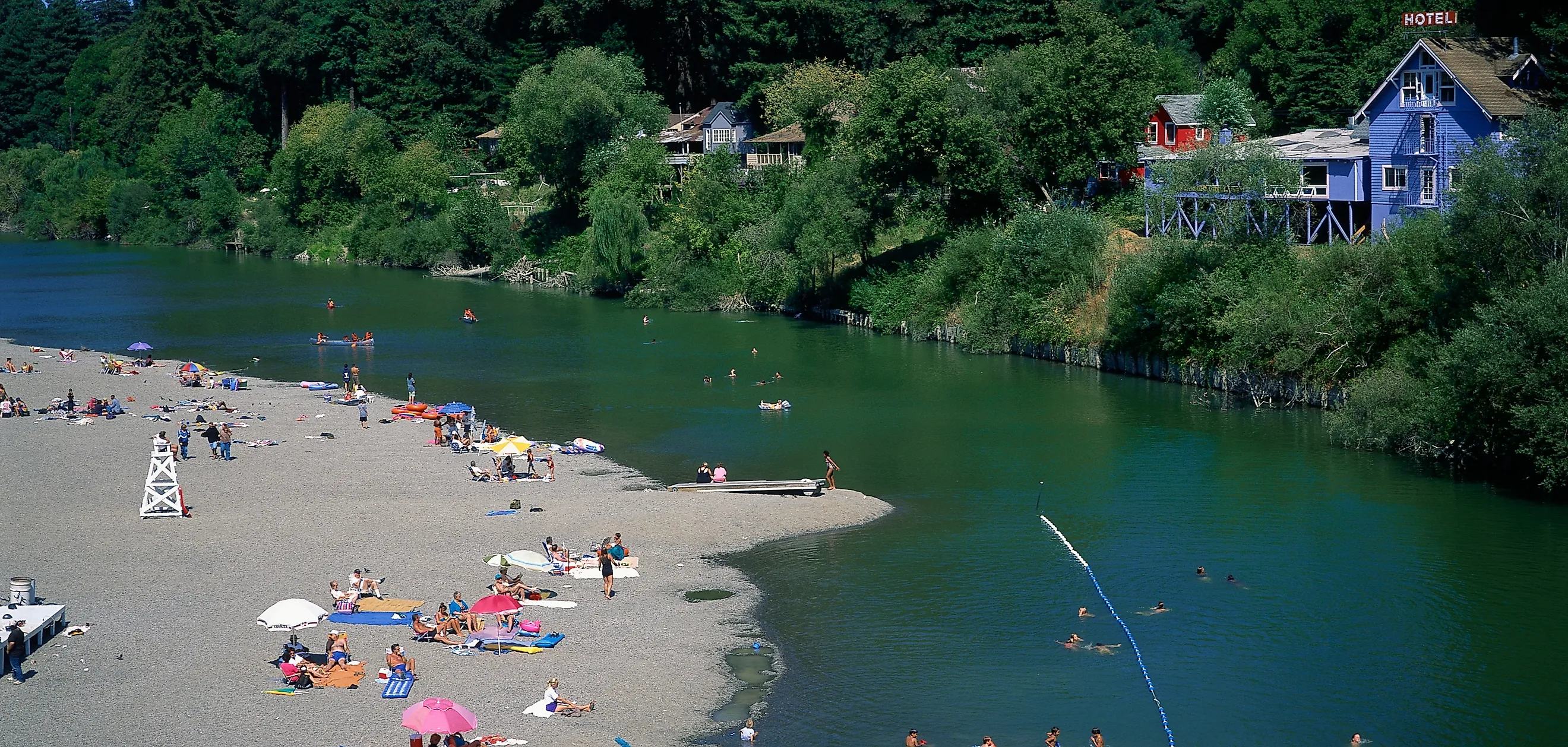
The nine-hole Northwood Golf Course was laid out by Alister MacKenzie, the same architect behind Augusta National, and it started life as a private retreat for the Bohemian Club before opening to the public. The course sits in a loop of the Russian River just outside Monte Rio, a Sonoma County resort town four miles west of Guerneville. The river is the whole point here, with a broad public beach that rents boats, keeps a dog-friendly stretch, and fills with swimmers and paddlers all summer. A neon sign arching over the road still welcomes arrivals to the "Vacation Wonderland" of the railroad era.
That nickname dates to the 1870s, when trains first carried San Franciscans out to summer cabins along the water. The town's most famous neighbor is Bohemian Grove, the private redwood camp the Bohemian Club has owned since 1899 and still uses for its secretive July gatherings of politicians and business leaders. Downtown life centers on the Rio Theater, a movie house built inside a World War II-era Quonset hut, and the Monte Rio Variety Show, a community fundraiser that locals have staged every summer since 1911. Cross the Monte Rio Bridge, a 1934 span listed on the National Register of Historic Places, and River Boulevard runs past old inns and river-view bars, including the former Village Inn where scenes from the 1942 film "Holiday Inn" were shot.
Felton

Board a narrow-gauge steam train at Roaring Camp and you ride straight through the redwoods, with the option to keep going all the way to the Santa Cruz Beach Boardwalk. This is the heart of Felton, where the San Lorenzo River cuts through Henry Cowell Redwoods State Park and old-growth trees tower over trails that run out to grasslands and sandhills. Banana slugs and coyotes share the ground below. More hiking waits at the park's Fall Creek Unit, which follows Bennett Creek along the west side of town.
After the trails, Felton Music Hall books live comedy and music most nights of the week. Up the hill, Hallcrest Vineyards has grown organic grapes in the Santa Cruz Mountains since San Francisco attorney Chaffee Hall planted the estate in 1941, when it was one of only three wineries in the range. The tasting deck looks out over the same slopes he chose more than 80 years ago.
Boulder Creek

Joe's Bar started as a community hall in the 19th century and reopened as a Boulder Creek watering hole in 1977, on a downtown street lined with false-front buildings that could pass for a Western film set. The San Lorenzo River runs through here as well, just under 20 minutes north of Felton, feeding the creeks that give the town its name. At the edge of town, the San Lorenzo Valley Museum occupies the old Grace Episcopal church and runs monthly heritage demonstrations like natural dyeing and candlemaking.
The town wears its history and its odd streaks side by side. The lille æske arthouse brings Scandinavian design, live music, and a First Friday art night to a hole-in-the-wall space downtown. A short walk away, Boulder Creek Antiques at Mac's Place trades in knick-knacks and gifts that keep the town's 19th-century character in circulation. It is a small place that rewards slow browsing.
Paso Robles

Frank and Jesse James are said to have passed through Paso Robles back when it drew cattle ranchers and outlaws to its stagecoach stops. You can still walk into that era at the Pine Street Saloon on Pine Street, one of the oldest surviving buildings in town, which served in turn as a stage stop, hotel, and saloon. This inland Central Coast city made its name on ranching before the vineyards arrived.
Today the wine does much of the talking. Vina Robles Vineyards and Winery sits close to the Salinas River on the road toward Atascadero, pouring sustainably farmed bottles in an upscale tasting room. Across the river and Highway 101, the Pioneer Museum fills little Pioneer Park with vintage cars and farm and ranch tools from the town's early days. The vines and the artifacts tell two halves of the same story.
Atascadero

The Atascadero Administration Building rises over the town center with upper and lower rotundas and terra cotta trim, designed by San Francisco architect Walter D. Bliss and built between 1914 and 1918. It has served as the town's bank, post office, and schoolhouse over the years, and now works as city hall. Founder E.G. Lewis planned the whole colony around it, right down to the formal Sunken Gardens out front, which he modeled on the Grand Basin from the 1904 St. Louis World's Fair.
Those gardens now host the Atascadero Farmers Market beside Highway 101, across from the Colony House Museum and the Hattie Prather Rose Garden run by the local historical society. The Salinas River draws close to town here, and stretches of the Juan Bautista de Anza National Historic Trail follow its course. Bring water when you walk it, since Atascadero sits farther inland than its coastal neighbors and runs hot in summer.
Blythe

Cut into the open desert floor outside Blythe are the Blythe Intaglios, giant human and animal figures that Indigenous peoples of the lower Colorado River regard as sacred. They are best seen up close, where their scale sinks in. Blythe sits in the Palo Verde Valley right where California meets Arizona along the Colorado River, an isolated town with a surprising run of landmarks.
Back in the center of town, the Palo Verde Historical Museum lays out Blythe's story alongside old farm machinery like grinding wheels. Nearby, the Blythe Wings Mural by local artist Jesus "Chuy" Ayala has become a favorite photo stop thanks to social media. For quieter company, the Palo Verde Ecological Reserve on the river shelters yellow-billed cuckoos, Gila woodpeckers, and the occasional desert tortoise.
Needles

El Garces Hotel once served Santa Fe Railroad passengers as one of the grand Harvey House hotels, and today the restored landmark anchors a transit hub for Amtrak and Needles Area Transit. The town sits on Route 66 beside the Colorado River, an hour and a half north of Blythe on the Arizona border. Just around the corner, the Needles Regional Museum keeps Indigenous beadwork and pottery alongside old town photographs, steps from the Needles Route 66 Monument.
Down at the riverfront stands the National Old Trails Monument, which honors the missionary Father Garcés, the namesake of El Garces Hotel, and the trapper Jedediah Smith, who rested near here with the Mojave in 1826 on the first overland crossing of the Southwest by American explorers. Smith's route and the railroad both funneled travelers through this desert crossing. Route 66 later did the same, and the town still greets road-trippers rolling through the heat.
Rivers That Shaped A State
The same water that drew loggers, ranchers, and rail crews still runs past these eight towns, and each one turned its stretch of river into something worth remembering. The redwood country around Monte Rio, Felton, and Boulder Creek trades on shade and old vines, while Paso Robles and Atascadero built colonies and vineyards on the Salinas. Out east, Blythe and Needles hold their desert history against the Colorado, and Red Bluff guards the northern reach of the Sacramento. Follow any of these rivers and the settlers who worked them are never far from the bank.