7 Oldest Founded Towns To Visit In the Gulf Coast
Pensacola got its start in 1559, when a Spanish expedition under Tristan de Luna planted a colony on the bay two centuries before the United States existed. St. Marks came next, built around a Spanish fort the Crown raised on the Apalachee coast in 1679. In the spring of 1699, Pierre Le Moyne d'Iberville came ashore at what is now Ocean Springs and built Fort Maurepas, the first French foothold on the coast. Mobile followed in 1702 and served as the colony's capital for most of the next two decades, before Biloxi and New Orleans took their turns. The lineup goes oldest first, heavy on Spanish forts and French colonial dates, with lighthouses that outlasted the flags above them.
Pensacola, Florida

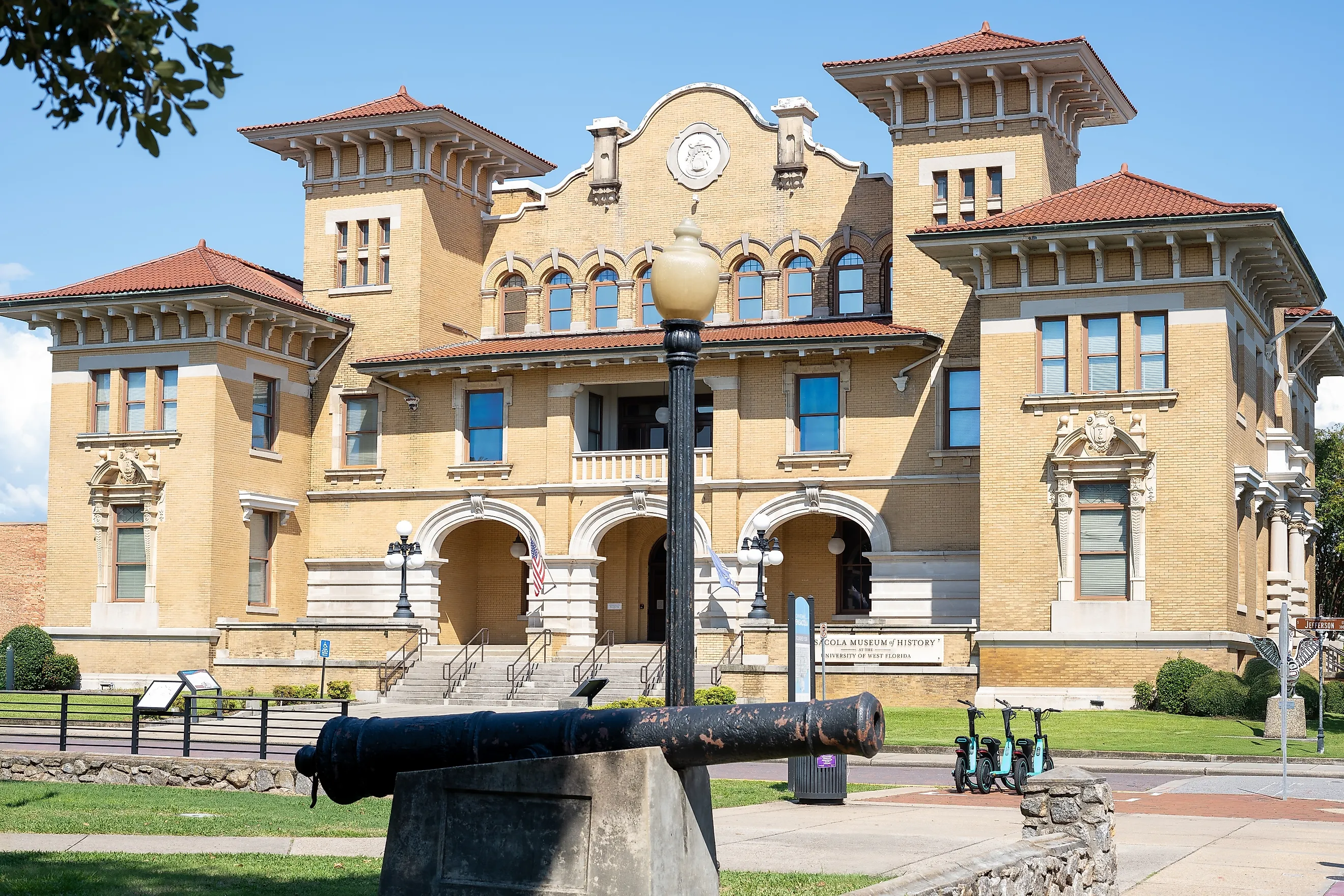
Escambia County Courthouse in Pensacola, Florida.
Pensacola is the oldest founding on this coast, planted by Tristan de Luna's Spanish fleet in August 1559 on the bay that opens the Florida Panhandle. A hurricane tore that first colony apart within two years. That handed St. Augustine the "oldest continuously occupied" title and left Pensacola with "first European settlement on the continent." The Spanish returned for good in 1698. The nickname City of Five Flags is literal, counting Spain, France, and Britain before the United States and the Confederacy.
Historic Pensacola Village preserves a stretch of the old colonial town in the Seville Historic District, where restored homes and small museums open for walking tours. The 1559 founding itself was lost for centuries until 2015, when a local turned up sixteenth-century Spanish pottery in a yard above Pensacola Bay and archaeologists confirmed the de Luna settlement site at last. The two Emanuel Point shipwrecks from that fleet still rest in the bay below, rare physical proof of a founding date most towns can only claim.
St. Marks, Florida

St Mark's Lighthouse - St. Marks, Florida.
St. Marks owes its founding to a fort, the Spanish stronghold of San Marcos de Apalache, raised where two rivers meet in 1679. The town that formed alongside it took the saint's name. The fort itself changed hands again and again over the next two centuries. Pirates and sunken Spanish ships still surface in the local lore, which is dense for a place this small.
The fort itself survives as San Marcos de Apalache Historic State Park, where stone ruins on the point and a small museum trace the site through Spanish, British, and American hands before the Confederacy took it last. The walls standing now belong to a later Spanish rebuild, but the ground is the same one the Crown picked in 1679. The town's other claim is its railroad, one of Florida's earliest. A mule-drawn line laid in the 1830s hauled cotton to Tallahassee and earned the town the name Tallahassee's Port City.
Ocean Springs, Mississippi

Fort Maurepas reconstruction replica in Ocean Springs, Mississippi.
Ocean Springs marks the spot where French Louisiana actually began. Pierre Le Moyne d'Iberville built Fort Maurepas here in April 1699, the first permanent French settlement on the coast and the first capital of the colony. Old maps even label the spot Old Biloxi. Biloxi proper stood across the bay and borrowed the name later, a detail that still settles the odd argument at this end of the coast.
A low brick outline at Fort Maurepas Park traces the fort's footprint on Front Beach today, with a bronze d'Iberville standing watch over the bay. Each spring the town stages the Landing of d'Iberville reenactment, period costumes and all, on the same shore the French waded onto in 1699. The original fort burned in the early 1700s and its exact spot is lost, so the outline is the closest thing to standing inside the first capital of French Louisiana.
Biloxi, Mississippi

Biloxi traces its 1699 birth to d'Iberville's landing, the one the maps first called Old Biloxi. The settlement moved to the present peninsula in 1720 and served as the colony's capital until New Orleans took over in 1722. The sea has driven the town's business ever since, first as a French port and later as the self-styled Seafood Capital of the World.
The 1848 Biloxi Lighthouse still stands in the median of the main beach road, a cast-iron tower that outlasted Hurricane Katrina when little around it did, now the city's symbol of recovery. The Maritime and Seafood Industry Museum lays out three centuries of shrimping and oystering nearby. Shrimp boats still work the Mississippi Sound off the same grounds that earned the town its title, the catch coming back to the docks much as it did a century ago.
Dauphin Island, Alabama

In January 1699, d'Iberville's expedition came ashore on Dauphin Island and found a heap of human bones, enough to saddle the place with the name Massacre Island. Settlement followed within a few years, once the French rebranded it Port Dauphin and made the island the colony's chief seaport until the harbor silted up in the 1720s. The modern town did not incorporate until 1988, but its roots reach to that early French port at the mouth of Mobile Bay.
Fort Gaines guards the eastern tip of the island, a masonry fort begun in 1821 that watched the Battle of Mobile Bay unfold offshore in 1864, its cannons and powder magazines still in place for a self-guided walk. Indian Shell Mound Park goes back much further, its oyster and clam middens piled up by Native people across the Mississippian period, about a thousand years ago. The skeletons that spooked d'Iberville came from a separate burial mound a storm had washed open, not a massacre at all.
Mobile, Alabama

The French founded Mobile in 1702 and soon moved the colony's capital there from Fort Maurepas. It changed hands among French, British, and Spanish rule before the United States seized it during the War of 1812, the last piece of the Gulf Coast to come under the American flag. The city threw its first organized Carnival in 1703, fifteen years before New Orleans even existed, which is why Mobile claims the oldest Mardi Gras in the country and lets the bigger city argue about it.
Colonial Fort Conde puts that founding on the ground, a partial reconstruction of the 1723 French fort that the History Museum of Mobile operates a block from its main hall. The original guarded the town under three flags before the Americans took it. Chunks of its real foundation turned up during 1960s tunnel work and stand on view in a nearby park. The first town actually stood upriver, founded in 1702 and moved down to this spot in 1711 when flooding made the original site untenable. The Mobile Carnival Museum handles the rest of the year, since the Mardi Gras the French started here in 1703 still rolls every winter.
Pascagoula, Mississippi

Pascagoula closes out the colonial run, founded on a French land grant handed to Joseph Simon de la Pointe around 1718. The family home, known for generations as the Old Spanish Fort, is neither Spanish nor a fort. It is a French planter's house whose timbers tree-ring-date to about 1757, which makes the LaPointe-Krebs House the oldest standing structure in Mississippi. The town wears that fact more quietly than it should.
The house is the centerpiece of the LaPointe-Krebs Museum on Krebs Lake, where the tabby-walled structure, restored and reopened in 2021, stands alongside a small interpretive center of excavated colonial artifacts. On the mainland now, the restored 1859 Round Island Lighthouse stands again after Hurricane Georges toppled it in 1998 and a long campaign hauled it back, a cast-iron marker of the era when the old port still moved under sail. Both fit a town whose founding date is older than the state it stands in.
The Coast Before The Country
Every town here was founded under a European flag, and most under more than one. Pascagoula still counts its age by the tree rings in a planter's house the locals miscalled a Spanish fort. Biloxi made its move across the bay in 1720 and carried the name along with it. Dauphin Island shed Massacre Island for Port Dauphin and handled the colony's shipping before Alabama was even a word. The forts and the tree-ring dates settle one question, who got to this coast first. That answer predates the country by a wide margin.