9 The Poconos Towns With A Slower Pace Of Life
Dinner in Lake Harmony means walking to a kitchen right on the water. That is the kind of afternoon these Pocono towns are built around. Each one grew up on a river or a rail line and kept the good parts. Barrel works host concerts now. Cut-glass factories rent rooms above the falls. Every town here holds well under 20,000 people and rewards a few unhurried days.
Jim Thorpe

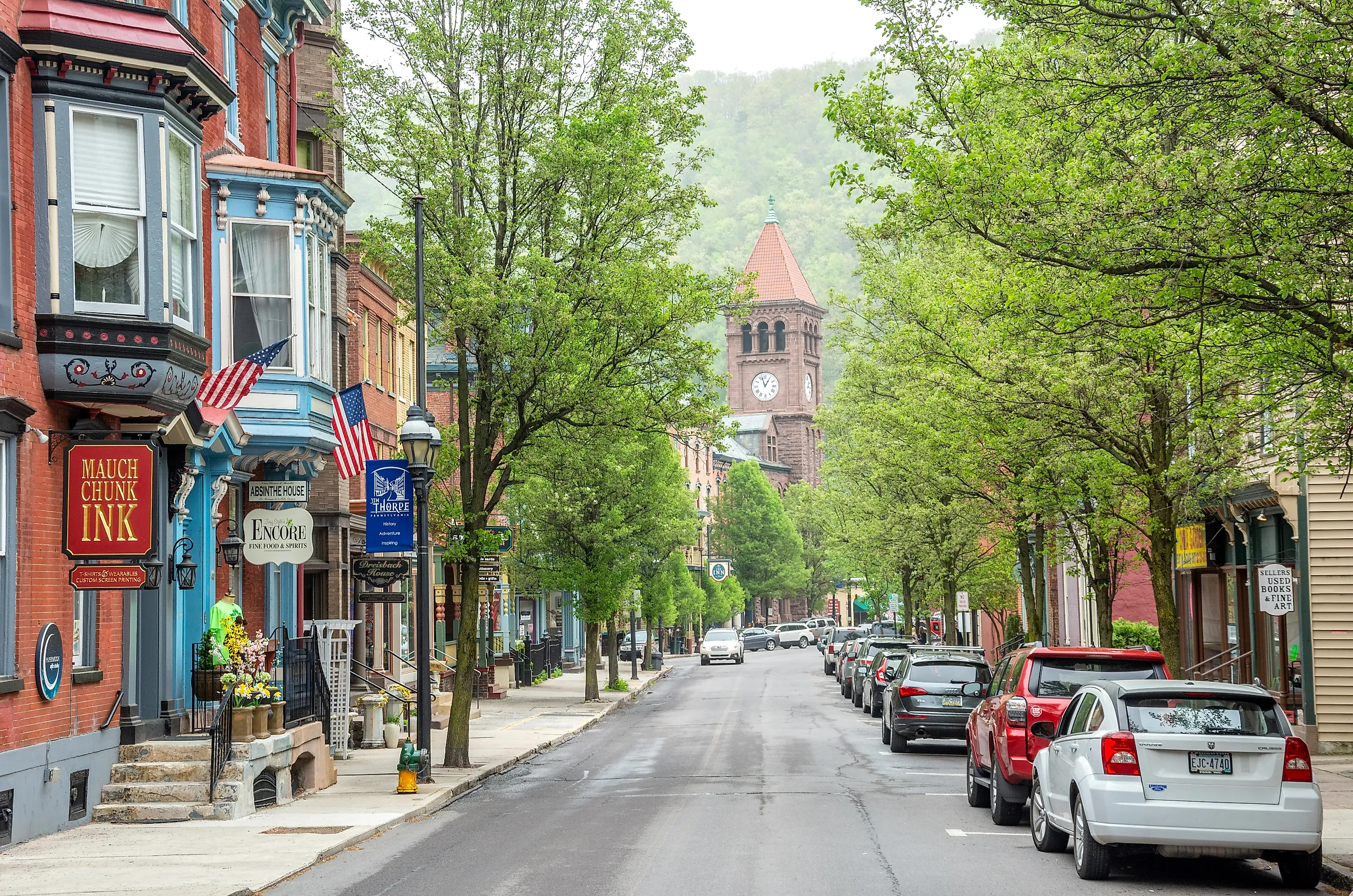
The town carries the name of an Olympic champion who set foot in it only after he died. Jim Thorpe was Mauch Chunk until 1954, when a deal made it the burial place of the great Native American athlete and gave it a new name. About 4,500 people live along a notch in the Lehigh River, where Victorian storefronts climb the hillside in tight rows.
The Asa Packer Mansion anchors the walk through the old center, an 1861 Italianate villa built for the railroad magnate who founded Lehigh University, its original furnishings still behind the porch. From the downtown station, the Lehigh Gorge Scenic Railway runs vintage coaches into Lehigh Gorge State Park, where the river cuts through cliffs and rapids. The Mauch Chunk Opera House has been staging performers since 1881 and still lights up at night.
White Haven

An old coal-and-rail borough, White Haven now runs on the people passing through on their way outside. The northern trailhead of Lehigh Gorge State Park sits right here, where a former rail corridor became more than 20 miles of crushed-stone path for bikers and walkers. A short drive east opens into Hickory Run State Park, nearly 16,000 acres that hold the Boulder Field, a wide spread of stones left by the last Ice Age and named a National Natural Landmark. In warmer months the river trades its calm for whitewater, and outfitters run rafting trips around the dam-release schedule. A slow town can still hand you a fast afternoon.
Lake Harmony

This Carbon County hamlet wraps around a glacial lake a couple of miles long, with forest and state game lands filling in around it. There is no main street, just a loose ring of cabins and lakeside restaurants, and the shoreline stays uncrowded because most of it belongs to the people staying on it. Summer is for boating, kayaking, and swimming, and neighboring Hickory Run State Park keeps its trails open year-round. Nick's Lake House sits on the bones of the 1923 Lake Harmony Hotel and turns out wings and burgers, while Piggy's has fed the lake crowd since 1985. Doing very little is the entire point.
Honesdale

North of the Lehigh country, the seat of Wayne County calls itself the birthplace of the American railroad. In 1829, the Stourbridge Lion ran here, one of the first full-size steam locomotives to operate on a commercial track in the country, and Honesdale has never stopped celebrating it. The town rests on the Lackawaxen River, and the history sits right on Main Street.
The Wayne County Historical Society fills the old 1860 canal company building and keeps a full-scale replica of that famous locomotive. When the weather warms, the Stourbridge Line runs heritage excursions along the Lackawaxen toward Hawley. A few doors down, the Cooperage Project stages concerts and community nights inside former barrel works, the kind of second life these old industrial buildings tend to find here. The storefronts stay family-run, and the railroad past hums under all of it.
Hawley

A few miles downstream from Honesdale, the railroad talk gives way to water. Hawley grew up where the Lackawaxen meets Lake Wallenpaupack, the 5,700-acre reservoir that has drawn boaters and anglers since the power company dammed the valley in 1926. The Hawley Silk Mill, an 1880 bluestone hulk, now holds shops, galleries, and studios where looms used to run. The habit of reusing old industry reaches the lodging too: the Ledges Hotel occupies a former cut-glass factory above Paupack High Falls, and the Settlers Inn, an Arts and Crafts lodge, has anchored Main Avenue for decades. A mill town can age into something softer than the work that built it.
Milford

American conservation took root in a French-style chateau above the Delaware River. Milford, the seat of Pike County, was the family home of Gifford Pinchot, first chief of the U.S. Forest Service and twice governor of Pennsylvania. The town sits on a small grid of squares and preserved 19th-century streets built to be walked.
Grey Towers is the centerpiece, its grounds open daily and its tours moving through rooms where the conservation movement found its footing. Down in town, the Upper Mill turns a restored water-powered gristmill into a free stop, its wheel still creaking through the motions. The Columns Museum holds the flag said to have cradled Abraham Lincoln's head the night he was assassinated. The Hotel Fauchere has run since 1852, opened by a chef who came out of the famed Delmonico's in New York.
Delaware Water Gap

Keep following the Delaware south and the river carves the notch that gives this borough its name. The Delaware Water Gap holds the Deer Head Inn, a jazz room that has filled an 1840s building since the resort era and put players like Keith Jarrett on its stage. The town is an official Appalachian Trail Community, and the climb up Mount Minsi lands hikers on that footpath with the gap spread out below. There is even a sake brewery in the mix at Sango Kura. For a place this small, the music is the reason to book a table.
Shawnee on Delaware

The next village down made its name on the airwaves. Shawnee on Delaware, a riverside community in Smithfield Township, is where bandleader Fred Waring ran his radio broadcasts in the 1950s and turned a slow bend of the river into an entertainment hub. The Shawnee Inn and Golf Resort anchors the village, with a course laid out across an island in the Delaware and beer brewed on site through ShawneeCraft. Up the road, the Shawnee Playhouse has staged productions since 1905 and still runs a full season. Add a guided paddle with a river outfitter, and the village makes its case: a river, a stage, and a course on an island beat a downtown.
Eagles Mere

Eagles Mere is home to roughly 150 year-round residents around a private spring-fed lake, and locals have long called it the town that time forgot. The Victorian cottages, the Shingle-style porches, and the lake look much as they did when Gilded Age families first built their summer escapes here. The lake still draws swimmers and paddlers to canoes kept in service for generations, and the Laurel Path traces the shoreline through old woods. The Eagles Mere Museum lays out the resort's heyday, and warm-weather antique shows suit the town's time-capsule character. The Eagles Mere Inn keeps its pub, A. C. Little's Drinkery, open to guests and locals alike.
Letting the Mountains Set the Pace
Drive between any two of these towns and the shift is easy to feel. The mills closed, the big resorts boomed elsewhere, and these places kept living at the speed the mountains set. Railroads, jazz, glacial water, and Gilded Age porches never add up to one tidy theme, except that each town decided long ago it had no interest in keeping up. Pick the one that matches the speed you are after and let it run the clock for a few days.