11 Most Relaxing Chesapeake Bay Towns
The Chesapeake Bay’s sheltered estuary supports countless calm, relaxing waterfront towns throughout. In Oxford, Maryland, the Oxford-Bellevue Ferry and the public shoreline at The Strand turn a small historic village into a place for scenic crossings and sailboat views. In Tangier, Virginia, ferry arrivals and meals at Hilda Crockett’s Chesapeake House make the island feel both remote and unforgettable. If you want to relax by the water, there's no place like the Chesapeake Bay, and the 11 towns below prove it.
Oxford, Maryland

Oxford occupies a pocket of Maryland’s Eastern Shore at the mouth of the Tred Avon, with quiet lanes, colonial-era buildings, and a waterfront woven tightly into daily life. The Oxford-Bellevue Ferry, operating since 1683, remains the defining attraction, carrying passengers across the Tred Avon on one of the oldest privately run ferry routes in the country. On South Morris Street, the Oxford Museum traces the area’s past as a tobacco port through maritime artifacts, maps, and exhibits tied to local commerce. The Strand supplies a rare public shoreline in a village of private docks, with a narrow beach, open sightlines, and a front-row place to watch sailboats tack offshore. The Robert Morris Inn rounds out the visit inside a 1710 structure known for its brick architecture and polished dining near the ferry dock.
Tilghman Island, Maryland

Tilghman Island stretches into Talbot County’s southern waters where the Choptank meets the Chesapeake, with crab shacks, docks, and low horizons defining the approach. Black Walnut Point Natural Resources Management Area gives the landscape its wildest expression, with a path leading to the island’s southern tip for birding, breezes, and wide-open scenery. The Tilghman Watermen’s Museum captures the character of the community through workboat history, oral traditions, and exhibits devoted to crabbers and oystermen. Phillips Wharf Environmental Center shifts the focus to ecology with tanks, displays, and programs centered on regional fisheries and estuarine life. Wylder Hotel Tilghman Island provides the most polished dining-and-lodging option, pairing marina views with Tickler’s Crab Shack for a meal rooted in the local catch.
Betterton, Maryland

Betterton lines a small stretch of Kent County shoreline on the upper Chesapeake, where bluffs and the nearby Sassafras create a broader outlook than most Bay communities offer. Betterton Beach is the main draw, with sand, a boardwalk, a fishing jetty, and a public landing that keeps the shoreline open and usable. The Betterton Heritage Museum preserves the community’s resort-era identity through photographs, artifacts, and the restored Betterton Fishing Ark. Sassafras adds a high-end restaurant in a cottage overlooking the shoreline, with a tasting menu built around regional seafood and carefully sourced produce. The old street plan still reveals the settlement’s summer-colony roots, with roads laid out to pull attention straight toward the water.
Vienna, Maryland

Vienna stands along the Nanticoke in Dorchester County, a compact old port where historic homes sit close to the road and the waterway remains central to the setting. Emperor’s Landing Park offers the easiest way to experience the shoreline, with a riverwalk, floating docks, and space for launching kayaks or watching boats pass under changing light. Inside the restored Nanticoke Inn, the Nanticoke River Discovery Center explores Captain John Smith’s 1608 voyage and the history of the Nanticoke people with a far more specific focus than a standard local-history site. Nearby, Handsell Historic Site preserves an eighteenth-century dwelling, a reconstructed Native longhouse, and the layered record of Native, European, and African American lives. Millie’s Road House adds a casual finish with oysters, crab cakes, and Eastern Shore staples served right in the center of the village.
Rock Hall, Maryland

Rock Hall spreads along the Chester in Kent County, with slips, deadrise boats, and working docks marking one of the most boat-centered communities on the Chesapeake. Eastern Neck National Wildlife Refuge, just south of town, brings in the natural side with trails, eagle sightings, and expansive views across the Bay and adjacent marsh. The Waterman’s Museum preserves the area’s maritime identity through exhibits on crabbing, oystering, fishing, and the labor that shaped the waterfront economy. The Mainstay gives the place an unexpected cultural edge, hosting live music in a compact venue on North Main Street that has become a serious destination for performers and audiences alike. Waterman’s Crab House anchors the dining scene with dockside tables, marina activity, and a seafood menu tied closely to local tradition.
Chesapeake City, Maryland

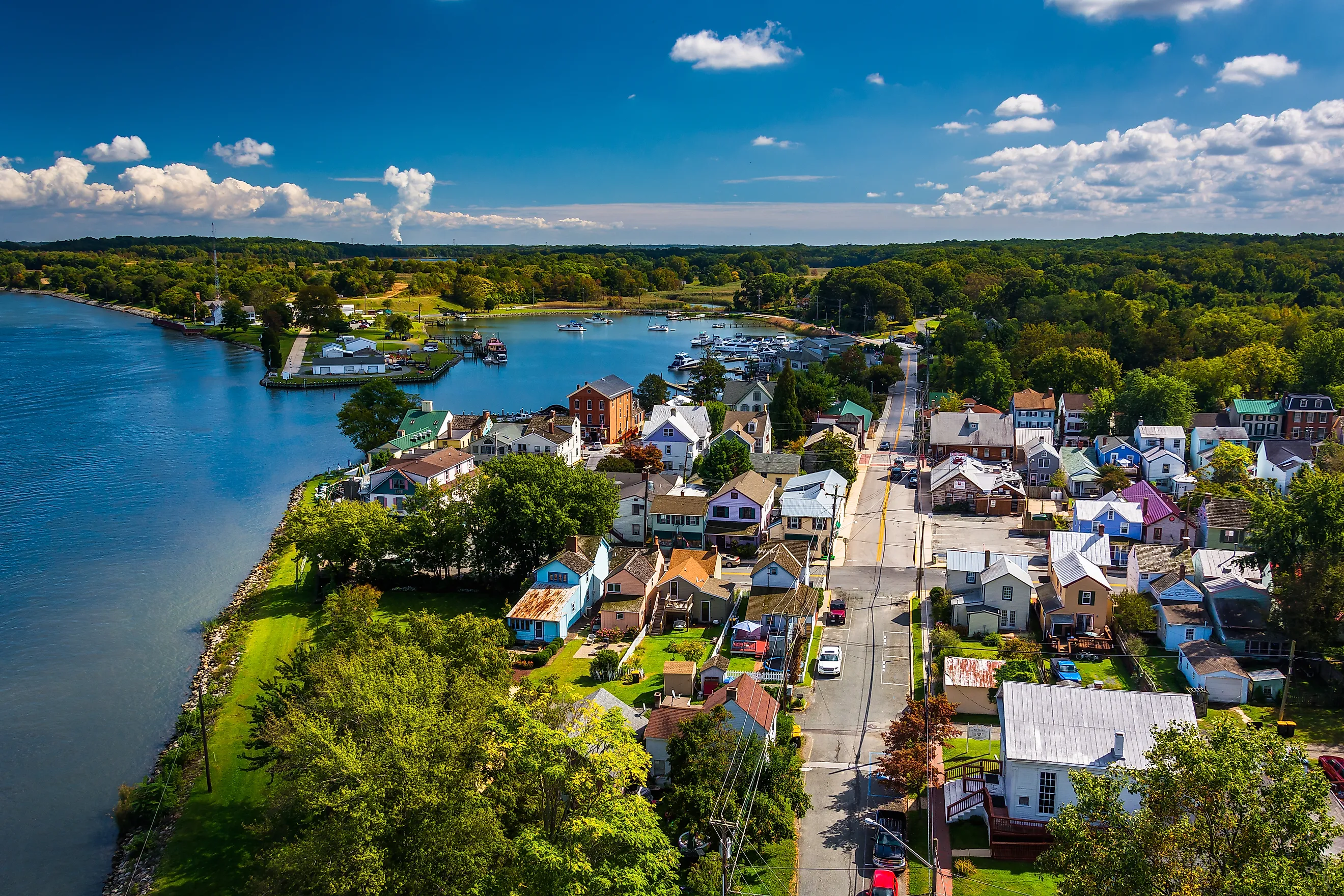
Chesapeake City rises above the south bank of the C&D Canal in Cecil County, where steep streets, brick sidewalks, and passing cargo ships create one of the most dramatic settings in the region. The C&D Canal Museum, inside the old pump house, explains the engineering behind the canal and the way it transformed trade along this corridor. Schaefer’s Canal House brings the dining scene into view with a deck suspended over the canal, placing diners close to the freighters moving through town. Chesapeake City Bridge supplies the strongest visual landmark, arching high above the canal and framing enormous vessels against the town’s compact historic core. Pell Gardens softens the industrial scale with formal landscaping, benches, and a lookout that works especially well for evening light and ship watching.
Smith Island, Maryland

Smith Island lies in Somerset County far out in Maryland’s lower Chesapeake, a marsh-fringed cluster of settlements connected by narrow roads and reached only by boat. The Smith Island Cultural Center in Ewell gives the clearest introduction to the place through exhibits on local speech, island life, and the watermen who sustained it. Martin National Wildlife Refuge spreads across the southern reaches with wetlands, birdlife, and a sense of remoteness that feels unlike mainland destinations. Drum Point Market supplies one of the signature local picks, serving crab cakes and slices of the famous multi-layer Smith Island Cake near the dock. Tangier Sound Watermen’s Heritage Tours adds a close working look at crab pots, boats, and the rhythms that continue to shape everyday life here.
Tangier, Virginia

Tangier sits roughly 12 miles off Virginia’s Eastern Shore in the middle of the Chesapeake, a remote Accomack County community reached by ferry or small plane and shaped by channels, docks, and narrow lanes. Tangier Island Cruises turns the trip out into part of the appeal, carrying visitors across Tangier Sound and emphasizing the island’s separation from the mainland. The Tangier Island History Museum offers the strongest historical grounding, with exhibits on commercial fishing, island settlement, and traditions that still define the community. The Tangier water trails invite paddling through marsh edges and quiet channels where wildlife is often closer than other people. Hilda Crockett’s Chesapeake House remains the best-known meal destination, serving crab cakes and other traditional dishes in a setting long associated with island hospitality.
Onancock, Virginia

Onancock sits along Onancock Creek in Accomack County, a deep-water port community on Virginia’s Eastern Shore where old buildings and a working marina still shape the waterfront. Ker Place, the 1799 Federal mansion operated by the Eastern Shore of Virginia Historical Society, stands out for its architecture and its detailed interpretation of the region’s merchant past. The Onancock Wharf and Marina makes access easy with a kayak launch and dinghy dock that pull visitors directly into the waterside setting. Hopkins & Bro. Store preserves the feel of a nineteenth-century mercantile building while now housing Mallards at the Wharf. North Street Playhouse gives the village a lively evening option through live productions staged in the middle of a compact historic district lined with galleries and porches.
Reedville, Virginia

Reedville occupies a stretch of Virginia’s Northern Neck in Northumberland County, where Cockrell’s Creek leads toward the Chesapeake and old captains’ houses still define the village streetscape. The Reedville Fishermen’s Museum explains the place best, with exhibits on the menhaden industry, regional workboats, and the fishing economy that built the community. Victorian Main Street shows off the prosperity of that era through ornate houses and a remarkably intact late-nineteenth-century streetscape. Public viewpoints along Cockrell’s Creek bring marinas, deadrise boats, and constant boat traffic into the foreground without requiring a formal excursion. The Crazy Crab supplies a strong dining option, pairing seafood with dockside seating that keeps the maritime setting visible throughout the meal.
Deltaville, Virginia

Deltaville sits in Middlesex County where Jackson Creek and the Piankatank meet the Chesapeake, a low-lying boating center known for marinas, boatyards, and sheltered access to open water. The Deltaville Maritime Museum provides the strongest historical draw, especially through the restored 1924 buyboat F.D. Crockett, which offers a full-scale link to the region’s commercial past. Holly Point Nature Park adds trails, gardens, a kayak launch, and shoreline scenery across 36 acres beside Mill Creek. Fishing Bay Marina represents the area’s sailing culture with deep-water slips and quick access to cruising grounds on the Piankatank. The replica Stingray Point Lighthouse supplies the most recognizable landmark, tying the waterfront scene to the navigation history that shaped this corner of the Bay.
From ferry rides in Oxford to the quiet remoteness of Tangier, these Chesapeake Bay towns show how much variety fits around one estuary. Some stand out for marsh trails and birding, others for crab houses, old inns, and working docks, but all keep the water close. That mix of history, scenery, and local character is what makes this region such an easy place to slow down and stay awhile.