11 Most Beautiful Small Towns In Australia
Strahan sits on the edge of Macquarie Harbour on Tasmania's west coast, a former timber and mining port of a few hundred people that now serves as the launching point for cruises up the Gordon River. It is one of eleven small Australian towns gathered here, each one built around a specific feature of the coast or country it occupies: a blowhole, a wine valley, a river mouth, a reef. The list runs the length of the continent, between the tropical north of Queensland and the temperate far south of Tasmania.
Byron Bay, New South Wales

Byron Bay sits beside Cape Byron, the easternmost point of the Australian mainland, which makes it the country's easternmost town. The beaches and coastal walking tracks draw surfers, swimmers, and kayakers, and the headland walk up to the Cape Byron Lighthouse is among the most popular short walks in New South Wales. The waters offshore are part of a marine park, with reefs that bring in snorkelers and divers.
The town also has a long reputation as a destination for wellness retreats and as a base for visiting celebrities, several of whom have bought property in the area. Operators run hot-air balloon flights, tandem skydives, and hang-gliding over the coast, and Arakwal guides lead cultural tours on Bundjalung country. In 2021, roughly a hundred surfers staged a paddle-out protest against Netflix filming the reality series "Byron Baes" in the town; the show aired in 2022 and was later cancelled.
Esperance, Western Australia

Esperance sits on the southern coast of Western Australia, fronted by white-sand beaches and the turquoise water of the Recherche Archipelago. Cape Le Grand National Park, a short drive east, is known for Lucky Bay, where kangaroos are often seen resting on the sand. The Great Ocean Drive loops west of town past a string of swimming and surfing beaches, including Twilight Beach.
Offshore, the islands of the archipelago can be reached by boat tour, with stops for wildlife including sea lions and dolphins. Experienced surfers know the area for Cyclops, a heavy, fast-breaking reef wave east of town. One landmark worth understanding before you go is Pink Lake, west of Esperance: it has not reliably appeared pink for around two decades, after salt harvesting altered the water's salinity and the color faded to blue-gray in the early 2000s. It still carries the name, but visitors hoping for pink water are usually disappointed.
Kiama, New South Wales

Kiama, on the New South Wales south coast about two hours from Sydney, is built around its blowhole. The Kiama Blowhole, beside the headland lighthouse, is widely cited as the largest in the world, with a 2.5-meter opening that can throw spray more than 25 meters into the air when a southeast swell is running. The town's name comes from a Dharawal word, recorded through the Wodi Wodi people, understood to mean "where the sea makes a noise." A second, smaller blowhole, known as the Little Blowhole, fires more consistently on a northeast swell.
Beyond the blowholes, the town has rock pools, a walkable center of cafes and shops, and a string of beaches along the Kiama Coast Walk. Blowhole Point, with the lighthouse and visitor information center, gives a 360-degree view over the harbor and is the easiest place to get your bearings on arrival.
Lorne, Victoria

Lorne sits about halfway along the Great Ocean Road, where the Otway forest meets the sea. Its main beach, on the sheltered curve of Loutit Bay, is one of the few patrolled swimming beaches on this stretch of coast and faces gentle, family-friendly surf rather than the heavy reef breaks found near Torquay. Behind the town, Great Otway National Park holds tall eucalypt forest and a series of waterfalls, including Erskine Falls, reached by walking tracks that start close to the center.
The town has a developed cafe and dining scene along Mountjoy Parade, the main street, and the Lorne Pier is a long-standing local fishing and walking spot. The annual Pier to Pub swim, from the end of the pier to the Lorne Hotel, has run since the early 1980s and draws thousands of swimmers each January.
Leura, New South Wales

Leura sits in the World Heritage-listed Blue Mountains, west of Sydney, where the Greater Blue Mountains Area is recognized for its eucalypt forests and deep sandstone valleys. The town itself is known for its tree-lined main street, its Edwardian-era architecture, and the cafes and shops along The Mall. Cool-climate gardens are a feature of the area, with the Art Deco Everglades Gardens, a property managed by the National Trust, sitting within the town.
Walking tracks lead from the edge of town to a series of waterfalls, including Leura Cascades and the falls around nearby Wentworth Falls, and to lookouts over the Jamison Valley. Gordon Falls Reserve, Sublime Point, and the cliff edge near Olympian Rock all give wide views across the valley, and there are guesthouses and cottages for overnight stays.
Margaret River, Western Australia

Margaret River, in the southwest corner of Western Australia, is best known for its wine region, but the town sits within reach of surf beaches, limestone caves, and tall karri and marri forest. Surfers Point at Prevelly hosts professional surfing events, and the Saturday farmers market draws on the produce of the surrounding country. The center has art galleries, produce stores, cafes, and restaurants.
South of town, Mammoth Cave in the Leeuwin-Naturaliste National Park is open for self-guided audio tours and holds fossils of extinct Australian megafauna, some dated at over 35,000 years old, including a zygomaturus jawbone embedded in the cave wall. The region is known for its Cabernet Sauvignon, produced at established wineries such as Vasse Felix and Cullen Wines. For walkers, the Cape to Cape Track runs roughly 123 kilometers (76 miles) along the coast between Cape Naturaliste and Cape Leeuwin.
Minnamurra, New South Wales

Minnamurra sits at the mouth of the Minnamurra River on the northern edge of Kiama, where the river meets the sea. The sheltered water suits swimming, kayaking, and paddleboarding, while the open beaches range from calm to surf depending on the tide and conditions. The town marks the northern start of the Kiama Coast Walk, a short climb up to the headland giving views back over the township.
The walk south passes a golf course set in a bend of the river and continues toward Mystics Beach, with the small Stack Island sitting offshore. Further along, the path passes the basalt columns of Cathedral Rocks at Jones Beach and offers chances to see migrating whales in season. The Dharawal people are the traditional custodians of this coast, and shell middens near the river mouth record their long presence here.
Port Douglas, Queensland

Port Douglas, on the tropical coast of far north Queensland, is one of the main gateways to the Great Barrier Reef, with dive and snorkel boats leaving the harbor daily for the outer reef. In town, Four Mile Beach runs along the eastern edge, and the Sunday markets at Anzac Park sell produce and crafts. Lagoon-style swimming pools and a row of restaurants line the waterfront.
The town is also the gateway to Daintree National Park, north across the Daintree River, which protects part of the Wet Tropics rainforest often described as among the oldest continuously surviving rainforest on Earth. Reef trips, rainforest tours, and the beach itself make Port Douglas a base for the two World Heritage areas that meet near here.
Port Fairy, Victoria

Port Fairy sits at the western end of the Great Ocean Road, on the mouth of the Moyne River. One of the oldest ports in Victoria, it began as a whaling and sealing station and a fishing port, and it retains a working harbor alongside its tourism. The town has more than fifty buildings listed by the National Trust, and its streets of cottages and bluestone make it one of the better-preserved 19th-century ports in the state.
The Port Fairy Folk Festival, held each March since 1977, is one of Australia's longest-running and best-known folk music events and fills the town over the Labour Day long weekend. Outside the festival, the harbor, the riverside walks, and the town's restaurants make for a quiet coastal stop, with East Beach a short walk away for swimming and surfing.
Queenscliff, Victoria

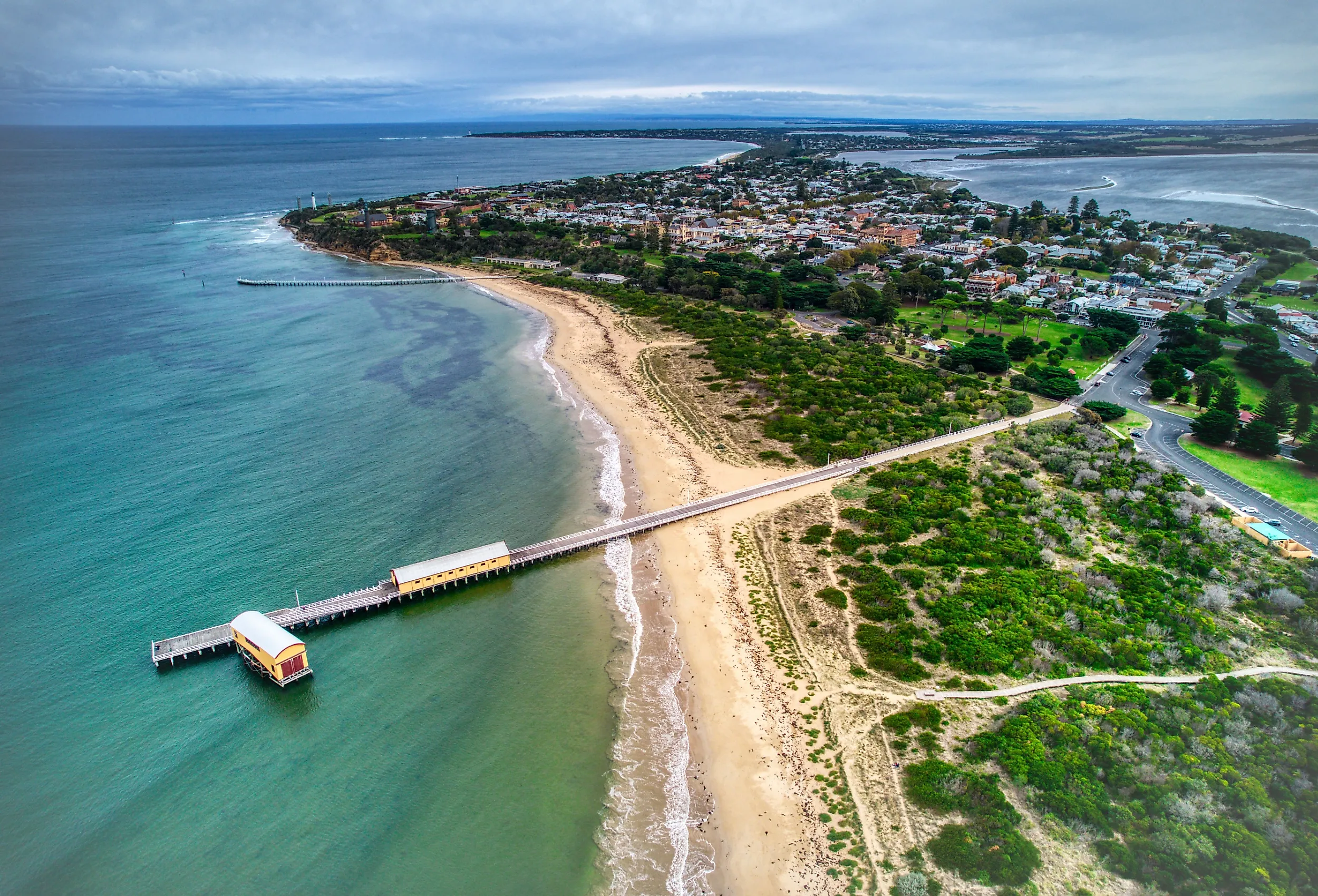
Queenscliff sits on the tip of the Bellarine Peninsula, south of Melbourne, looking across the Rip at the entrance to Port Phillip and over to the Mornington Peninsula beyond. The town grew in the second half of the 19th century, and Fort Queenscliff was built to guard the heads of the bay; it now operates as a museum. Grand Victorian-era hotels, jetties, and a lighthouse give the center its character.
The town has both calm bay beaches and ocean surf beaches nearby, along with a row of dining options. A passenger and car ferry crosses the heads to Sorrento on the Mornington Peninsula, and the short walk along the jetty is a standard way to take in the harbor.
Strahan, Tasmania

Strahan, pronounced "Strawn," sits on Macquarie Harbour on Tasmania's west coast, roughly four to five hours by road from Hobart. It is the access point for the Franklin-Gordon Wild Rivers National Park, and cruises run from the harbor up the Gordon River through temperate rainforest. Nearby, short walks lead to Hogarth Falls, Nelson Falls, and the lookout at Donaghys Hill.
Out in the harbor, Sarah Island holds the ruins of the Macquarie Harbour Penal Station, a convict settlement that operated in the 1820s and early 1830s and was known for its harsh conditions. Within town, People's Park gives access to the Hogarth Falls walk, and the West Coast Wilderness Railway runs a heritage train inland toward Queenstown through the rainforest and river gorges.
These eleven towns share a coastline more than they share a character. Strahan faces a cold harbor and temperate rainforest; Port Douglas opens onto a tropical reef. Kiama and Minnamurra sit minutes apart on the same New South Wales coast, while Esperance and Margaret River anchor opposite corners of the southwest. What links them is scale: each is small enough to walk, and each is built around something specific worth the trip.