11 Best Towns In Georgia For Retirees
Here is the number that matters most if you are retiring in Georgia: $65,000. That is how much retirement income each resident aged 65 or older can exclude from state tax, so a married couple can shelter $130,000 a year in pension, IRA, and 401(k) withdrawals. Social Security is exempt on top of that, at any income level. For most retired couples, Georgia's effective state income tax works out to zero, the same as Florida, and the median property tax bill runs about $2,554 against a national median over $3,200. That settles the finances. What is left is picking the landscape, and these eleven towns cover mountains, farm country, river bends, and salt marsh.
Adairsville

Adairsville was the first town in Georgia listed in its entirety on the National Register of Historic Places, which covers about 170 acres of tree-lined streets, nineteenth-century houses, and churches in the Oothcalooga Valley. Median home prices sit near $315,000, comfortably under the state figure.

The town also has an outsized amenity five miles out: Barnsley Resort, built around the ruins of an 1840s manor, with a golf course, spa, and dining that would be at home in a resort town three times the size. Day passes and dinner reservations do not require a room. For groceries and errands, Calhoun and Cartersville are each about fifteen minutes off, and Atlanta is an hour south when you want an airport.
Rome

Rome sits where three rivers meet, the Etowah and the Oostanaula joining to form the Coosa, and it was named for the seven hills it was built across. Northwest Georgia's largest town outside the Atlanta orbit, it has the hospital capacity, the restaurants, and the college-town calendar that a lot of retirees discover they miss in a village of 4,000.
Berry College sits just north of town on a campus of roughly 27,000 acres, among the largest contiguous college campuses anywhere, with trails and a road network open to the public and a famous pair of nesting bald eagles. Downtown Broad Street runs wide and walkable, the Rome Braves play minor league ball at AdventHealth Stadium, and the riverwalk connects most of it. Housing stays well below the state median.
Toccoa

Toccoa Falls drops 186 feet on the college campus at the edge of town, which makes it taller than Niagara, and reaching it takes a walk of about a hundred yards from the parking lot. That ratio of payoff to effort is a good summary of the town generally.
Behind Toccoa rises Currahee Mountain, where the 506th Parachute Infantry Regiment trained at Camp Toccoa before D-Day; their cry of "Currahee" and the run up that mountain became famous through Band of Brothers, and the Currahee Military Museum downtown keeps the record. Stephens County housing is among the most affordable in north Georgia, and Lake Hartwell is twenty minutes east for anyone who wants a boat.
Dahlonega

America's first major gold rush started here in 1829, two decades before California, and the town has been trading on it ever since. The 1836 courthouse on the square is the oldest surviving courthouse building in Georgia and now houses the Dahlonega Gold Museum. The name itself comes from a Cherokee word for yellow metal.

A third of Lumpkin County lies inside the Chattahoochee National Forest, which puts hiking, mountain biking, and horseback trails within minutes, and the Appalachian Trail's southern terminus at Springer Mountain is a short drive out. The Chestatee and Etowah rivers handle tubing and paddling. More than a dozen wineries work the hills around town, and the square keeps a full calendar. Home prices run slightly above the state average, which is the premium for mountains an hour from Atlanta.
Winder

Winder's selling point is Fort Yargo State Park, right at the edge of town, built around a log blockhouse from 1792 and a 260-acre lake. The park carries trails, fishing, boat rentals, mini-golf, and cottages, and an annual pass costs less than most gym memberships.

Housing sits below the state median in a county that has been growing steadily, which means newer inventory than most small towns offer. Chimneys Golf Course plays par 72 just outside town, the Barrow County farmers market runs Saturdays from spring through fall, and Athens is half an hour east if you want a university town's calendar without its prices.
Carrollton

The Carrollton GreenBelt is the reason to look here: an eighteen-mile paved loop, the longest of its kind in Georgia, circling the whole town and connecting neighborhoods, parks, and the University of West Georgia campus without putting you on a road. For a retiree who wants to walk or cycle daily without driving somewhere first, that is worth more than most amenities on a brochure.
Housing runs around the mid-$300,000s. The Carrollton Center for the Arts programs exhibits and performances through the year, there are disc golf and pickleball courts in the city parks, and Tanner Medical Center is in town rather than a county away. Atlanta's airport is about an hour northeast.
Milledgeville

Milledgeville was Georgia's capital from 1804 until 1868, and the town still has the architecture to prove it: the Old Governor's Mansion of 1839, a Greek Revival landmark open for tours, and the old statehouse now anchoring Georgia Military College. The grid Milledgeville was laid out on was designed for a capital city, which is why a town of 17,000 has such generous streets.

Flannery O'Connor wrote most of her work at Andalusia, the farm on the edge of town, now a museum with the peafowl descendants still on site. Georgia College keeps a public lecture and concert calendar, Lake Sinclair is fifteen minutes north with 417 miles of shoreline, and the Oconee River Greenway runs through the middle of town. Central Georgia housing costs keep this one of the better values on the list.
Barnesville

Barnesville built buggies. At its peak the town turned out tens of thousands a year and called itself the Buggy Capital of the South, and it still throws Buggy Days every September, filling the square with a parade and several hundred vendors. Home prices around $325,000 buy a lot of nineteenth-century house here.
The self-guided walking tour covers those houses, including one built by the founder's daughter. The Carnegie Library, restored and still in use, holds art, poetry programming, and a sculpture garden. Lamar Arts runs galleries and classes free of charge out of the old train depot. Barnesville sits an hour south of Atlanta and half an hour from Macon, which is where the larger hospitals are.
Douglas

At a median near $290,000, Douglas is the most affordable entry on this list, and south Georgia's cost of living generally runs below the rest of the state. What you trade is proximity: Savannah, Jacksonville, and Macon are each roughly two hours off.
What you get is space. General Coffee State Park has cypress swamp boardwalks and one of the better places in the state to see a gopher tortoise, Georgia's state reptile. Broxton Rocks, a Nature Conservancy preserve with sandstone outcrops and a waterfall, protects plants found almost nowhere else in the coastal plain, though access is by guided tour rather than open gate. Downtown, Peterson Avenue carries the antique shops, and the Martin Centre programs live music in a restored theater.
Kingsland

Kingsland sits in Camden County at the Florida line, which puts Jacksonville's airport and hospitals about forty minutes south while Georgia's tax treatment applies to your income. That combination is the whole argument, and housing just above $300,000 seals it.
The Okefenokee National Wildlife Refuge is roughly forty minutes west, 400,000-plus acres of blackwater swamp that is one of the largest intact freshwater wetlands in North America. Cumberland Island is reachable from neighboring St. Marys. The Woodbine Opry, fifteen minutes north, runs old-time country shows. One caution worth budgeting for: this is coastal Georgia, and hurricane exposure shows up in insurance quotes.
St. Marys

Founded in 1787, St. Marys is the second-oldest city in Georgia after Savannah, and its waterfront grid of live oaks and clapboard houses has stayed intact. Median listings run around $300,000 for a town where you can walk to the water.

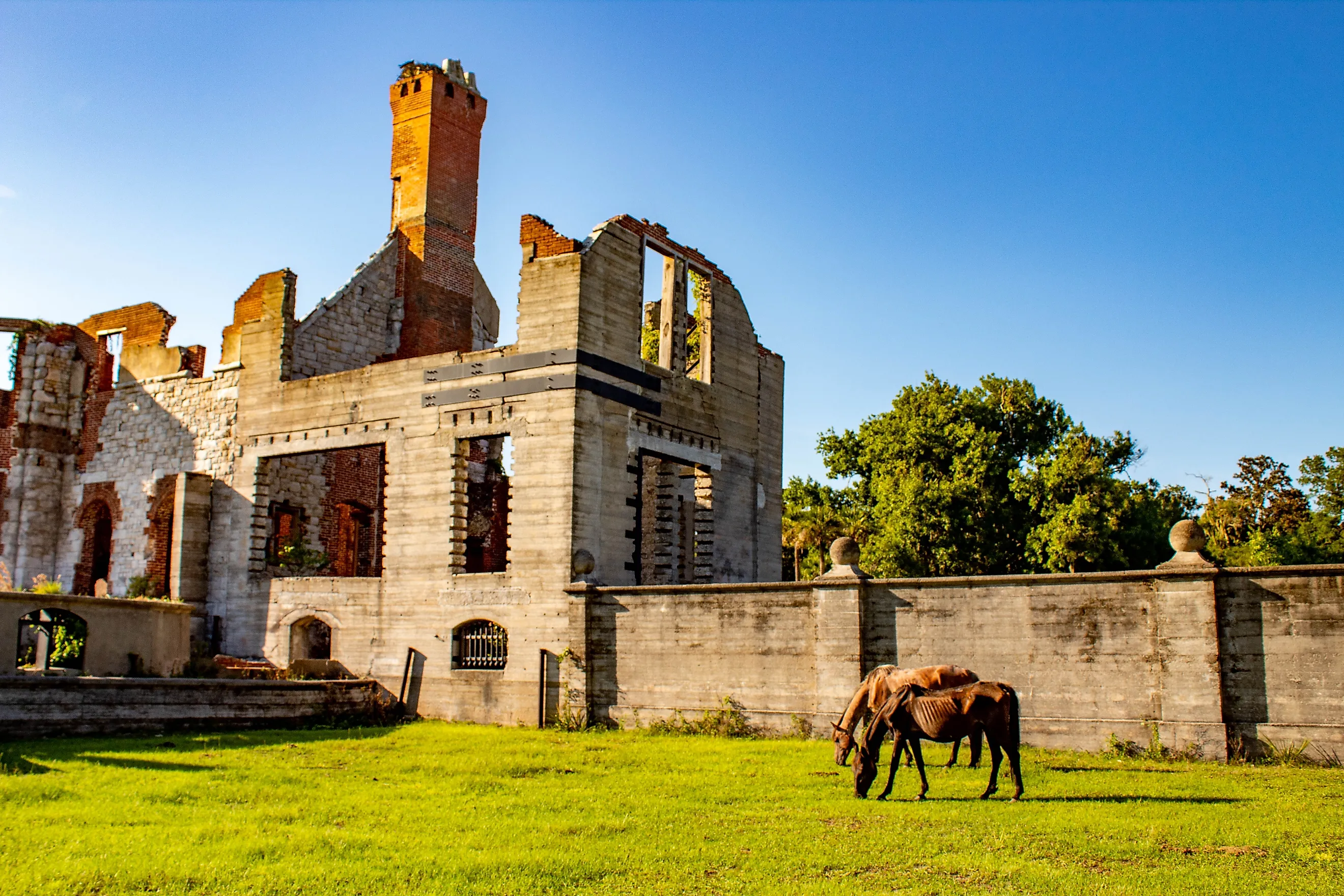
The ferry to Cumberland Island National Seashore leaves from the downtown dock, a forty-five-minute crossing to an island with no roads, wild horses, and the tabby ruins of the Carnegie mansion. Crooked River State Park is minutes away on the intracoastal. The town runs a seafood festival in summer, Mardi Gras in spring, and Music in the Park monthly through the warm season. Same coastal caveat as Kingsland applies on insurance.
Running The Numbers
The tax picture is identical in all eleven, so the decision comes down to what you want out the front door and what you are willing to drive for. Douglas and Milledgeville stretch a fixed income furthest. Rome and Carrollton give you a hospital, a college, and a walkable loop without leaving town. Dahlonega and Toccoa put mountains and waterfalls within minutes and charge a little more for it. Kingsland and St. Marys buy salt marsh and an airport across the state line, with insurance to match. Adairsville, Winder, and Barnesville sit in the middle in every sense, close enough to Atlanta or Macon for a specialist appointment and far enough out to be quiet. Sort by the drive you are prepared to make twice a month, and the list narrows quickly.