11 Best Towns In Alabama For Retirees
In Gadsden, the average home is worth a little under $78,000, roughly a third of the Alabama average of about $241,500. That gap is the reason a fixed income stretches further in the state's smaller towns than in most of the Southeast. Alabama also exempts Social Security and defined-benefit pension income from state income tax, and homeowners aged 65 and older are exempt from the state portion of property tax.
The towns below match that affordability with senior housing and hospital access close to home, not to mention a range of attractions and landmarks to keep retirees active and engaged. Anniston preserves the Greyhound depot, where a mob attacked the Freedom Riders in 1961, now a national monument. In Monroeville, the 1903 courthouse Harper Lee used as her model still stages To Kill a Mockingbird each spring. And Selma's streets form the largest contiguous historic district in the state. Read on to discover eleven towns that make living the retirement dream a reality in Alabama.
Gadsden

The lakeside town of Gadsden offers retirees a mix of everyday conveniences and affordable living. Average home values sit just under $78,000, among the lowest of any city in the state and well below the Alabama average. Gadsden Regional Medical Center provides inpatient and outpatient care and holds Joint Commission certification in hip and knee replacement. Noccalula Falls Park spreads across 250 acres on the edge of Lookout Mountain, where the 90-foot falls drop into Black Creek Gorge past a bronze statue of the Cherokee figure the cascade is named for. A gorge trail leads down to the base and under the falls, and the grounds hold botanical gardens planted with more than 25,000 azaleas.
The pioneer village nearby is a cluster of hand-hewn log buildings that includes a country store, a grist mill, a smokehouse, and a blacksmith shop, with the Gilliland-Reese Covered Bridge standing alongside. The Black Creek Trail network carries walkers and cyclists through the surrounding woods, and the park discounts admission for visitors 55 and older. Historic Downtown Gadsden fills out an afternoon, while Twin Bridges Golf Club is an 18-hole public course that welcomes golfers of all skill levels.
Anniston

Anniston has fewer than 21,000 residents, with hospital care and senior housing both available in town. Average home values are about $150,000, well above Gadsden but still comfortably under the state figure. McClellan Senior Living, on Polkville Drive next to the former Fort McClellan, is licensed for 60 residents and provides assisted and independent living. Nearby Northeast Alabama Regional Medical Center provides 24/7 emergency care.
The Freedom Riders National Monument preserves the old Greyhound depot on Gurnee Avenue, where a segregationist mob attacked a busload of Freedom Riders on Mother's Day in May 1961 before pursuing the bus out of town and setting it alight. A painted mural and interpretive panels stand outside and can be read at any hour, with an audio post carrying Freedom Rider Hank Thomas describing the day in his own words. Indoor exhibits inside the depot open on a limited weekly schedule. A short drive away, Anniston Museums and Gardens combines two collections under one admission. The Anniston Museum of Natural History holds Egyptian mummies and a walk-through replica of an Alabama cave. The Berman Museum next door displays historic arms, Asian art, and espionage artifacts gathered by a former intelligence officer. For daily walks, the paved Chief Ladiga Trail follows a converted rail line with a trailhead in town.
Atmore

One of the smallest towns for retirees in Alabama, Atmore is home to fewer than 8,500 people. This town is affordable, with average home values around $160,000. Senior residents can walk through downtown Atmore and visit its revitalized spaces. Atmore Senior Village, which opened in 2021, offers several services to residents 55 and older, and Atmore Community Hospital provides local inpatient and emergency care. The Poarch Creek Indian Reservation sits about eight miles northwest of Atmore and is home to the Poarch Band of Creek Indians, the only federally recognized tribe in Alabama.
The Poarch Creek Indians Museum and Welcome Center on Jack Springs Road is free to enter and holds exhibits of Creek pottery, tools, textiles, and traditional art, along with the tribe's 1980 petition for federal recognition. Guided tours are available. Over Thanksgiving and the day after, the tribe hosts its annual Pow Wow on the grounds nearby, a homecoming that has run since 1971 and draws dancers and craft vendors from across the country. Closer in, the Water Conservation and Butterfly Pollination Park anchors downtown as a green space built around pollinator and conservation education. Magnolia Branch Wildlife Reserve, roughly seven miles south, adds hiking trails and river tubing.
Bessemer

Located near Birmingham, Bessemer provides a quieter alternative for retirees who still want access to big city amenities. Average home values are around $135,000, making it one of the more affordable retirement options. The nearby UAB Medical West Hospital offers primary care and emergency services, and The Oaks on Parkwood community provides maintenance-free retirement options that prioritize an active lifestyle. The Downtown Bessemer National Historic District traces the town's steel industry past through the storefronts and civic buildings that boom money paid for.
The Bessemer Hall of History occupies the old Southern Railway depot on Alabama Avenue and opens Tuesday through Saturday, and its civil rights exhibit displays the cell door from the Bessemer courthouse jail where Martin Luther King Jr. spent his first night in custody after his 1963 Birmingham arrest. A few blocks over, the Bright Star has been serving since 1907, which makes it the oldest continuously operating restaurant in Alabama. Greek immigrant Tom Bonduris opened it and moved it into its present 19th Street North room in 1915, and his descendants still run the place.
Muscle Shoals

Muscle Shoals suits music lovers, with an average home value above the state average at around $266,000. The payoff is worth it for those who can make it work. Memory care and assisted living can be found at The Pearl of the Shoals on South Wilson Dam Road, and North Alabama Shoals Hospital on Avalon Avenue provides full-service care to residents.
Outside the public library on Avalon Avenue stands one of the Singing River Sculptures, an aluminum figure of a studio session bass player modeled on Muscle Shoals Rhythm Section bassist David Hood. The pieces in the series run 18 to 20 feet tall and were cast from recycled aluminum donated by a local plant. A short distance away, FAME Recording Studios opened in 1959 as the first successful recording studio in the state. Guided tours walk visitors through Studios A and B, where Aretha Franklin and Wilson Pickett cut records that have sold in the hundreds of millions. The building is still a working studio, so tour times shift with the booking calendar. Wilson Lake, an impoundment of the Tennessee River, gives residents somewhere to fish or take a boat out, and the Alabama Music Hall of Fame sits just across the river in Tuscumbia.
Selma

Selma has one of the lowest average home values in Alabama at roughly $79,500, with fewer than 20,000 residents. Its quiet setting appeals to retirees seeking a calmer lifestyle. Vaughan Regional Medical Center is the most accessible hospital option for residents thanks to its central location. There are also several assisted living options in Selma, including Cedar Hill Assisted Living Facility and Park Place. Selma played a major role in the Civil War as an arsenal and foundry town, and a century later, it became the flashpoint for the Voting Rights Act of 1965. The Edmund Pettus Bridge still carries traffic over the Alabama River, and the Selma Interpretive Center sits at its foot as the National Park Service welcome center for the 54-mile Selma to Montgomery National Historic Trail, with exhibits and a bookstore covering the marches that began at Brown Chapel AME Church on March 7, 1965.
Across the river, the National Voting Rights Museum and Institute holds the Footprints Hall of Fame, a gallery of casts taken from the feet of marchers who made the crossing. The Vaughan-Smitherman Museum on Union Street occupies an 1847 Greek Revival building that served in turn as a Masonic institute, a Confederate hospital, the county courthouse, and Vaughan Memorial Hospital until 1960, and its third floor is restored to look as the hospital wards once did. The Old Depot Museum fills in the rest, and the surrounding streets form the largest contiguous historic district in the state.
Oneonta

Another town located near Birmingham, Oneonta has around 7,000 residents, and the average home value is near $218,000. For those seeking assisted living in Oneonta, Magnolia House is an option that helps retirees retain independence. It assists residents with basic needs and offers both private and semi-private rooms. UAB St. Vincent's Blount provides local healthcare and 24/7 emergency services. Blount County calls itself the Covered Bridge Capital of Alabama, and two of its three surviving bridges sit within a short drive of town.
Horton Mill Covered Bridge, built in 1934, runs across the Calvert Prong of the Little Warrior River and stands 70 feet above the water, the highest covered bridge above any waterway in the country and the first in the Southeast to be added to the National Register. Easley Covered Bridge, finished in 1927 and just 95 feet long, is the oldest and shortest of the three. Every October, the Covered Bridge Festival takes over downtown Oneonta with craft vendors, live music, a car cruise-in, and chamber-run bus tours out to the bridges. Palisades Park opened in 1973 atop Ebell Mountain, where a sandstone bluff standing 60 to 70 feet high runs for about a quarter mile. The county park features nature trails and picnic pavilions along the rim, plus a set of restored pioneer cabins and a one-room schoolhouse.
Ozark

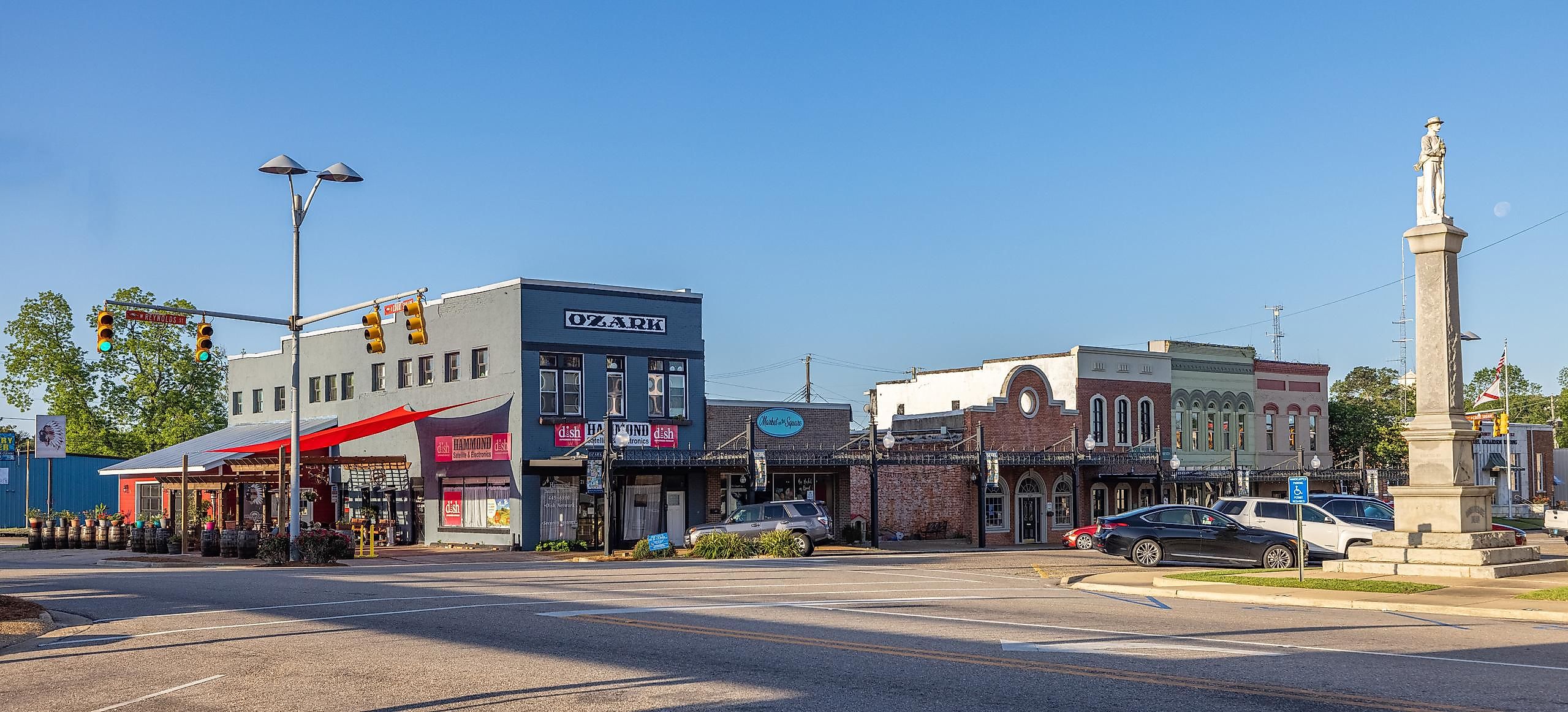
Ozark is home to a little over 15,000 residents, and the average home value is right around $150,000. The town serves as one of the three main gates to Fort Rucker, the Army's aviation training post, which is a large part of why so many military retirees settle here. Those looking to retire in Ozark should consider the Oakview Manor community, which provides skilled care and sits near the public library and municipal walking tracks. Dale Medical Center has been serving Ozark residents for more than 70 years.
Ed Lisenby Lake covers 96 acres on the edge of town, built by the state in 1958 and run by the city ever since, with a clubhouse that rents boats and gear and stocks bait for anglers after bass and catfish. The Dowling Museum and Ann Rudd Art Center share a building downtown and rotate art exhibits throughout the year. On East Andrews Avenue, the Claybank Log Church has stood since 1852, a rough-hewn log building set on split-log pedestals that is thought to be the oldest surviving structure in Dale County, with a cemetery on the grounds and simple pews still used for occasional services. It joined the National Register in 1976. Out at Fort Rucker, the U.S. Army Aviation Museum is open to the public and holds one of the largest helicopter collections anywhere.
Fort Payne

Fort Payne is known as the "Sock Capital of the World" because its mills once produced more than half the socks made in America. The town is on the more expensive end for retirees, with an average home value of about $210,000, but it is still below the state average. Retirees can choose Spring Grove Apartments, a senior community located near the Senior Center, and take advantage of the nearby DeKalb Regional Medical Center. This 134-bed not-for-profit hospital is the major medical provider in the area and joined the Huntsville Hospital Health System in 2024.
Fort Payne is the hometown of the country band Alabama, and the Alabama Fan Club and Museum keeps the group's awards and memorabilia on display, with bronze statues of the band standing at the city park down the road. The 1891 pink sandstone depot now houses the Fort Payne Depot Museum, and the Fort Payne Opera House, built in 1889, still books live performances. DeSoto State Park lies about six miles northeast on Lookout Mountain, with waterfalls and more than 25 miles of hiking and biking trails. The 1,000-foot Talmadge Butler Boardwalk Trail suits anyone who wants the scenery without the climb. Little River Canyon National Preserve protects 15,288 acres along one of the longest mountaintop rivers in the country, and a rim parkway strings together overlooks that require no hiking at all. The DeKalb County Fiddlers Convention brings string bands to town the first weekend of August.
Scottsboro

Scottsboro is a mid-range option for affordable retirement in Alabama, with a population of just over 16,000 people and an average home value of $219,000. There are multiple assisted living options in the area, such as Rosewood Manor and Southern Estates Assisted Living. Both offer round-the-clock supervision along with help for meals and daily needs. Highlands Medical Center provides local hospital care to the Scottsboro community.
Unclaimed Baggage on West Willow Street is the only retailer in the country that buys unclaimed airline luggage, which reaches the store after the airlines spend 90 days trying to reunite bags with their owners. Roughly 7,000 items go out on the floor daily, and a small on-site museum displays the strangest things staff have pulled from suitcases over the decades, with a café attached for a break mid-browse. Goose Pond Colony Resort sits on the Tennessee River with a golf course, a boat launch, and a waterfront restaurant, and it hosts the town's dragon boat races each year. The Scottsboro Boys Museum tells the story of nine Black teenagers pulled from a freight train near Scottsboro in 1931 and falsely accused of assault. Their prosecutions produced two landmark Supreme Court rulings, one on the right to counsel and one on the exclusion of Black jurors.
Monroeville

A strong retirement location for literary enthusiasts, Monroeville has an average home value of about $147,000. Monroe County Hospital serves the town directly, with a VA clinic and a dialysis center also close at hand. Cedar Chase and The Meadows are among the assisted living options to choose from. Monroeville is the designated Literary Capital of Alabama, and the reason sits at the center of town.
The Old Courthouse Museum occupies the 1903 county courthouse, whose courtroom Harper Lee used as the model for the trial in To Kill a Mockingbird, and which Hollywood set designers measured and photographed before rebuilding it on a sound stage for the film. The room has been restored to its 1930s appearance, and visitors can sit in the balcony where Lee watched her father practice law. Two permanent exhibits cover Lee and her childhood friend, Truman Capote, and the collection includes a piece of the oak that inspired the Radley tree. A local company stages To Kill a Mockingbird each April and May, performing the second act in the actual courtroom. The Atticus Finch monument stands on the courthouse grounds, and a marker downtown notes the site of the Faulk house, where Capote spent his childhood before the building was lost.
Retire in Small Town Alabama
Gadsden and Selma sit near the bottom of the state's housing market, which frees up budget but comes with fewer services. Muscle Shoals and Scottsboro cost more, and the money buys a wider range of amenities and, in the case of Muscle Shoals, a cultural calendar that punches well above the town's size. Ozark and Fort Payne land in between, each shaped by federal institutions like the Army aviation post and a national preserve. Alabama also offers tax incentives, which further sweeten the pot, meaning fixed incomes can stretch a bit further in these retirement hot spots across the state.