11 Best Small Towns In South Dakota For A Crowd-Free Summer
Skip the noon crush at Mount Rushmore and drive the Needles Highway at dawn instead, when the granite spires above Custer belong to almost nobody. That is the whole strategy for a quieter South Dakota summer. From Hill City, the 1880 Train, Pactola Lake, and the Mickelson Trail sit minutes away. Base yourself in Chamberlain, and the Dignity statue waits on the bluff while Lake Francis Case opens for an evening paddle. The eleven towns below stretch across the Black Hills, the Badlands, and the Missouri River prairie, and each one lets you reach the marquee sights early and retreat somewhere calmer by the time the sun starts to set.
Keystone

Keystone is best known as the gateway to Mount Rushmore, and it stays manageable if you treat it as more than a quick photo stop. A former gold-mining camp of roughly 240 residents, it packs lodging, meals, and attractions into a compact downtown, which suits families who want outdoor fun without long drives between activities. The memorial itself is quietest right after it opens in the morning and again during the evening lighting program, so the busy midday hours are best spent elsewhere.
That is when the 1880 Train earns its place, hauling vintage steam coaches on the two-hour round trip through the pines toward Hill City. Rushmore Tramway Adventures adds a chairlift up the ridge, along with an alpine slide and a zipline course, for anyone traveling with restless kids. History-minded visitors can head underground at Big Thunder Gold Mine, a genuine late-1800s claim where guides walk you through the tunnels and demonstrate the tools miners once swung by lantern light.
Hill City

Small, walkable, and sitting near the geographic center of the Black Hills, Hill City has earned the nickname "Heart of the Hills." Its Main Street holds enough galleries, tasting rooms, and cafés to fill a gentle afternoon, while lakes, trails, and monuments wait just a short drive out of town. Travelers who prefer quiet over commotion tend to settle in here because so much is reachable without complicated planning.
The 1880 Train runs from the Hill City depot, where its restored locomotives have been rolling through the forest since 1957. A short walk away, the Museum at Black Hills Institute displays one of the country's most notable privately held fossil collections, including full dinosaur skeletons. For time outdoors, the George S. Mickelson Trail passes right through town; the 109-mile rail-trail follows old railbeds across more than 100 converted bridges and tunnels and is easy to sample by bike or on foot. Pactola Lake, the largest reservoir in the Black Hills, lies a few miles north and draws swimmers, paddlers, and anglers to its clear, pine-ringed shoreline.
Custer

Custer is the oldest town settled by European Americans in the Black Hills, and it delivers major scenery without putting you in the busiest resort corridors. Granite peaks, ponderosa forest, and open grassland ring the town, which makes it a natural base for travelers who want nature first and crowds second. Mornings on the trails are calmest, and downtown's restaurants and brewpubs stay relaxed enough for an unhurried dinner.
The Needles Highway is the signature drive, threading its narrow lanes past the granite spires and one-lane tunnels that give the route its name. Sylvan Lake anchors the northern end inside Custer State Park, ringed by rock outcrops that make its small beach a fine spot for a swim and a picnic. The park's Wildlife Loop Road runs through open range where bison herds, pronghorn, and the park's famous "begging burros" often stop traffic. Hikers can choose the boulder-and-staircase climb through Sunday Gulch, the granite scramble up to the Cathedral Spires, or gentler paths that trace the lakeshore.
Hot Springs

At the southern edge of the Black Hills, Hot Springs offers a softer, quieter version of the region, built around warm mineral water, pink sandstone buildings, and a river running through the middle of downtown. The town pairs indoor attractions with mellow time outside, which helps when the afternoon heat settles in. Its position also makes it a smart base for the southern hills, with fewer visitors than the better-known northern towns.
Evans Plunge is the local institution, an indoor pool fed by a natural warm spring that has been drawing bathers since 1890. A few minutes away, the Mammoth Site protects an active fossil dig where dozens of Columbian and woolly mammoths became trapped in an ancient sinkhole; a climate-controlled building lets visitors watch excavation continue over the bonebed. Wind Cave National Park sits just north of town, combining one of the world's longest and most intricate caves with a prairie surface where bison and elk range freely. Back in town, a stroll along the Fall River passes the sandstone storefronts that landed downtown on the National Register of Historic Places.
Spearfish

Spearfish feels spacious even at the height of summer because its best experiences reach out into the canyon and hills around it. A morning downtown can give way to an afternoon beside waterfalls and shaded creekside trails, and the mix of easy dining and nearby recreation makes the town flexible for couples, families, and road-trippers alike. It sits at the northern edge of the Black Hills, where prairie gives way to canyon.
The Spearfish Canyon Scenic Byway is the reason many people come, a roughly 19-mile route beneath limestone cliffs with pullouts at each of its waterfalls. Roughlock Falls tumbles in tiers near the canyon's upper end, Bridal Veil Falls drops in a thin ribbon visible right from the road, and Spearfish Falls sits a short walk from the historic Latchstring area. Spearfish Creek runs the length of town for fishing and creekside cycling, and downtown fills with patios, shops, and summer events once the day cools off.
Deadwood

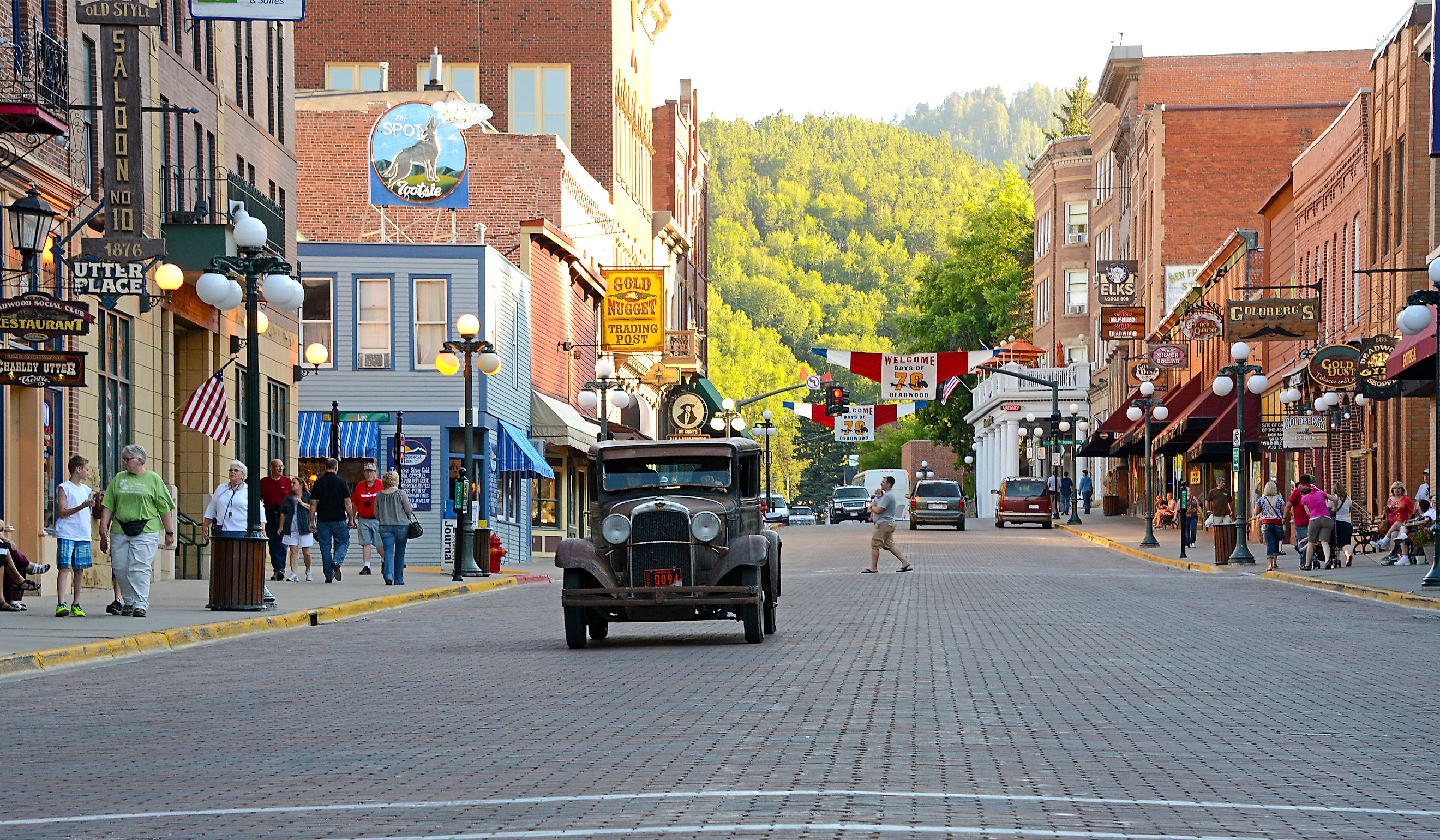
Deadwood carries a famous name, yet it still works for a crowd-free trip if you wander beyond the liveliest blocks of Main Street. The whole town, set deep in a narrow gulch, was named a National Historic Landmark in 1961 for its carefully preserved gold-rush architecture, so history, scenery, and short outings all sit close together. Museums and walking tours fill the mornings well, leaving afternoons open for trails, overlooks, or a slow drive into the northern hills.
Along Main Street, summer brings costumed reenactments and street performances that play out the town's Wild West lore. The Adams Museum, the oldest in the Black Hills, gathers gold-rush relics and regional oddities, while the Days of '76 Museum preserves an award-winning collection of horse-drawn vehicles alongside its rodeo history. Above town, Mount Moriah Cemetery holds the graves of Wild Bill Hickok and Calamity Jane and rewards the climb with a wide view over the gulch. Sections of the George S. Mickelson Trail run nearby for anyone wanting to trade the sidewalks for pines.
Lead

Just up the hill from Deadwood, Lead (pronounced "leed") is the quieter neighbor and a strong pick for Black Hills history without the bustle. Its mining legacy still shapes the town, and an elevation above 5,000 feet keeps summer evenings pleasantly cool. Scenic highways, trail connections, and Spearfish Canyon all sit close by, so a full day outdoors can end back at a low-key base.
The Sanford Lab Homestake Visitor Center on Main Street tells the town's remarkable double story, and admission is free. Its observation deck looks straight down into the Homestake Open Cut, a mining pit about 1,250 feet deep, while its exhibits trace how the deepest gold mine in North America became a cutting-edge science lab. Nearly a mile underground, the retired mine now shelters dark-matter and neutrino research, a lineage that began when a solar-neutrino experiment here earned a share of the 2002 Nobel Prize in Physics. The Historic Homestake Opera House, built in 1914 for the mining community, still stages summer performances and community events. A short drive away, Spearfish Canyon offers waterfalls, picnic areas, and shaded trail connections into the northern Black Hills.
Wall

Wall is a classic road-trip town, perched on the rim of the Badlands and built for easy access to that eroded, otherworldly landscape. It gets busy around its most famous stop, but the surrounding country opens up quickly, especially early and late in the day when the light is best and the tour buses have moved on. That rhythm makes Wall a practical base for sunrise drives, short hikes, and prairie wildlife watching.
Wall Drug remains the town's roadside landmark, a sprawl of shops and Americana that grew from a struggling 1930s pharmacy into a bona fide institution. The real draw, though, is next door: the Badlands Loop Road strings together overlooks where bison, bighorn sheep, and pronghorn graze below jagged spires. Short, well-marked trails such as the Door, Window, Notch, and Fossil Exhibit routes let you walk out among the formations without a long commitment. Staying into the evening pays off, because the park's remoteness makes it one of the darkest, and best, places for stargazing in the region.
De Smet

Out on the eastern prairie, De Smet keeps a gentle summer rhythm suited to travelers who want history and open skies rather than packed attractions. Readers of Laura Ingalls Wilder will find the town especially meaningful, since this is the "Little Town on the Prairie" where the Ingalls family settled, but even first-time visitors can appreciate its preserved homes and grassy horizons. Summer is prime time here for living-history experiences, evening drives, and unhurried picnics.
The Laura Ingalls Wilder Historic Homes preserve the surveyors' house the family wintered in, and the home Charles Ingalls built in town, both furnished to the period. A short drive away, the Ingalls Homestead sits on the family's original claim and leans into hands-on activities: visitors ride in covered wagons, twist hay sticks, and drive a pony cart across the same prairie Wilder wrote about. In midsummer, the outdoor Laura Ingalls Wilder Pageant dramatizes scenes from the books under the open sky. An evening drive out to the nearby lakes and prairie viewpoints is the natural way to close the day.
Yankton

Larger than several towns on this list, Yankton still feels unhurried because the Missouri River and its recreation areas spread visitors out. Once the capital of Dakota Territory, the town now centers its summers on water, trails, and breezy river views, and it makes a good alternative for travelers who want outdoor time without driving all the way to the Black Hills. Downtown carries enough restaurants and shops for an easy evening, while the lakeshore can fill an entire vacation day.
The Lewis and Clark Recreation Area, spread along the reservoir just west of town, offers swimming beaches, boat ramps, and shaded campgrounds. Lewis and Clark Lake itself is the venue for paddling, fishing, and lazy afternoon cruises, formed where Gavins Point Dam backs up the Missouri. In town, the Meridian Bridge, a former highway crossing converted to a pedestrian-and-bike double-decker, spans the river for wide water views and an easy walk between South Dakota and Nebraska.
Chamberlain

Chamberlain sits high on the bluffs above the Missouri River, roughly halfway between the eastern prairie and the Black Hills, which makes it a scenic place to break a long drive. Here, the river widens into Lake Francis Case, opening up boating, fishing, and slow evenings by the water. It appeals most to road-trippers who want an overnight that feels like more than a fuel stop, and the town backs that up with a pair of meaningful cultural landmarks.
The best-known is Dignity of Earth and Sky, sculptor Dale Lamphere's 50-foot stainless-steel figure of an Indigenous woman receiving a star quilt, dedicated in 2016 at the interstate rest area east of town. Its quilt of 128 blue diamonds shifts in the wind above a sweeping bend of the Missouri. In town, the Akta Lakota Museum and Cultural Center presents the history and living traditions of the Lakota, Dakota, and Nakota people through art and artifacts. A sunset drive across the Chamberlain-Oacoma bridge and along the river overlooks is a fitting way to end the visit.
Choosing Your Base For A Quieter Summer
The towns here are split roughly into three landscapes, and matching one to your interests does more for a crowd-free trip than trying to see everything. The Black Hills cluster, Keystone, Hill City, Custer, Hot Springs, Spearfish, Deadwood, and Lead, puts granite peaks, caves, and mining history within short drives of one another, rewarding travelers who base themselves in one town and radiate out. Wall opens the door to the Badlands and its dark, star-filled nights, while De Smet, Yankton, and Chamberlain trade mountains for prairie history and the wide Missouri River.