These 11 Towns In Tennessee Were Ranked Among US Favorites In 2026
Tennessee in 2026 still rewards a slow walk down a courthouse square. The towns ahead each carry one thing the state is known for. Some sit at the edge of the Smokies. Others run on whiskey or storytelling or Civil War streets that still read as one. They span East, Middle, and West Tennessee with a useful range of size and pace. Each one earns its spot on a favorites list a different way.
Gatlinburg

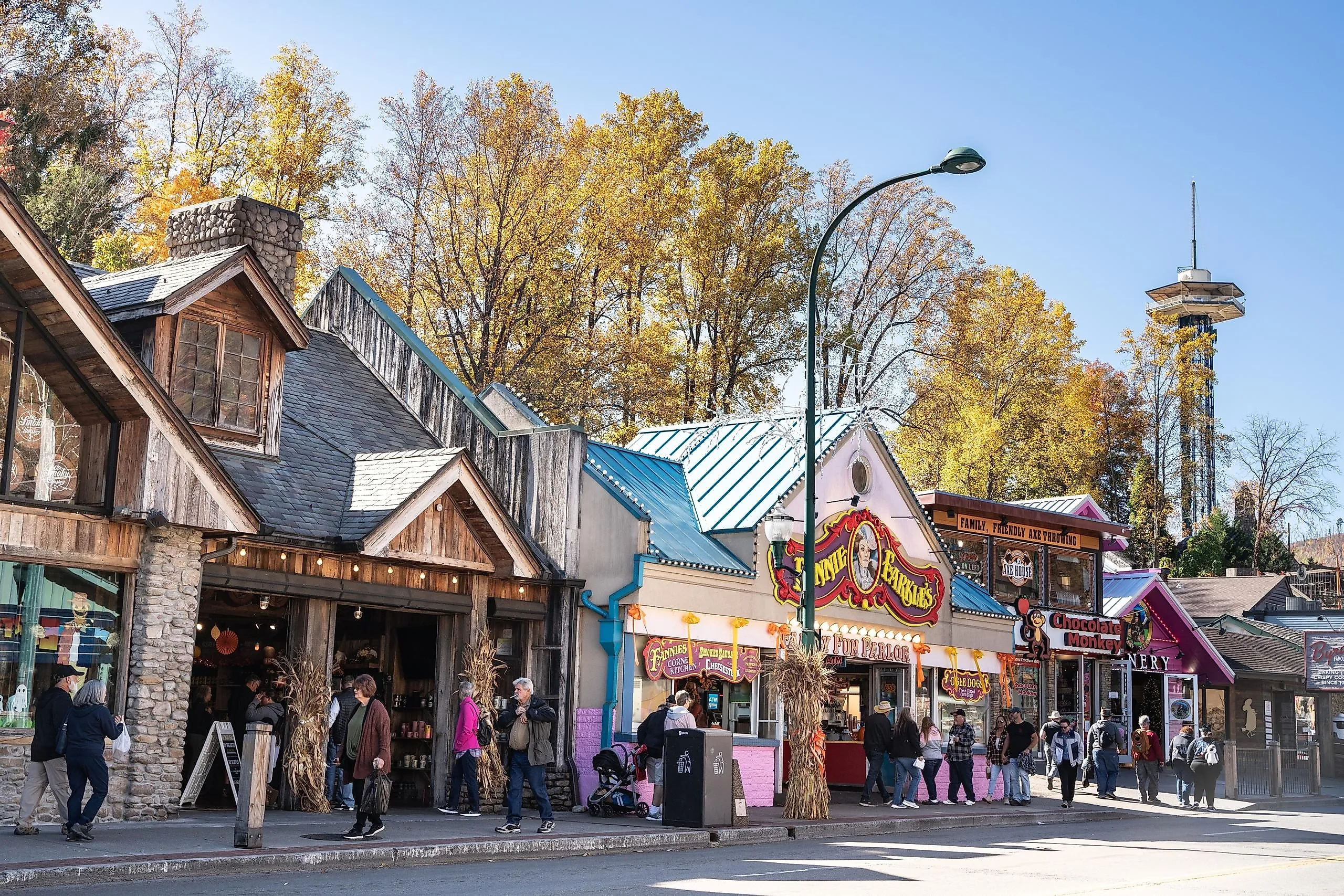
Gatlinburg sits at the main entrance to Great Smoky Mountains National Park. The park draws roughly 12 million visitors a year and most of them pass through this town. That makes it the most visited national park in the country by a wide margin. The Parkway strip in town is narrow and loud, with candy stores, arcades, and pancake houses lined up between mountains on either side.
The Gatlinburg SkyBridge spans 680 feet across a mountain valley and was the longest pedestrian suspension bridge in North America at its 2019 opening. Anakeesta on the south side runs gardens, treetop walkways, and a chondola lift up to a peak above downtown. Ober Mountain operates an aerial tramway from the Parkway up to a year-round ski and tubing area at the summit. The 5.5-mile Roaring Fork Motor Nature Trail loops past old-growth forest, historic mountain cabins, and small waterfalls just beyond the park entrance.
Pigeon Forge

Pigeon Forge got its modern identity in 1986, when Dolly Parton became co-owner of the existing Silver Dollar City Tennessee park and rebranded it Dollywood. The park now draws roughly three million visitors a year and ranks among the most visited theme parks in the Southeast. The rest of Pigeon Forge is built around it. The Parkway runs about five miles south from the Sevierville line, lined the whole way with rides, dinner theaters, and hotels.
The Island at Pigeon Forge sits in the middle of the strip and centers on the 200-foot Great Smoky Mountain Wheel, which carries a view across the Little Pigeon River to the foothills. The Titanic Museum is housed in a half-scale replica of the ship's bow and holds more than 400 artifacts pulled from passengers and crew. Country Tonite Theatre and the Comedy Barn run nightly shows that have outlasted most of the strip's earlier dinner-theater experiments. The mountains remain the long view from anywhere on the Parkway.
Sevierville

Sevierville is Dolly Parton's hometown, and the bronze statue of her in front of the Sevier County Courthouse is the photograph most visitors take first. She grew up in a one-room cabin in nearby Locust Ridge. The statue, sculpted by Jim Gray and dedicated in 1987, sits in the same town square where she sang on the courthouse steps as a child.
The downtown beyond the courthouse holds the rest of the visit. Historic Downtown Sevierville keeps restored brick storefronts, antique shops, and murals along Court Avenue. Forbidden Caverns east of town runs guided tours through a multi-level cave system that once hid a Prohibition-era moonshine still. The Tennessee Museum of Aviation at the local airport keeps a notable collection of restored World War II warbirds and runs flight demonstrations on summer weekends.
Townsend

Townsend bills itself as the peaceful side of the Smokies and the description holds up. The town sits along the Little River on the park's western edge, about 30 miles southwest of Gatlinburg. Where Gatlinburg's Parkway runs neon, Townsend's main road runs past horse pastures, inner-tube outfitters, and Sunday-driving traffic. The pace is the point.
Cades Cove is the area's biggest draw. The eleven-mile loop road runs through a broad mountain valley with white-tailed deer, black bears, restored 19th-century cabins, and one of the most photographed views in the Southeast. Tuckaleechee Caverns just outside town opens into a multi-room cavern system once used as a Cold War seismic monitoring station for nuclear test detection. The Great Smoky Mountains Heritage Center fills in the Cherokee, pioneer, and logging history before anyone heads up the mountain. The Little River runs cold even in August, which is most of why the tubing outfitters stay busy.
Jonesborough

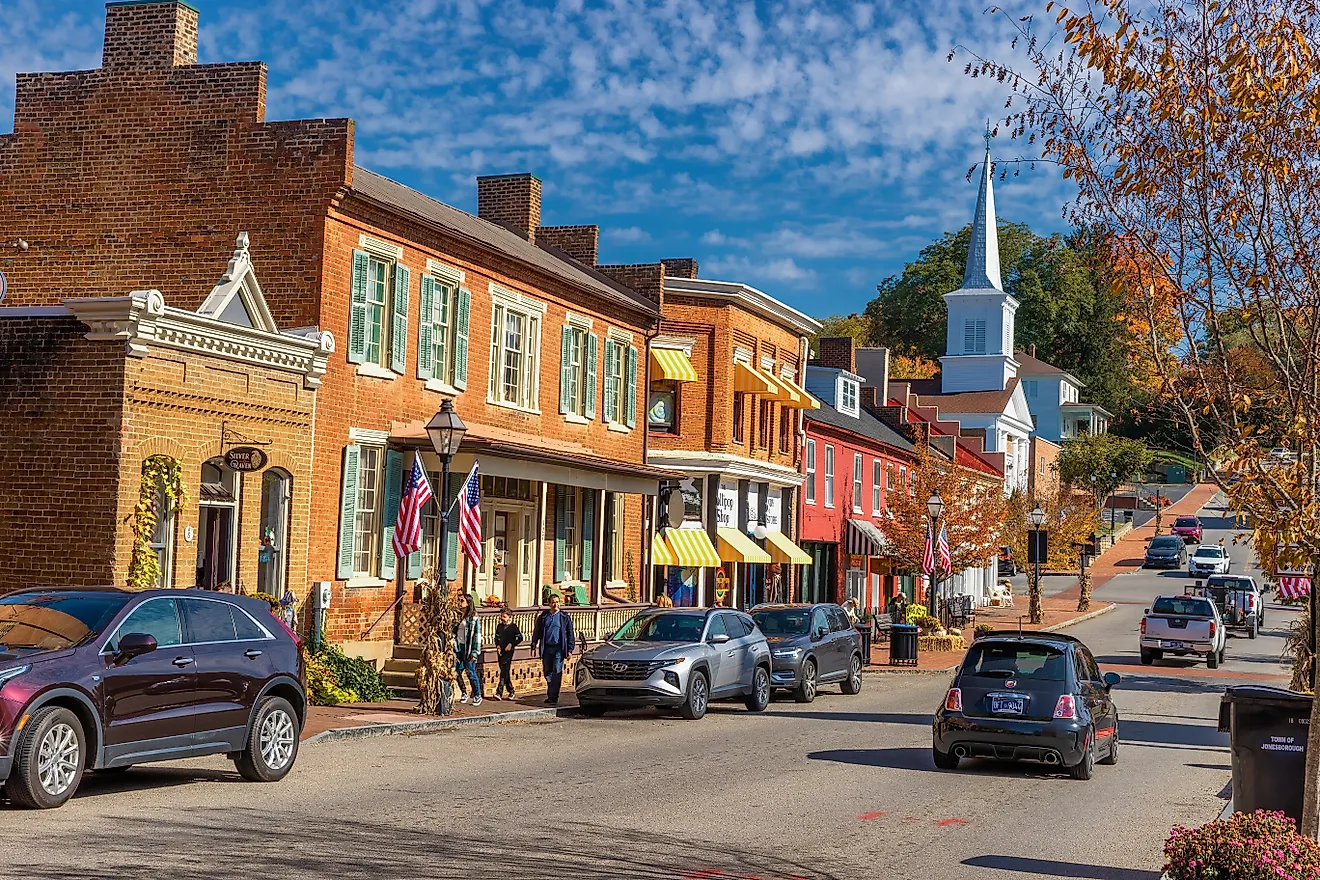
Jonesborough was founded in 1779, when this corner of east Tennessee was still part of North Carolina and seventeen years before Tennessee was a state. The town also served as the capital of the unrecognized State of Franklin from 1784 to 1788, a separatist attempt at a fourteenth state that ended when North Carolina reclaimed jurisdiction. Today the downtown is the most intact 18th-century main street in Tennessee.
The International Storytelling Center on Main Street has hosted the National Storytelling Festival every October since 1973, drawing professional storytellers from across the country to four days of stages set up around town. The Chester Inn from 1797 is Tennessee's oldest commercial frame building and now houses a museum on the lower floor with an 1850s diorama of the town. Main Street itself runs less than a half mile, brick-sidewalked the whole way and lined with restored Federal-period buildings now holding bookshops, cafes, and the Jonesborough Repertory Theatre. The aggregate effect is that the whole town can be read in an afternoon.
Franklin

Franklin was founded in 1799 about 20 miles south of Nashville. The November 30, 1864 Battle of Franklin lasted barely five hours but produced roughly 9,500 casualties and effectively ended the Confederate Army of Tennessee. The Carter House on Columbia Pike still has hundreds of bullet holes preserved in its outbuildings. Carnton, the McGavock family mansion that served as the largest field hospital that night, sits on the south end of what was the battlefield and now opens for guided tours.
Downtown Franklin runs around Public Square with restored 19th-century brick storefronts holding boutiques, restaurants, and the Franklin Theatre, a 1937 movie house restored in 2011 and running concerts and films year-round. The Factory at Franklin is a 250,000-square-foot former stove and bedding factory turned into shops, restaurants, and a music venue on the west side of town. Walking battlefield tours run from the Carter House visitor center most of the year. Franklin still feels lived-in despite the polish.
Lynchburg

Lynchburg and Moore County are functionally consolidated and together hold about 6,500 people. Almost everything about the visitor identity runs through Jack Daniel's Distillery. Jack Daniel registered the distillery with the federal government in 1866, which makes it the oldest registered distillery in the United States. The town also remains in a mostly dry county, so visitors can take the tour and the tasting but cannot buy a bottle of whiskey at the local store without the commemorative-bottle arrangement the distillery worked out by ordinance.
The town square is a single block centered on the Moore County Courthouse, with the original Jail Museum, the Lynchburg Hardware and General Store, and Miss Mary Bobo's Boarding House all within a few storefronts. Miss Mary Bobo's has served family-style Southern lunch since 1908 by reservation, with seatings around a single dining room. The distillery itself sits a quarter mile north of the square in a hollow fed by the limestone-filtered cave spring that water-drives the whiskey. Tours run year-round and the cooper's barrel-charring demonstration is the part most people remember.
Bell Buckle

Bell Buckle has roughly 500 residents and a half-square-mile downtown that fits comfortably on a postcard. The town grew up along the Nashville and Chattanooga Railroad after the line came through Bedford County in the 1850s, and the Victorian-era buildings on Railroad Square date from that period. The name itself is a local mystery. Early settlers reportedly found a carving of a bell and a buckle on a tree near the present-day square, though no one knows who put it there.
The Webb School east of the square has operated as a college-preparatory boarding school since 1886 and is one of the oldest continuously operating boarding schools in the South. The Bell Buckle Café on Railroad Square turns out country-fried steak, smoked pork chops, and the MoonPie Sundae for the lunch crowd. The RC Cola-MoonPie Festival each June draws tens of thousands of visitors for a parade, a 10-mile run, and the ceremonial cutting of the world's largest MoonPie. Daffodil Day on the third Saturday in March covers six miles of town roadways with thousands of blooms planted by local civic clubs since 1978.
Columbia

Columbia sits on the Duck River about 45 miles south of Nashville and serves as the seat of Maury County. Two things give the town its visitor identity. James K. Polk lived here as a young man, and the 1816 Polk family home is the only surviving private residence of the eleventh president. The other defining feature is Mule Day, held every spring since 1840 and now drawing more than 200,000 visitors over four days for a parade, a mule show, and a town that still calls itself Muletown.
The Maury County Courthouse on the public square is a 1906 Beaux-Arts building still in active use, with the restaurants and shops of downtown Columbia spreading out from its corners. Muletown Coffee on the square is the local roaster and the unofficial headquarters of the town's revival. The Athenaeum Rectory two blocks south is an 1837 Moorish-Gothic Revival oddity that housed a girls' school from the 1850s through the Great Depression and now opens for tours. The Duck River runs about a half mile from the square and is one of the most biodiverse rivers in North America with more than 150 fish species and 50 freshwater mussel species.
Greeneville

Greeneville is the seat of Greene County in upper East Tennessee, about 70 miles northeast of Knoxville at the foot of the Appalachian foothills. Andrew Johnson, the seventeenth president, lived here from his teenage years onward. He ran his tailor shop on a downtown corner and served on the town's aldermanic board. From there he went to the Tennessee legislature, then to Congress, and eventually became Lincoln's second-term running mate.
The Andrew Johnson National Historic Site preserves the original tailor shop, the home where Johnson lived after returning from the White House, and the family burial ground on Monument Hill. The Dickson-Williams Mansion on Church Street is an 1821 Federal-style townhouse used as headquarters by both armies during the Civil War, including for the planning of John Hunt Morgan's 1864 raid that ended in Greeneville with Morgan's death. The Niswonger Performing Arts Center runs concerts, regional theater, and touring Broadway productions in a 1,143-seat hall on the south end of town. The Nathanael Greene Museum covers Greene County history through Cherokee, pioneer, and modern eras in a former Coca-Cola bottling plant.
Tellico Plains

Tellico Plains is the western terminus of the Cherohala Skyway, a 43-mile National Scenic Byway that climbs through Cherokee National Forest into Nantahala National Forest and ends in Robbinsville, North Carolina. The drive takes about two hours without stops and gains roughly 4,000 feet in elevation, with overlooks high enough to catch the Smokies to the northeast and the Unicoi Range to the south. The town itself stays small and unfussy at the foot of the mountains.
Bald River Falls drops about 80 feet beside the road in Cherokee National Forest, just a few miles outside town, and is the most photographed waterfall in the region. The Charles Hall Museum on Tellico Street holds roughly 10,000 artifacts collected by a single Monroe County resident over decades. Cases include firearms, Cherokee material culture, mining tools, and household pieces, with proceeds going back to local schools. The Tellico River carries trout-fishing water year-round with paddling access at the Skyway crossings. The Cherohala Skyway Visitor Center on the east side of town fills in the geological and cultural context before anyone starts the climb.
Tennessee Favorites Worth Visiting In 2026
The eleven towns above do not run on one formula. Gatlinburg, Pigeon Forge, Sevierville, Townsend, and Tellico Plains all lean on a national park, a scenic byway, or a mountain gateway. Jonesborough, Franklin, Greeneville, and Columbia carry the state's historic weight. Lynchburg and Bell Buckle prove that one strong identity can carry a place far past its population. What these towns share is the reason Tennessee keeps showing up in favorite-state conversations.