10 of the Most Welcoming Towns in New York
New York State stretches well past the city that shares its name. Woodstock still trades on the spirit of its 1969 festival in a Catskills setting. Cooperstown holds the National Baseball Hall of Fame. Lake Placid carries a two-time Olympic legacy. Hudson runs as the Hudson Valley's antiques-and-restaurant capital. The ten towns ahead reward the trip out of the city with welcoming downtowns, walkable main streets, and easy weekend pacing.
Woodstock

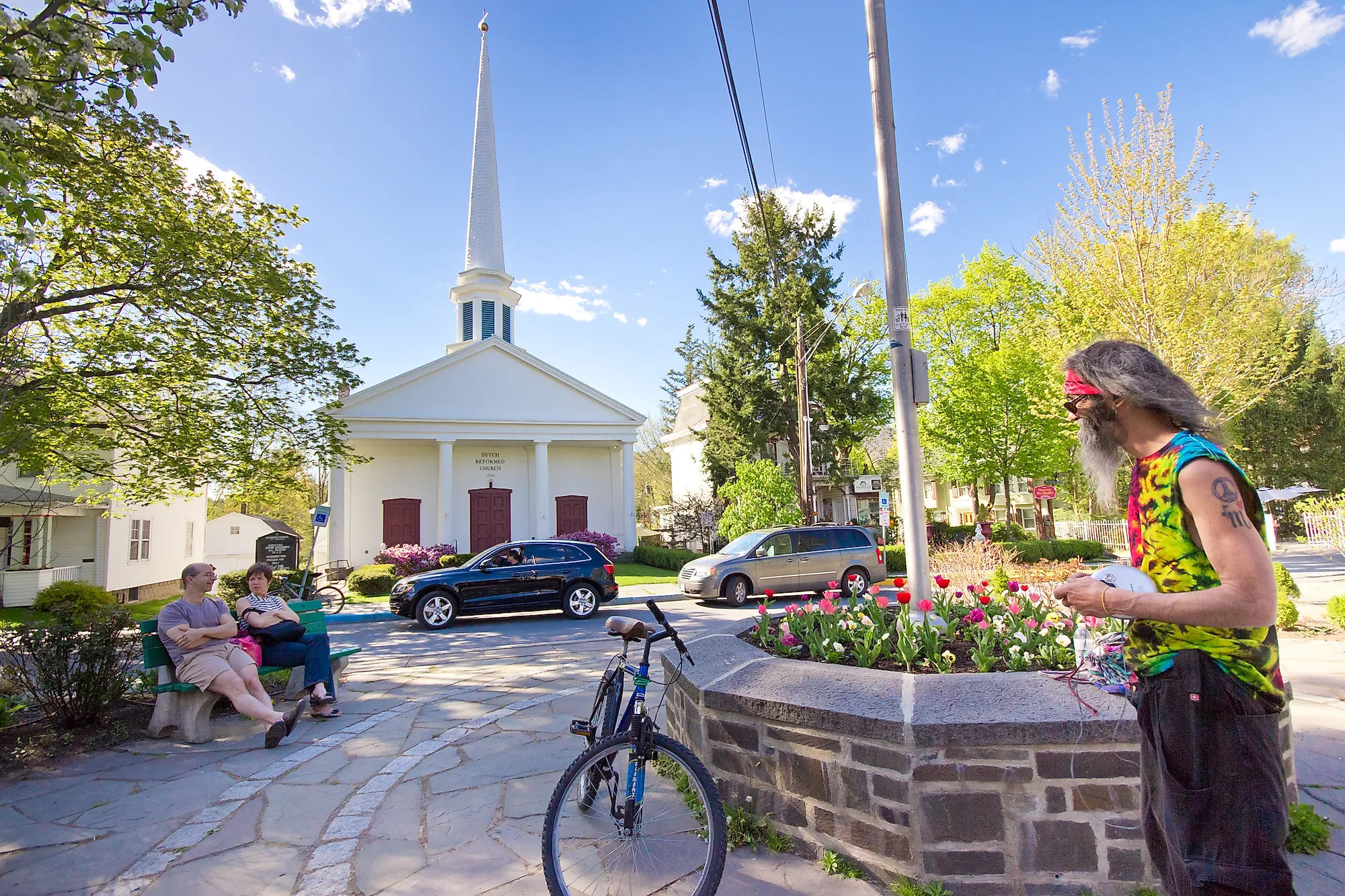
Woodstock, in Ulster County, gets its name recognition from the 1969 music festival, which famously was held about 60 miles southwest in Bethel rather than in Woodstock itself. Even so, the town's bohemian arts identity predates the festival by half a century and still defines its downtown. The Tinker Street strip is lined with galleries, independent bookstores, and small restaurants, and the Woodstock Artists Association & Museum traces the colony back to its 1902 founding. Just outside town, Opus 40 is sculptor Harvey Fite's 6.5-acre bluestone earthwork built over 37 years, set on a 60-acre property of meadows and trails. Overlook Mountain Trail climbs 2.5 miles to the ruins of a 19th-century hotel and a working fire tower with views into five states.
New Paltz

New Paltz is about 90 minutes north of Manhattan and runs at the pace of a college town built around SUNY New Paltz and a working historic core. Historic Huguenot Street, a National Historic Landmark district founded by French Protestant settlers in 1678, holds seven stone houses from the late 17th and early 18th centuries that you can tour year-round. The town is also the gateway to the Shawangunk Ridge, with Minnewaska State Park Preserve and the Mohonk Preserve covering 20,000 acres of cliffs, lakes, and carriage roads. The Wallkill Valley Rail Trail runs 22 miles through town and is a popular Sunday cycle for visitors and locals alike.
Ithaca

Ithaca sits at the southern tip of Cayuga Lake in the Finger Lakes Region and is home to both Cornell University (founded 1865) and Ithaca College. The town's local slogan "Ithaca is Gorges" earns its keep with Ithaca Falls, Buttermilk Falls State Park, and Robert H. Treman State Park all within or right next to the city. The Ithaca Commons pedestrian district runs four blocks of independent restaurants, bookshops, and craft breweries. Cornell's Herbert F. Johnson Museum of Art, designed by I.M. Pei, holds a strong Asian art collection and is free to visit. The Ithaca Apple Harvest Festival each October closes the Commons for three days of cider, food vendors, and live music.
Cooperstown

Cooperstown, with a population just under 1,800, is the home of the National Baseball Hall of Fame and Museum, opened in 1939 in honor of (the now-debunked) myth that Abner Doubleday invented baseball here in 1839. The Hall of Fame itself remains the central attraction with plaques for every inducted player, video archives, and the actual artifacts of the game's history. Cooperstown also offers the Farmers' Museum (a recreated 1840s village with working blacksmith, printing office, and general store), the Fenimore Art Museum (named for novelist James Fenimore Cooper, whose family founded the town), and the summer Glimmerglass Festival, one of the country's most respected smaller opera companies, performing on the shores of Otsego Lake.
Ellicottville

Ellicottville, in Cattaraugus County in western New York, is a small village of about 1,500 residents that punches well above its size as a year-round resort destination. Holiday Valley Resort and Holimont Ski Area both run downhill and cross-country skiing in winter, and both convert to mountain biking, golf, and ziplining in summer. The Washington Street Historic District holds an intact 19th-century streetscape on the National Register of Historic Places. Nannen Arboretum, run by the local Lions Club on Parkside Drive, holds dwarf conifers, a Japanese garden, and ornamental trees across eight acres. The village's restaurant scene includes Ellicottville Brewing Company (the original location, with the Beemus Point lakeside spot pictured above as a sister location), Dina's Restaurant, and several seasonal patios that fill on summer weekends.
Kingston

Kingston, settled by the Dutch as Esopus in 1652, became New York's first state capital in 1777 and was burned by the British four months later in October that year. The Stockade District in uptown Kingston still holds around two dozen pre-Revolutionary stone houses within the original 1658 fortified perimeter, an eight-block area that makes it one of the most intact 17th-century streetscapes in the country. Senate House State Historic Site, where the state Senate first met in 1777, is open as a museum. Downtown along the Hudson, the Rondout district has been redeveloped into a waterfront of restaurants, galleries, and the Hudson River Maritime Museum, where the 1898 Mathilda tugboat is on display.
Jamestown

Jamestown sits between Chautauqua Lake and the Allegheny National Forest in the southwestern corner of the state, about 75 miles south of Buffalo. The town is the birthplace of comedian Lucille Ball, and the National Comedy Center on West Second Street opened in 2018 as a hands-on museum dedicated to the art of comedy, with over 50 immersive exhibits covering everyone from Charlie Chaplin to contemporary stand-ups. Two blocks away, the Lucy Desi Museum holds the personal archives of Ball and Desi Arnaz. Outside of town, Panama Rocks Scenic Park offers a 60-foot ledge of glacial sandstone formations carved into caves and crevasses you can walk through.
Aurora

Aurora sits on the eastern shore of Cayuga Lake with around 600 residents and an extraordinary concentration of 19th-century architecture for its size. Main Street is a National Register Historic District with mostly Federal and Greek Revival buildings dating to the 1830s through 1870s. The Aurora Inn, dating to 1833 and renovated as a boutique hotel, anchors the downtown along with MacKenzie-Childs (the ceramics and home-goods company headquartered just outside town with a free farm shop and seasonal events). The Cayuga Lake Wine Trail, which runs around the lake, brings tasting tours through the village all summer. Wells College, founded 1868, closed permanently in 2024, but the campus remains open as the village works on a long-term plan for the buildings and grounds.
Hudson

Hudson, about two hours north of Manhattan, runs on Warren Street, a roughly seven-block strip that has become the Hudson Valley's busiest antique, design, and restaurant corridor. Around 6,000 residents support more than a hundred independent shops and dining spots along the strip. The FASNY Museum of Firefighting, on Harry Howard Avenue, holds one of the largest collections of firefighting equipment in the country including a 1725 hand-pumped fire engine. Olana State Historic Site, just south of town across the Rip Van Winkle Bridge, was Hudson River School painter Frederic Edwin Church's Persian-revival home, now run as a state historic site with views down the river.
Lake Placid

Lake Placid, in the High Peaks region of the Adirondacks with around 2,200 residents, is one of only a handful of cities worldwide to host two Winter Olympic Games (1932 and 1980). The Olympic Center on Main Street still operates the rink where the 1980 "Miracle on Ice" hockey game took place, and the Lake Placid Olympic Museum on the same site holds the artifacts from both Games. The Olympic Jumping Complex and Mt. Van Hoevenberg offer summer tours, ziplines, and bobsled rides. Mirror Lake, despite the town's name, is the lake that runs through downtown (the actual Lake Placid is a separate, larger lake just north). Whiteface Mountain, the fifth-highest peak in New York at 4,867 feet, sits 15 minutes away in Wilmington for skiing and summer driving up the Veterans Memorial Highway.
New York's Welcoming Small Towns
New York's small towns offer a working counter to the city that shares the state's name. Woodstock and New Paltz handle the Catskills weekend. Ithaca, Aurora, and Cooperstown anchor the Finger Lakes and Otsego country. Kingston and Hudson run as the Hudson Valley's most-visited downtowns. Jamestown and Ellicottville cover the western corner with a comedy museum and a four-season resort village respectively. And Lake Placid carries the Adirondacks. Each town rewards a weekend more than an afternoon, and the welcome is the easy default.