The Most Picturesque Towns In Indiana
Indiana hides more variety than the cornfield reputation suggests. The state's towns step past flat farmland into limestone bluffs along the Ohio River. Canal locks, Amish farms, and gilded-age resort hotels fill the gaps between them. The nine towns ahead all have a distinct landscape or built environment that has held its shape for at least a century. Each downtown stays small enough to walk and specific enough to be remembered.
French Lick

French Lick sits in the rolling Hoosier National Forest hill country of southern Indiana, built around two grand spa hotels and the mineral springs that drew visitors in the late 1800s. The French Lick Springs Hotel opened in 1845 and was rebuilt in 1901, while the West Baden Springs Hotel, two miles away, holds the 200-foot domed atrium that earned it the "Eighth Wonder of the World" nickname when it opened in 1902. The French Lick Scenic Railway runs heritage diesel rides through the hill country on weekends from spring through fall. Patoka Lake, about 15 miles east, has boating, fishing, and wildlife cruises that include eagle and osprey sightings. The Pete Dye Course at the resort runs across the ridge above downtown, with long sightlines over the wooded valleys.
Metamora

Metamora is a 19th-century canal town in southeastern Indiana, preserved largely intact since the 1830s and 1840s. The Whitewater Canal still runs through the village, and the Duck Creek Aqueduct, the only wooden covered aqueduct still standing in the United States, carries the canal over the Whitewater River. The Metamora Grist Mill, rebuilt in 1932 after a fire and still operating with 19th-century machinery, sells stone-ground cornmeal milled on site. The Whitewater Valley Railroad runs heritage train rides along the canal route between Connersville and Metamora. The Whitewater Canal Trail follows the towpath for about 2.6 miles, an easy walking route that ends at the historic canal lock.
Vevay

Vevay sits on the Ohio River in southeastern Indiana, founded by Swiss immigrants in 1802 and known locally as "Little Switzerland of America." The architecture downtown still reflects early 19th-century Greek Revival and Victorian work, including the Switzerland County Courthouse. Paul W. Ogle Riverfront Park runs along the Ohio Scenic Byway with river views and benches for watching the barges. The 1874 Schenck Mansion, a 35-room Italianate brick home built by a riverboat shipper, opens for tours and as a bed and breakfast. The Switzerland County Historical Society and the Life on the Ohio River Museum cover the town's Swiss settler heritage on the courthouse square. Ridge Winery Tasting Room sits on the hillside south of town with views back across the river valley.
Madison

Madison sits along the Ohio River about 50 miles upstream from Louisville and holds one of the largest continuous National Historic Landmark Districts in the country, with 133 blocks of 19th-century buildings preserved largely intact. Clifty Falls State Park, just outside downtown, has 70-foot waterfalls, fossil-rich limestone gorges, and overlooks above the river. The Lanier Mansion State Historic Site, a Greek Revival home completed in 1844 for financier James Lanier, sits on the riverfront with formal gardens and a spiral staircase that runs three stories without center support. The Broadway Fountain, cast in 1876 for the Philadelphia Centennial Exhibition, anchors the central square. Rockin' Thunder River Tours runs jet boat trips on the Ohio with views back at the Indiana bluffs and the Kentucky shore.
Shipshewana

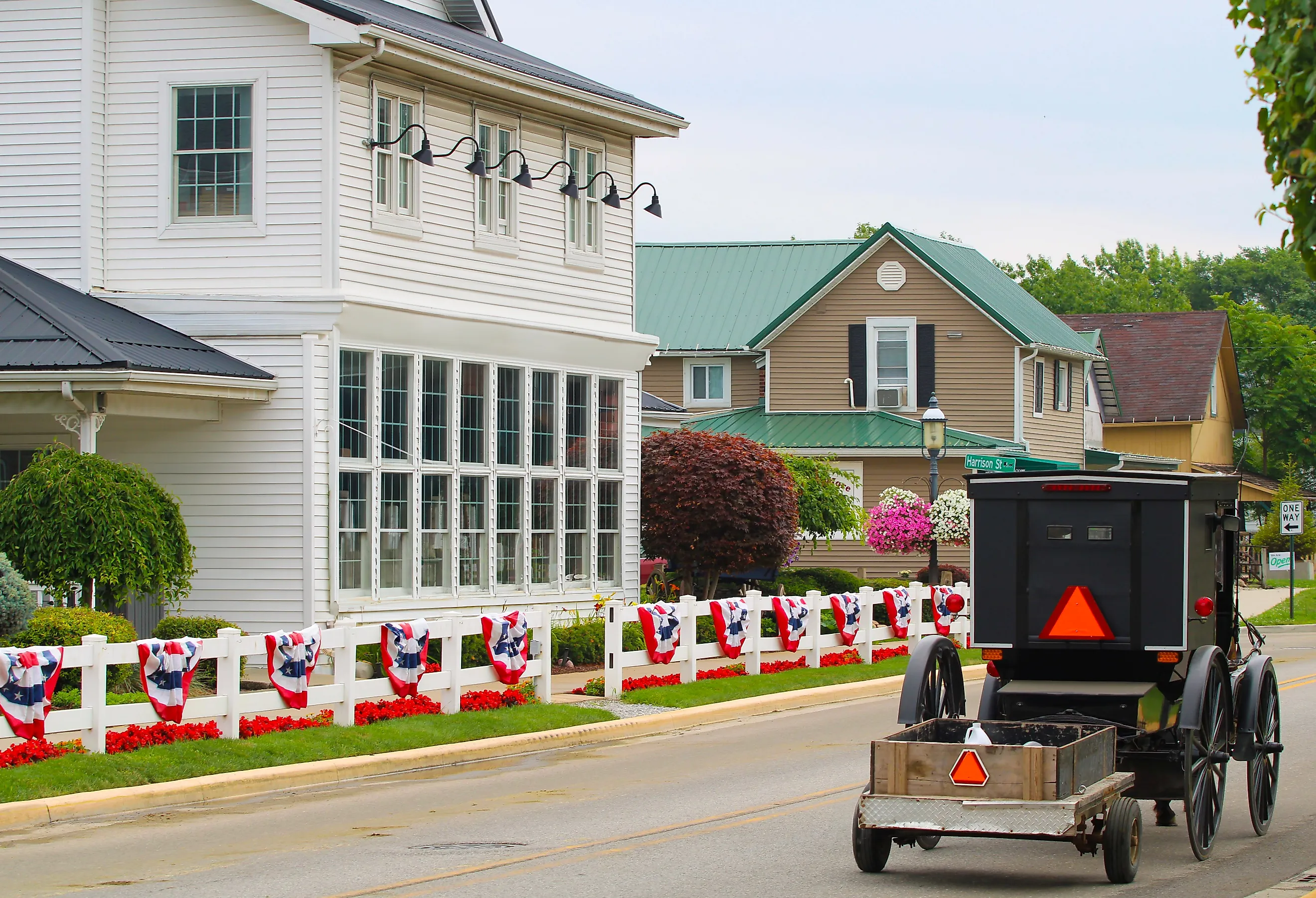
Shipshewana sits in LaGrange County in northern Indiana, the center of the state's largest Amish community at about 15,000 people. Horse-drawn buggies share the rural lanes with cars across the surrounding farmland. The Pumpkinvine Nature Trail, a 17-mile rail-trail conversion, runs from Shipshewana south through Amish farmland to Goshen. Davis Mercantile, a multi-story shopping building in downtown, holds the 1906 Dentzel Carousel along with shops, a candy store, and a bakery. The Menno-Hof cultural center, across from the flea market, covers Amish and Mennonite history with multimedia exhibits. The Shipshewana Auction and Flea Market, with about 700 vendors, runs Tuesdays and Wednesdays from May through September.
Danville

Danville is the seat of Hendricks County, about 20 miles west of Indianapolis. The Hendricks County Courthouse, an early 1900s Classical Renaissance building, sits at the center of the town square with cafes, local boutiques, and a stained-glass ceiling under its dome. The Hendricks County Historical Museum operates inside the 1866 Sheriff's Residence and Old County Jail one block south, the only surviving example of Second Empire architecture in the county. The Royal Theater, a 1914 venue restored as a live performance hall, runs film screenings and stage shows just off the square. Ellis Park covers 50 acres along White Lick Creek with a swinging bridge across the water, a fishing pond, and walking paths. Beasley's Orchard, a working farm a few miles north of town, runs apple picking and hayrides through October. The Mayberry Cafe on the courthouse square has served Andy Griffith Show fans since 1992.
Jeffersonville

Jeffersonville sits on the north bank of the Ohio River directly across from Louisville, Kentucky. The Big Four Bridge, an 1895 railroad truss bridge converted to a pedestrian and bike path in 2014, crosses the river to Louisville from Jeffersonville's downtown waterfront and lights up after dark with an LED display. The Jeffersonville Historic District covers most of the original 1802 town grid with Federal, Italianate, and Victorian buildings. Riverside Drive runs along the levee with Ohio River views and a string of restored 19th-century homes facing the water. The Ohio River Greenway connects 7 miles of waterfront walking and biking trail through Jeffersonville and the adjacent towns of Clarksville and New Albany. The NoCo Arts and Cultural District, just north of Court Avenue, occupies former industrial buildings with murals, galleries, and maker spaces.
Santa Claus

Santa Claus, Indiana, runs its Christmas identity year-round. The town's post office, established under the Santa Claus name in 1856, receives thousands of letters addressed to Santa each December, answered by local volunteers since 1914. The Santa Claus Museum and Village holds the 1880 Santa Claus Church and the 22-foot Santa Statue cast in 1935. Lake Lincoln, inside Lincoln State Park, has swimming, hiking trails, and quiet shoreline a few minutes from town. The Lincoln Pioneer Village and Museum holds reproductions of log cabins from Abraham Lincoln's Indiana boyhood years. The Lincoln Amphitheatre, an outdoor venue inside the park, runs musical productions and concerts on summer weekends.
Wabash

Wabash, on the Wabash River in north-central Indiana, became the first city in the world to be lit entirely by electric streetlights on March 31, 1880, when Charles F. Brush mounted four 3,000-candlepower carbon-arc lamps on the dome of the Wabash County Courthouse for a crowd of about 10,000 onlookers. The Wabash County Courthouse still stands at the top of the hill on Main Street, and one of the original Brush lamps is displayed inside. The Charley Creek Inn, a 1919 hotel restored in 2010, sits in the heart of downtown with the Charley Creek Gardens behind it, a privately maintained garden of bridges, paths, and a waterfall along a small ravine. Matlock Falls, on Treaty Creek about five miles south, cascades through a limestone gorge in a small county park. Salamonie Lake State Recreation Area, about 20 miles southeast, has boating, hiking, and lake views across the reservoir.
Indiana's Strongest Small Towns Hold Their Shape
Indiana's strongest small towns share a habit of holding onto something specific for a long time. French Lick keeps its early-1900s resort grandeur. Metamora keeps the canal. Vevay and Madison keep the Ohio River. Shipshewana keeps the Amish farms. Danville and Jeffersonville keep their courthouse square and riverfront cores. Santa Claus keeps Christmas year-round. Wabash keeps the memory of the first electrically lit town. The nine together show that Indiana holds more visual identity than the cornfield map suggests.