10 Most Walkable Town Centers In Upstate New York
Settlers in upstate New York platted their town centers before anyone owned a car, and the proof is how little ground those centers cover. Builders set the earliest streets around a canal basin, a lake landing, or a village green, then put up the buildings worth visiting facing that one spot. Two centuries later the layout still holds. In Seneca Falls, three museums stand on one short stretch of street. A single trail rings the entire village of Sackets Harbor. These 10 centers reward walkers most, and in each one a visitor can follow a single spine the whole way across.
Lewiston

An aerial view of the Niagara River near the village of Lewiston, New York.
Center Street runs west through this Niagara County village toward the Niagara River, so a walker can hardly get the route wrong. The Tuscarora Heroes Monument stands on village park land at Center and Portage. Sculptor Susan Geissler cast its three bronze figures at 110% of life size, showing two Tuscarora men who led a woman and her baby to safety during the British attack of December 19, 1813. Volunteers from the Historical Association of Lewiston led the effort to fund it.
Water Street crosses the end of Center Street on the bluff above the river. The Freedom Crossing Monument, dedicated on October 14, 2009, stands at 110 North Water Street. Its life-size figures show a family being guided toward the crossing into Canada. Below the bluff, the Lower Landing Archeological District sits within Artpark, part of the larger Colonial Niagara Historic District. The Lewiston Museum, in an 1835 church on Plain Street, holds the written half of the story.
Lockport

The Lockport Locks in Lockport, New York.
Canal Street carries no cars. The pedestrian and bicycle street runs directly above the Erie Canal locks in the Niagara County seat. The Erie Canal Discovery Center sits at the head of the row along it. An ice cream shop, a winery, and the cave and underground boat tours line the same short stretch, and vendors set up a community market there each week.
The Discovery Center at 24 Church Street sets out the history behind the walk outside. It holds a Raphael Beck mural of the canal's 1825 opening and screens a film about cutting the channel through solid rock. Outside its door, the Flight of Five drops away below street level. Restoration of Locks 69 and 70 finished in 2014, and Lock 68 followed in 2019, returning the staircase that once lifted boats over the Niagara Escarpment. Modern Locks 34 and 35 still work alongside them, and boats still pass beneath the Big Bridge.
Medina

The same canal continues east to Medina, in Orleans County, where a National Register district covers 54 Main Street buildings. A run of fires in the 1860s and 1870s cleared what came before, so almost everything went up between 1870 and 1900. The result is a streetscape consistent block for block.
Bent's Opera House stands at the northwest corner of Main and Center. Work on the Medina sandstone building got under way in 1864 and finished early the next year, with a dedication on February 28, 1865, and it took the name of the farmer who paid for it. Today the building is a boutique hotel with the Harvest restaurant inside. Just east of Main, the canal bends through the village, and the basin at that bend is the reason Medina grew where it did. Center Street runs east to St. John's Episcopal Church, known locally as the Church in the Middle of the Street.
Penn Yan

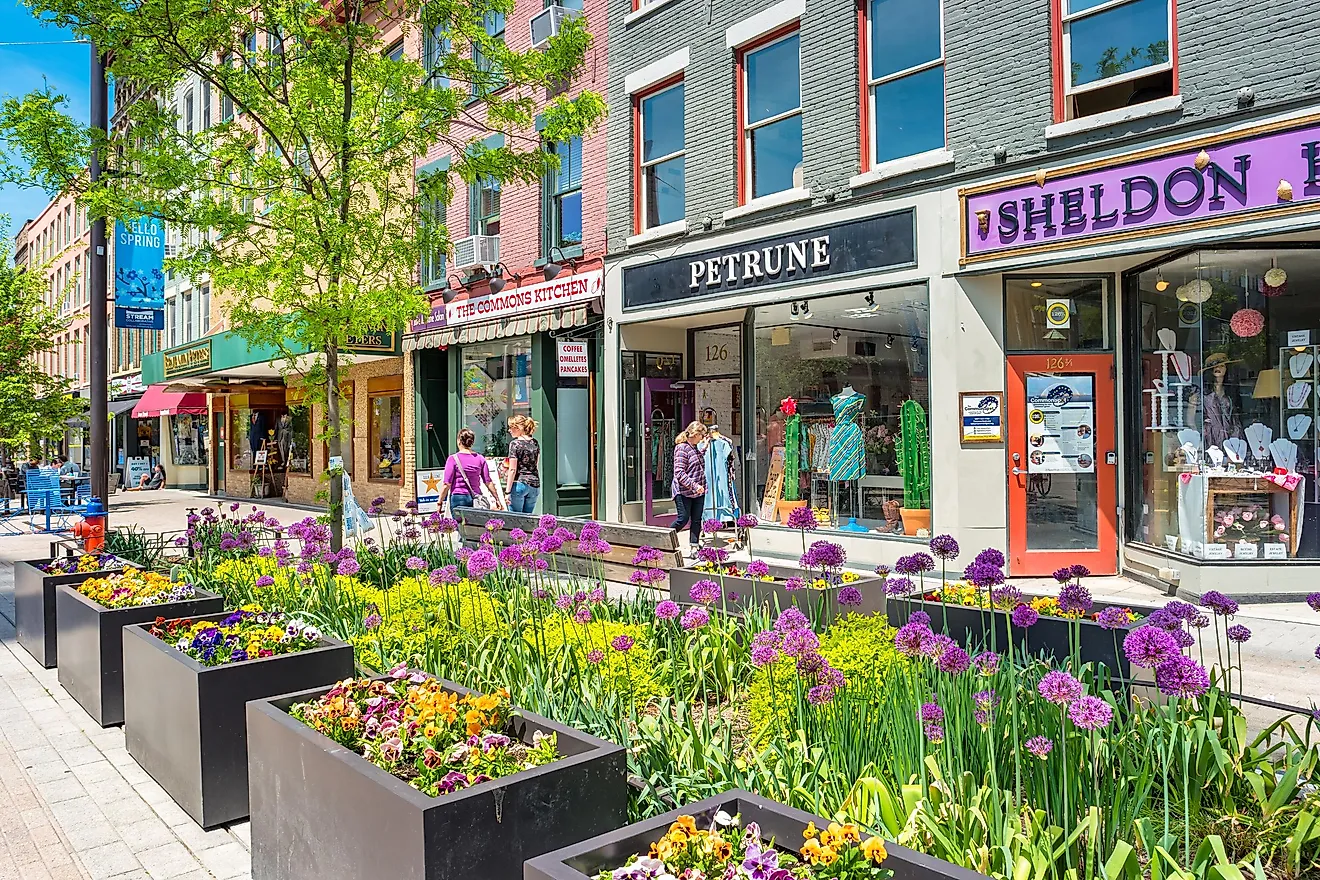
Local businesses in downtown Penn Yan, New York.
Birkett Mills stands at the center of Penn Yan's Main Street, where millers have ground buckwheat on the same site since 1797, one of the few mills of its era still running in its original location. A large iron griddle hangs on the outside wall of the building.
The mill also marks an access point on the Keuka Outlet Trail, a seven-mile route along the old Fall Brook Railroad bed between Keuka and Seneca Lakes. The trailhead is part of downtown instead of a drive away, and the paved section continues into the village itself. Back on Main Street, the Arts Center of Yates County runs a gallery, and the Yates County History Center occupies three adjoining buildings on Main and Chapel Streets. They are the Oliver family's Victorian house, a second museum of local archives, and a carriage house devoted to the Public Universal Friend.
Seneca Falls

A few blocks of Fall Street cover almost everything this Seneca County town is known for. The visitor center of Women's Rights National Historical Park stands at 136 Fall Street. Beside it is the Wesleyan Chapel, where delegates to the first women's rights convention met on July 19 and 20, 1848.
A short walk down Fall Street reaches the It's a Wonderful Life Museum at 32 Fall Street, built around the town's long-held belief that Seneca Falls inspired Frank Capra's Bedford Falls. The National Women's Hall of Fame stands across the canal at 1 Canal Street, inside the former Seneca Knitting Mill. Staff there point walkers toward it by the brick smokestack and the limestone building on the water. The Hall moved into the mill in 2020, more than four decades after its first induction ceremony. Two further park houses sit in Waterloo and need a car.
Auburn

East along the same highway, the Cayuga County seat has two of its museums at consecutive addresses, which settles the walking question in advance. The Cayuga Museum of History and Art occupies the Willard-Case mansion at 203 Genesee Street. The Schweinfurth Art Center sits next door at 205, with its public entrance on Genesee.
Directly behind the mansion is the Case Research Laboratory. Theodore Willard Case and his father set it up in 1916, and the first commercially successful system for recording sound onto film emerged from the work done there. Talking pictures began in that back garden in Auburn. Nearby on South Street, the Seward House Museum at number 33 was built around 1816 as the home of William H. Seward and holds National Historic Landmark status.
Sackets Harbor

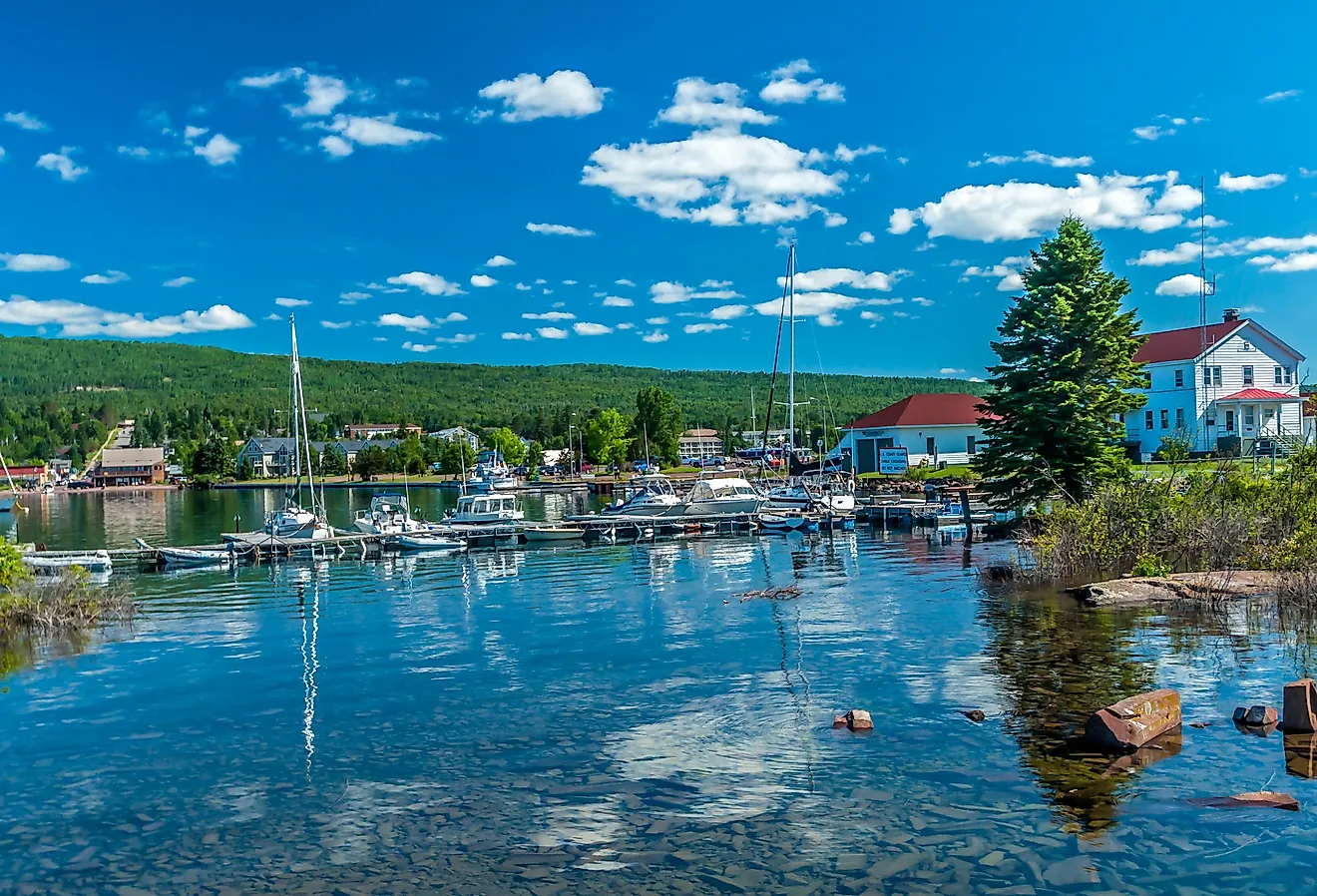
West Main Street ends at the water in Sackets Harbor, and what it ends at is a battlefield. Sackets Harbor Battlefield State Historic Site sits at that terminus, 504 West Main Street, in western Jefferson County. British and Canadian forces landed at Horse Island and advanced on the village there on May 29, 1813. A restored 1850s navy shipyard and the site's own visitor center share the grounds.
From that same terminus, the Sackets Harbor Battlefield History Trail connects to the village's War of 1812 Bicentennial Recreation Trail. Together they make a six-mile loop of stone dust paths, old rail bed, village streets, and sidewalks. Ten interpretive panels stand along the way, and the loop passes Madison Barracks, the stone army post built on Military Road after the war. The trail is free, flat, and open year-round. The harbor at its center is the only deep-water United States port on eastern Lake Ontario.
Cazenovia

The whole of this Madison County village's business runs along a half-mile of Albany Street, and the historic district around it includes 68 contributing buildings across 25.5 acres. Greek Revival and Italianate fronts run its length.
The Cazenovia Public Library at 100 Albany Street falls inside that district, and its museum room is worth the stop on its own. Robert James Hubbard came home from Egypt in 1894 with a complete mummy and its case, bought so the library could open a museum upstairs. That collection now sits in a ground-floor room alongside rare books, local tools, and Native American beadwork. Memorial Park breaks the run of storefronts partway along, and the farmers market sets up there. Past the shops, Lakeland Park runs down to Cazenovia Lake. John Lincklaen founded the village in 1793 and built the Lorenzo mansion at the lake's south end, well beyond walking range.
Cohoes

Street view in Cohoes, New York, with historic buildings. Editorial credit: Alizada Studios / Shutterstock.com
Remsen Street forms the core of a 35-acre historic district in this northern Albany County city, where 165 contributing properties date between 1820 and 1930. The Cohoes Music Hall at 58 Remsen Street is the anchor, a four-story Second Empire building from 1874. John Philip Sousa and Buffalo Bill Cody both performed in the theater on its upper floors.
The city bought the building for one dollar in 1968, residents raised the restoration money, and the theater reopened in 1974. The Cohoes Visitor Center occupies the street-level space now, with exhibits on Cohoes Falls and the Harmony Mill power system, so most walkers learn about both without leaving the block. Restaurants and a brewery fill the rest of Remsen Street. At Harmony Mills, a marker notes where the bones of a 13,000-year-old mastodon turned up in September 1866 during construction of Mill No. 3.
Plattsburgh

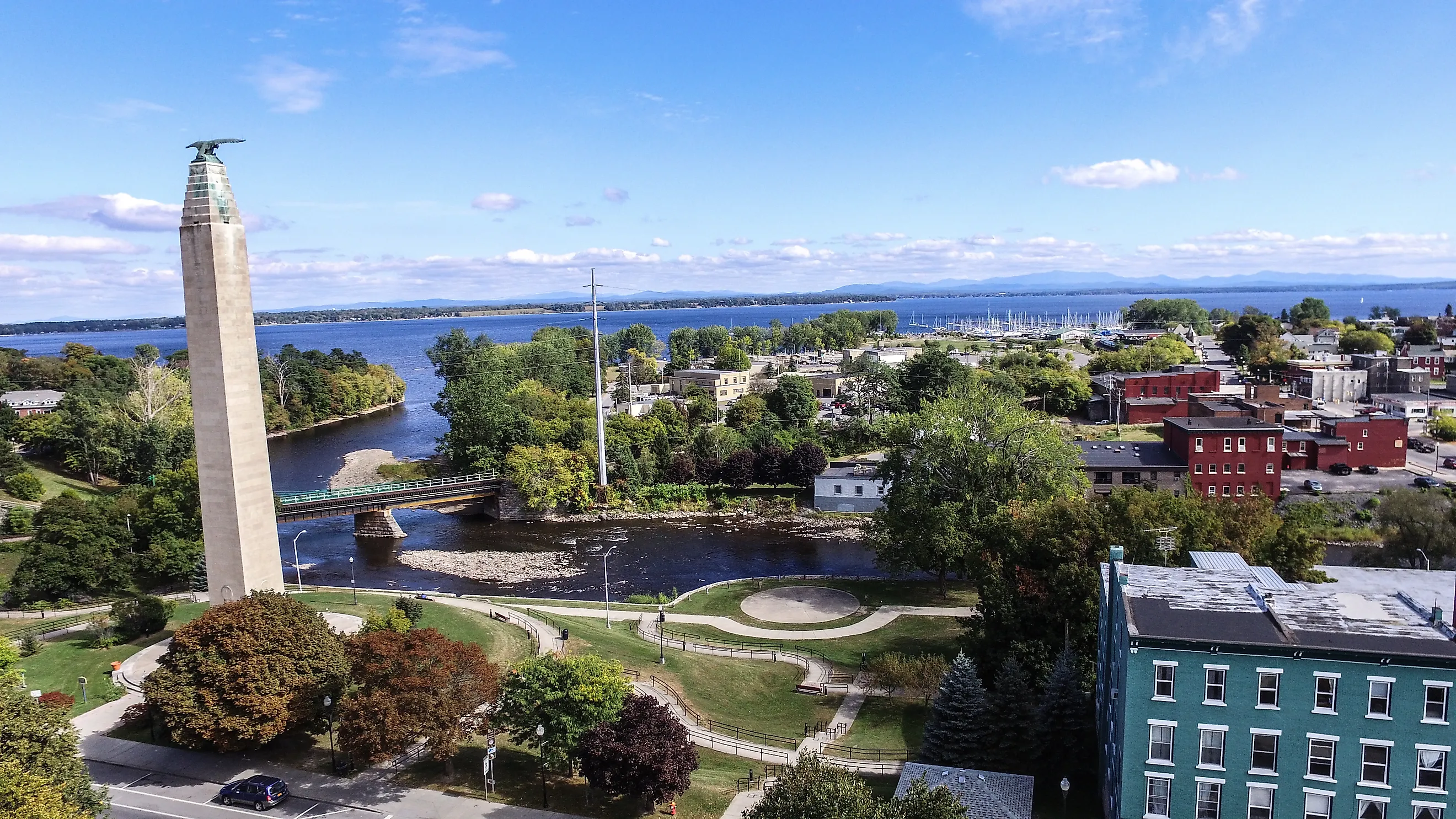
The Saranac River cuts through the center of Plattsburgh, the Clinton County seat, and the city's Heritage Trail follows it. The route links Riverwalk Park with the downtown monuments, the library, and the museums, rarely leaving the riverbank.
The Macdonough Monument rises from City Hall Place, put up in 1926 for Commodore Thomas Macdonough, whose fleet beat the British on Lake Champlain on September 11, 1814. Plattsburgh City Hall beside it holds a rotunda of murals and came from the drawing board of John Russell Pope, architect of the National Archives. The Strand Center for the Arts stands on the same downtown blocks. The Kent-Delord House at 17 Cumberland Avenue, built in 1797, is reputedly the oldest house in the city. British officers used it as a headquarters that September, before the battle went against them. It has been a museum since 1928.
Built to Be Walked
Planners laid out these towns around the places that mattered most: a canal, a harbor, a mill, a courthouse, or a village green. That early layout is still visible in how the centers feel today. In Seneca Falls, major museums sit within a few blocks of Fall Street. In Sackets Harbor, a walker can move between the battlefield, the waterfront, and the village trails without ever stepping onto a highway. The other towns repeat the pattern in different ways. Builders set out their centers before cars dictated the distance between stops, and that is exactly why walking them still works so well.